



Twelve Words
Carmen Jones, Catherine Proctor
Publisher: Bluemoose Books
Summary
Sorry, we have no synopsis for this book right now. Sign in to read it on 24symbols.com
Available since: 07/25/2025.
Print length: 192 pages.

Publisher: Bluemoose Books
Sorry, we have no synopsis for this book right now. Sign in to read it on 24symbols.com
Throughout the long centuries of human history is the want, and the need, to share information, to exchange ideas and for that knowledge and experience, for curiosity and learning, to be the basis of a civil society.
In literature the ambition is much narrower.  In order to be known, to be popular, you had to be published.  And for that people had to know you existed and your ideas worth reading.  Obviously for most of humanity’s time people couldn’t read and texts couldn’t be published in any great number.
In the 15th Century Gutenberg’s printing press began the revolution to address the second and by the 19th century had gathered pace with startling speed and mass distribution.  Education for the many was brought in to help people understand more of their world and, with new skills, how to have a better place within it.  Now, if the powers that owned the presses and means of distribution agreed an audience would now be able to avail themselves of your ideas, your printed words.
Sadly, in the thirst for the new, the recent and the past fell from sight, relegated to dark corners and dusty shelves.
But the printed word is rarely without someone, somewhere busying themselves through piles of papers and books rediscovering what a good story is, whatever its age.
Sadly, in the thirst for the new, the recent and the past fell from sight, relegated to dark corners and dusty shelves.
But the printed word is rarely without someone, somewhere busying themselves through piles of papers and books rediscovering what a good story is, whatever its age.
In this volume we offer up a small selection of those talents whose time has now come again.
Show book
Katharine Hepburn was one of the most accomplished and enduring actresses in the history of motion pictures. Over a career that spanned more than six decades, she earned a reputation for intelligence, independence, and artistic excellence, becoming one of the defining figures of Hollywood's Golden Age. Her performances helped reshape the portrayal of women on screen and established a standard of excellence that few performers have matched.

Born in Connecticut in 1907, Hepburn entered the world of acting through the stage before achieving success in Hollywood during the early 1930s. Her distinctive voice, strong-willed characters, and refusal to conform to industry expectations quickly set her apart from her contemporaries. Throughout her career, she demonstrated remarkable versatility, excelling in comedy, drama, romance, and literary adaptations. Hepburn's filmography includes such classics as The Philadelphia Story, Bringing Up Baby, The African Queen, and Guess Who's Coming to Dinner. Her celebrated partnership with Spencer Tracy became one of the most famous personal and professional relationships in film history.

This biography traces Hepburn's journey from ambitious young performer to cinematic legend. Drawing upon historical records, interviews, correspondence, memoirs, and contemporary accounts, it explores her career, personal life, artistic achievements, and lasting influence.
Show book
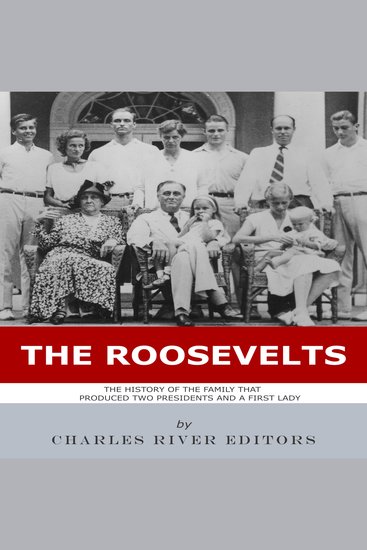
For a man who grew up to become the “Bull Moose”, Theodore Roosevelt was a sickly child, suffering from asthma and other maladies. But his physical weakness actually drove him to be more active, which also fostered an interest in nature. In the 1890s, it was Teddy’s turn to make history, leading the Rough Riders during the Spanish-American War and being decorated for his service with a Medal of Honor. He parlayed his glory into the governorship of New York and then the Vice Presidency under William McKinley. When McKinley was assassinated in 1901, young Teddy was thrust into the presidency, one that would earn him a place on Mount Rushmore.
	Franklin Delano Roosevelt might be America’s greatest 20th century president, but there’s no question that he was the most unique. A well-connected relative of Theodore Roosevelt, FDR was groomed for greatness until he was struck down by what was widely believed to be polio at the time. Nevertheless, he persevered, rising through New York politics to reach the White House just as the country faced its greatest challenge since the Civil War, beginning his presidency with one of the most iconic lines ever spoken during an inaugural address.  For over a decade, President Roosevelt threw everything he had at the Great Depression, and then threw everything the country had at the Axis powers during World War II.
	If Dolley Madison was instrumental in molding the role of First Lady in the 19th century, credit can be given to Eleanor Roosevelt for revolutionizing the political nature of the role in the 20th and 21st centuries and making it possible for presidents like Bill Clinton to enlist their wives to handle political duties. At the same time, history might remember Eleanor more for what she did outside of the White House, as she became a critically acclaimed and world famous international author and advocate of civil rights, women’s rights.
Show book
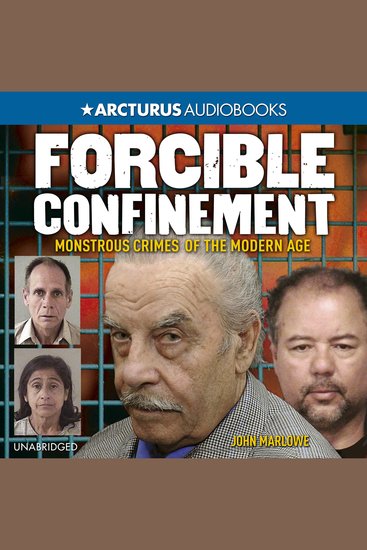
In 1984 abusive father Joseph Fritzl drugged his 18-year-old daughter with ether and imprisoned her in a dungeon under his house - she wasn't to see daylight for 24 years.

Down-and-out millionaire Gary Heidnik wallpapered his hallway with $5 bills, anointed himself bishop of his own religion and began collecting 'wives', women he abducted from the street and kept chained up in a pit.

Bondage freak Izabela Lewicka willingly signed a 115-item contract giving John Edward Robinson complete control over her life, but she never imagined it was a license to kill.

Forcible Confinement is a study of the warped thinking that went into some of the world's most macabre crimes, as well as a clinical examination of the purpose-built rooms, hidden spaces and soundproofed dungeons prepared for victims.

From the massive 'Murder Castle' once used by Dr H. H. Holmes to prey upon those attending the 1893 Chicago World's Fair to the hell house where self-professed sex-addict Ariel Castro kept three women in chains for more than ten years, the book examines famous cases of the past along with many from the modern age. John Marlowe takes the listener on a disturbing journey through a world of murder and mayhem, providing insight into evil and the motivations of monsters.
Show book
Secrets of an American Crime Boss: A Thrilling Rise and Fall
⭐⭐ Simplified Audio Guide & Explanations Included ⭐⭐
Are you looking to progress in your career and solidify your knowledge by immersing yourself in a gripping tale of power, crime, and betrayal?
Seeking a comprehensive guide that provides all necessary elements to understand the intricate world of organized crime?
Your search ends here!
This audiobook serves as your definitive companion for delving into the life of a notorious crime figure, understanding intricate details, and engaging in captivating storytelling. With this, you're in for a thrilling experience.
Key features of this enriched guide:
- Profound insights about the journey of an American crime boss
- Detailed explanation of factors leading to his rise and dramatic fall
- Fruitful strategies for understanding and analyzing criminal tactics
Our guide distinguishes itself through comprehensive coverage, which is essential for truly grasping the complexity of organized crime. Concepts aren't merely skimmed; they are delved into with precision.
Please note that this guide is not affiliated with any official entity and is purely an independent resource for your benefit.
Designed with a clear structure and easy-to-understand language, our audiobook ensures smooth transitions between topics. Say goodbye to dense jargon and welcome clear, precise, and technically accurate content.
So, why wait? Click the BUY NOW button, secure your guide, and begin your thrilling journey through crime history!
Show book
Few contemporary writers ask the questions about faith, morality, and God that Christian Wiman does, and even fewer—perhaps none—do so with his urgency and eloquence. Wiman, an award-winning poet and the author of My Bright Abyss, lays the motion of his mind on the page in this genre-defying work, an indivisible blend of poetry, criticism, theology, and searing memoir. As Marilynne Robinson wrote, "[Wiman's] poetry and his scholarship have a purifying urgency that is rare in this world . . . [It] enables him to say new things in timeless language, so that the reader's surprise and assent are one and the same."


Zero at the Bone begins with Wiman's preoccupation with despair, and through fifty brief pieces, he unravels its seductive appeal. The book is studded with the poetry and prose of writers who inhabit Wiman's thoughts, and the voices of Wallace Stevens, Lucille Clifton, Emily Dickinson, and others join his own. At its heart and Wiman's, however, are his family—his young children (who ask their own invaluable questions, like "Why are you a poet? I mean why?"), his wife, and those he grew up with in West Texas. Wiman is the rare thinker who takes on the mantle of our greatest mystics and does so with an honest, profound, and contemporary sensibility. Zero at the Bone is a revelation.
Show book





