Join us on a literary world trip!
Add this book to bookshelf
Grey
Write a new comment Default profile 50px
Grey
Subscribe to read the full book or read the first pages for free!
All characters reduced
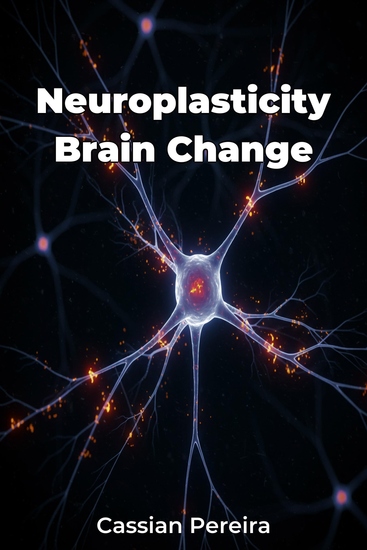
Neuroplasticity Brain Change - cover

Neuroplasticity Brain Change

Cassian Pereira

Translator A AI

Publisher: Publifye

  • 0
  • 0
  • 0

Summary

Neuroplasticity Brain Change explores the remarkable ability of the brain to reorganize itself by forming new neural connections throughout life. This concept, known as neuroplasticity, challenges the traditional view of the brain as a fixed entity, revealing its dynamic potential for change and adaptation.

 
For example, the book explains how learning a new skill or breaking a bad habit physically alters the structure of the brain, rewiring neural pathways. This offers practical implications for cognitive enhancement and rehabilitation.

 
The book progresses by first laying the groundwork with fundamental concepts like synaptic plasticity and neurogenesis. It then delves into how experiences and environment shape the brain. Finally, it presents practical applications of neuroplasticity, such as stroke recovery and overcoming learning disabilities.

 
By translating complex neuroscience into actionable strategies, Neuroplasticity Brain Change provides readers with the tools to actively influence their own brain development, improve memory, and enhance learning speed.
Available since: 03/15/2025.
Print length: 80 pages.

Other books that might interest you

  • Treating Suicidal Clients & Self-Harm Behaviors - Assessments Worksheets & Guides for Interventions and Long-Term Care - cover

    Treating Suicidal Clients &...

    PhD Meagan N. Houston

    • 0
    • 0
    • 0
    The most comprehensive, practical, and user-friendly workbook to help save lives. 


    Developed from years of working with the most challenging suicidal cases, Dr. Meagan N. Houston has created a workbook to prepare you for all the intricacies that affect clients' choices to live or die. 


    Treating Suicidal Clients & Self-Harm Behaviors is filled with proven assessments, unique worksheets and action-based methods to help your clients navigate and survive the turbulent periods of their lives where suicidal and/or self-harm behaviors appear to be their primary options to cope. This complete resource also includes underlying etiology, varying life factors, and mental health concerns that influence suicidal and self-destructive behavior. Inside you will find: assessments, worksheets and guides; therapy approaches for Non-Suicidal Self-Injury (NSSI) and suicidal behavior; applying crisis management skills, DBT and CBT to treatment; ethical and legal issues related to working with suicidal behavior; incorporating technology into treatment; case examples; and specific strategies for working with children and adolescents, veterans, military personnel, LGBTQI, and the elderly.
    Show book
  • 7 Interoceptive Breathing Meditations - cover

    7 Interoceptive Breathing...

    Dejanae Bankhead

    • 0
    • 0
    • 0
    Here are 7 guided meditations, designed to connect your mind, body, and soul, using breathwork and imagination. Human beings are beautifully complex and tuning into our bodie's functions, can be life changing. Interoception is our ability to sense our bodies inner workings, our emotions, when we are hungry, when we need rest. These breathing and visualization exercises helped me to strengthen my interoceptive sense, and I hope they can guide you too.
    Show book
  • Game Theory - Understanding the Mathematics of Life - cover

    Game Theory - Understanding the...

    Brian Clegg

    • 0
    • 0
    • 0
    Brian Clegg was always fascinated by Isaac Asimov's classic Foundation series of books, in which the future is predicted using sophisticated mathematical modelling of human psychology and behaviour.
    
    Only much later did he realise that Asimov's 'psychohistory' had a real-world equivalent: game theory.
    
    Originating in the study of probabilistic gambling games that depend on a random source - the throw of a dice or the toss of a coin - game theory soon came to be applied to human interactions: essentially, what was the best strategy to win, whatever you were doing? Its mathematical techniques have been applied, with varying degrees of wisdom, to fields such as economics, evolution, and questions such as how to win a nuclear war.
    
    Clegg delves into game theory's colourful history and significant findings, and shows what we can all learn from this oft-misunderstood field of study.
    Show book
  • Untangling AI - Driving Business Success Through Enterprise Automation and AI Agents - cover

    Untangling AI - Driving Business...

    Matt Kesby

    • 0
    • 0
    • 0
    In Untangling AI, founder and Chief AI Officer at Multiplai Tech, Matt Kesby, delivers an incisive roadmap for business leaders interested in assessing where their companies stand in the AI adoption lifecycle and where they want to go. Kesby explains how to rethink your current operational model and how to replace traditional workflows with AI-powered decision-making and execution. 
     
    You'll discover insights and examples that demonstrate how to build the four key foundations of your organization's AI adoption plan: strategy, execution, people, and technology. You'll learn how to use agentic AI technology to run entire businesses processes and automate important parts of your operations. Untangling AI explains exactly how to create a leaner, more efficient, more effective firm by:Generating a strategic AI roadmap with a High-Trust Communication campaign and prioritizing ethics, privacy, and securityEquipping your people to take advantage of AI capabilities with upskilling, critical thinking, and by providing psychological safetyInsightful discussions of how to identify automatable processes that are ideal for custom-built AI agents
    Show book
  • Agentic Artificial Intelligence - Harnessing AI Agents to Reinvent Business Work and Life - cover

    Agentic Artificial Intelligence...

    Pascal Bornet, Jochen Wirtz,...

    • 0
    • 0
    • 0
    A practical, non-technical guide for business leaders, entrepreneurs, and curious minds. 
    "Agents are (…) bringing about the biggest revolution in computing since we went from typing commands to tapping on icons." — Bill Gates 
    "AI agents will become the primary way we interact with computers in the future.” — Satya Nadella 
    "The age of agentic AI is here." — Jensen Huang 
    AI Agents—like Jarvis in Iron Man or Samantha in Her—are revolutionizing business and society. These intelligent systems can execute actions, learn from experience, and automate workflows with minimal supervision. Yet, behind the excitement lies a crucial gap between promise and reality. 
    This book provides a clear, jargon-free roadmap to harnessing agentic AI for real-world impact. Drawing from hands-on implementation across global enterprises and startups, the authors reveal: 
     How to **identify high-value agentic opportunities** and build AI-driven solutions The secrets behind **successful AI transformations**—cutting costs by 25%+ and boosting customer satisfaction by 40% New business models in the **Agent Economy**—from automation to AI-powered startups How to **avoid common AI pitfalls**—from integration challenges to user adoption The **mindset & skills needed** to lead in an AI-powered world  
    AI agents create "compounding intelligence advantages"—the more they’re used, the smarter they become. Those who master AI agents today will define the next business era. Will you lead this transformation or be left behind? This book challenges you to shape AI’s future with purpose and integrity.
    Show book
  • Conserving Nature in Greater Yellowstone - Controversy and Change in an Iconic Ecosystem - cover

    Conserving Nature in Greater...

    Robert B. Keiter

    • 0
    • 0
    • 0
    The story of how Yellowstone, established in 1872 as the world’s first national park, has become synonymous with nature conservation—and an examination of today’s challenges to preserve the region’s wilderness heritage. For more than 150 years, the Yellowstone region—now widely known as the twenty-three million acre Greater Yellowstone Ecosystem—has played a prominent role in the United States’ nature conservation agenda. In this book, Robert B. Keiter, an award-winning public land law and policy expert, traces the evolution and application of fundamental ecological conservation concepts tied to Yellowstone.
     
    
    Keiter’s book highlights both the conservation successes and controversies connected with this storied region, which has been enmeshed in change. 
    But in the face of explosive human population growth and related development pressures, new efforts must also account for the region’s privately owned lands along with accelerating recreational activities that present quite different problems.
    
    Exploring both notable conservation accomplishments and the ongoing challenges confronting this special place, Keiter’s book explains the many forces—scientific, political, economic, legal, cultural, climatic, and more—at work driving controversy and change across the region. But more than this, Conserving Nature in Greater Yellowstone shows us that the lessons gleaned from Yellowstone’s expansive nature conservation efforts are profoundly important for both the country and the world.
    Show book