Unisciti a noi in un viaggio nel mondo dei libri!
Aggiungi questo libro allo scaffale
Grey
Scrivi un nuovo commento Default profile 50px
Grey
Iscriviti per leggere l'intero libro o leggi le prime pagine gratuitamente!
All characters reduced
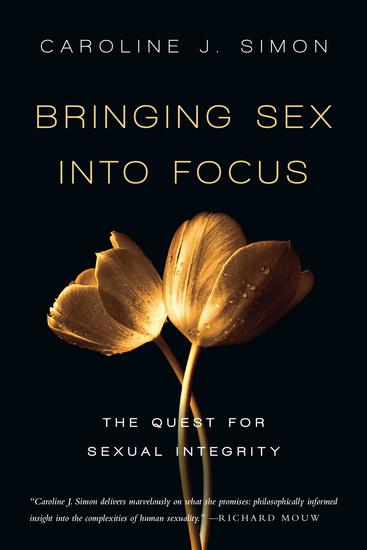
Bringing Sex into Focus - The Quest for Sexual Integrity - cover

Bringing Sex into Focus - The Quest for Sexual Integrity

Caroline J. Simon

Casa editrice: IVP

  • 0
  • 1
  • 0

Sinossi

In a culture that includes sex in everything from advertising to climbing the corporate ladder, it's easy to feel fuzzy about the true purpose and place of sexuality.In this book philosopher and ethicist Caroline J. Simon identifies six "lenses" through which people understand sex and sexuality: covenantal, procreative, expressive, romantic, power and "plain sex." Guided by a virtue ethic, she applies those lenses to a variety of sexual scenarios, from flirtation and desire to marital sexuality, helping us to see what filters we run issues of sexuality through and how, properly ordered and weighted, they can help us achieve sexual integrity.Here is a book for anyone interested in developing a holistic, biblical sexual ethic that brings into focus the bewildering array of cultural sexual presentations we're surrounded by every day.
Disponibile da: 30/11/2011.
Lunghezza di stampa: 176 pagine.

Altri libri che potrebbero interessarti

  • Clovis Culture The: The History and Legacy of the Prehistoric Paleoamericans - cover

    Clovis Culture The: The History...

    Editors Charles River

    • 0
    • 0
    • 0
    In popular media and culture, the Paleolithic era is often depicted as a time when humans were completely savage, spoke with little more than grunts, hit women over their heads with clubs and kidnapped them, and of course, everyone lived in caves. The reality is that the Paleolithic era was a time of great change when humans coalesced into groups and developed different technologies that helped them survive and ultimately thrive in harsh environments. Among the most important technologies developed by Paleolithic humans were those helping them hunt because, after all, the Paleolithic era was when humans lived as hunters and gatherers, so human survival and advancement were contingent upon developing better tools and weapons.  
    Any examination of the Clovis culture begins with what is known. Archaeologists know the approximate chronological and geographic range of the Clovis culture, and they can identify what made the Clovis people unique. These were the projectile points the Clovis people made, setting them apart from most people that came before and after them, and it was those same tools that made them a successful people for such an extended period in the harsh climate of the Upper Paleolithic era (50,000 to 12,000 years ago). Scholars have also determined that the Clovis people were big game hunters, chasing and killing mammoths and other now-extinct animals across North America. The picture that has emerged of the Clovis people is one of an industrious, resourceful, and prolific people who became masters of the environment and North America for approximately 2,000 years. That being said, there is also much that is not known about the Clovis culture. For example, the Clovis people’s religious ideas, particularly about their views on an afterlife, remain a mystery. The lack of art at Clovis sites has also raised more questions, including if it was the result of a dearth of materials or societal norms and taboos.
    Mostra libro
  • Navy Gazette - A voyage into the turbulent events of the British Navy at Sea A full-cast audio - cover

    Navy Gazette - A voyage into the...

    Mr Punch

    • 0
    • 0
    • 0
    Experience first-hand the reality of life in the British Navy as we sail from the Viking invasion of Anglo Saxon England to a young sailor’s grief at the death of Lord Nelson, from the Spanish Armada to the Battle of Jutland and from organised press gangs to murderous mutinies. Told entirely in the words of those who were there. 
      
    Performed by an outstanding company of award-winning actors including Dame Eileen Atkins, Cheryl Campbell, Nigel Davenport, Alex Jennings, Richard Johnson OBE, Hugh Laurie CBE, Michael Maloney, Geoffrey Palmer OBE, Michael Pennington, Prunella Scales CBE, Samuel West, John Wood CBE & full supporting cast. 
        
    Also available as part of The Gazettes Box Set, a six-volume edition (Military, Sport & Travel) creating a vivid portrait of British life through the centuries. 
      
    It is a highly enjoyable collection. Some pieces are just dazzling. Independent on Sunday 
      
    An extraordinary series... deserves a medal. The readers are all excellent and many of them distinguished. The Spectator 
      
    From the same stable that produced The Chronicle, my favourite audio this year, I've just listened equally spellbound to a compilation of travellers' tales at home. The Guardian 
     
    ©2022 Mr Punch Audiobooks Ltd. (P)2022 Mr Punch Audiobooks Ltd
    Mostra libro
  • Phenomenology - Philosophy and the Structure of Consciousness - cover

    Phenomenology - Philosophy and...

    Hector Davidson

    • 0
    • 0
    • 0
    Phenomenology is a branch of philosophy that seeks to explore and describe the structures of experience as they present themselves to consciousness. Rooted in the Greek words phainomenon (meaning "that which appears") and logos (meaning "study" or "discourse"), phenomenology is concerned with the direct investigation and description of phenomena as consciously experienced, without recourse to theories about their causal explanation or objective reality. It aims to understand the essence of experiences, focusing on how things are perceived, rather than on external facts or empirical data. 
    Edmund Husserl, often regarded as the father of phenomenology, established the discipline in the early 20th century. His groundbreaking work sought to return philosophy to the "things themselves," emphasizing the need to examine experiences without preconceived notions or biases. Husserl introduced the concept of intentionality, the idea that consciousness is always directed toward something—it is always consciousness of something. This fundamental notion shifted the focus from the contents of the mind to the ways in which objects are experienced, highlighting the inseparable relationship between the subject and the object in acts of consciousness. 
    Phenomenology differs from other philosophical approaches in that it does not seek to explain experiences through causal or scientific means. Instead, it adopts a descriptive method, aiming to reveal the underlying structures that make experience possible. Through techniques such as epoché (the suspension of judgment about the external world) and phenomenological reduction (focusing solely on the contents of consciousness), phenomenologists attempt to uncover the pure essence of experiences, free from external assumptions.
    Mostra libro
  • Carlist Wars The: The History and Legacy of the Spanish Civil Wars in the 19th Century - cover

    Carlist Wars The: The History...

    Editors Charles River

    • 0
    • 0
    • 0
    Thinking of Spain as a modern nation state today distorts the complicated reality that the Iberian Peninsula faced in the past. Spain was a nation in progress, consisting of regions united under the Spanish crown, but with strong regional identities based on different historical and cultural experiences. The largest entities were the kingdoms of León and Castile, but Spain also included the kingdoms of Navarre, Andalusia, Granada, Jaén, Aragon, and Valencia. There were also the principalities of Asturias and Catalonia, the lordship of Vizcaya, and both Guipúzcoa and Alava were “exempted provinces.” Navarre, Aragon, and Catalonia had separate Cortes, which were versions of parliaments (Parker 18-19). This complex system of entities granted privilege to local power structures over the concept of a unified nation and made administration difficult, because there were few standards that applied to all of Spain. Many of the regions had special laws that respected and allowed traditional institutions, administrative patterns, and cultural patterns. These local and regional rights were called fueros and were fiercely defended against centralization. The fueros originated as rights agreed to when the regions joined the Spanish crown. Before becoming king, the king-designate had to swear to maintain and respect the fueros. This meant that the rights of the king were to a considerable extent limited. 
    Inevitably, liberals and centralizing monarchs alike tried to change the situation over the years, which produced political tensions. The Carlists promised to maintain the older system, which is why they were so firmly backed in the Basque regions by most of the peasants and nobility. The Carlist claimants were strong Catholics and were strongly supported by the Church, and thus by the more fervently Catholic portions of the population. 
    Mostra libro
  • How to Lose Yourself - An Ancient Guide to Letting Go - cover

    How to Lose Yourself - An...

    The Buddha and His Followers

    • 0
    • 0
    • 0
    Inviting new translations of classical Buddhist texts about why the self is an illusion—and why giving it up can free us from suffering 


    From self-realization and self-promotion to self-help and the selfie, the modern world encourages us to be self-obsessed. We are even told that finding ourselves is the key to happiness. Better to lose yourself! More than 2,500 years ago, the Buddha argued that the self is an illusion—and that our belief in it is the cause of most, if not all, of our suffering. How to Lose Yourself presents lively, accessible, and expert new translations of ancient Buddhist writings about the central, unique, and powerful Buddhist teaching of "no-self." 


    Drawn from three important Buddhist traditions, these essential Indian, Tibetan, and Chinese writings provide a rich sampling of the ways Buddhist philosophers have understood the idea that we are selfless persons—and why this insight is so therapeutic. When we let go of the self, we are awakened to the presence of all things as they truly are, and we let go of the anxiety, fear, greed, and hatred that are the source of all suffering.
    Mostra libro
  • Mommy’s Pretty Girl - Mommy makes everything better That’s what Meg learned as she entered an MDLG relationship with Anna who made all her ABDL dreams come true - cover

    Mommy’s Pretty Girl - Mommy...

    Tina Moore

    • 0
    • 2
    • 0
    An MDLG and ABDL themed love story for the age play fetishist. 
    Please note: This book contains content only appropriate for individuals interested in the MDLG subgroup of BDSM. It includes kink related themes, lactation, sex with a strap on, psychological power-play both sexual and non-sexual, sub-training in deep throating and re-conditioning using domination techniques with little space as a reward, and punishment by flogging and forced orgasms utilizing a sex dungeon. Mild degradation and a fast-moving relationship that explores when a limit is pushed too far. 
    The story is a work of fiction, and although based on multiple personal experiences, Tina Moore does not assume to speak for the entire community. She also believes that the kink is as broad and diverse as the consenting adults who engage in it, and thus there is not a ‘correct’ way to be a consenting adult involved in age play and/or regression. 
    Tina Moore would like to thank all her loyal, supportive, and loving fans. She wishes you every happiness and success and hopes that you stay safe, calm, and healthy. 
    Anna had a perfect life. The perfect job and the perfect apartment, but something was missing. As the young, stunning, blonde Meg catches Anna’s eye, she knows exactly who she wants to be her perfect baby girl. As their relationship takes form, will Meg be the girl Anna has always dreamed of? 
    If you are looking for a loving and romantic MDLG story… 
    Then scroll up and click “add to cart”
    Mostra libro