Join us on a literary world trip!
Add this book to bookshelf
Grey
Write a new comment Default profile 50px
Grey
Subscribe to read the full book or read the first pages for free!
All characters reduced
Temporalities of Modernism - cover

Temporalities of Modernism

Carmen Borbély, Erika Mihálycsa, Petronia Petrar

Publisher: Ledizioni

  • 0
  • 0
  • 0

Summary

Temporalities of Modernism gathers fourteen scholars whose contributions readdress the very tenets of modernism by approaching its multifaceted relationship with time in a series of fresh and original essays. The contemporary energies behind the collection are rooted in the turbulence of the modernist age: relativity, irreversibility, duration, fragmentation, contingency, and the looming threat of the apocalyptic future. The collection includes geographical areas often neglected by the habitual reduction of modernist studies to English-speaking literary high modernism, or to the concentration of famous figures in the traditional capital of modernism—Paris. Thus it offers detailed presentations of Italian pre-WWI modernism, Czech Dadaism, or of Polish, Romanian, and Hungarian writers and artists. The borders also open in terms of genres and mediums, as the contributions are not limited to fiction, but examine the multi-faceted productions of modernist artists: poetry, theatre, painting, music, cinema, photography, etc. In addition, the limits are temporally stretched out as some contributions focus on more recent writers (such as Sylvia Plath) and their reactivation of modernist discoveries.
Available since: 03/22/2023.
Print length: 406 pages.


Other books that might interest you

  • Behind the Mask Beyond the Mind: Discover who your really are - Transcending Anxiety Fear and Depression Without Techniques or Skills – A Self-Help Guide to Rediscover Life's Essence - cover

    Behind the Mask Beyond the Mind:...

    Rudy Daniel

    • 0
    • 0
    • 0
    Discover who your really are. Transcending Anxiety, Fear, and Depression Without Techniques or Skills – A Self-Help Guide to Rediscover Life's Essence.Have you ever truly pondered the most fundamental questions of life? Who are you anyway? What is this place we call the Universe? What is reality?As midlife came about, drained and unfulfilled despite being fairly successful, I was almost done . From the outside, my life looked usual, positive, but inside - there was a whole different story.During my life journey, extraordinary encounters propelled me onto a path of deep exploration that concerns the nature of reality. It led me to the crossroads of spirituality, philosophy, science, psychology and even the veiled territory of the psychedelic realm, all in pursuit of understanding the very essence of myself.In a span of years, I delved into the depths of my mind, confronting its enigmatic corners, including the dark ones, in a search for clarity.I’m not a scientist or a mystic. You could say that I’m a philosopher that went outside the perimeters of the institution to test out his philosophy in real life, or in other words, I live by what I say. This is my experience, my self-evident interaction with the universe on a daily basis over a lifetime of almost 40 years.I’m here not to create another belief system but rather to make you question yours.This book could be interpreted as a self-help guide, a spiritual journey, or a philosophical discourse. However, I believe that within the words of "Behind the Mask, Beyond the Mind," readers can discover themselves, or provoke deep questions. In this sense, this book represents a dialogue between you and me; I pose questions, and you respond within yourself. Through honest conversations, we can come to perceive reality as it truly is, and as a result, celebrate, accept, and love ourselves just as we are.
    Show book
  • Nerva-Antonine Dynasty The: The History and Legacy of the Emperors Who Ruled the Roman Empire at Its Peak - cover

    Nerva-Antonine Dynasty The: The...

    Editors Charles River

    • 0
    • 0
    • 0
    “The Five Good Emperors,” a reference to the five emperors who ruled the Roman Empire between 96 and 180 CE (Nerva, Trajan, Hadrian, Antoninus Pius, and Marcus Aurelius), was a term first coined by Machiavelli and later adopted and popularized by historian Edward Gibbon, who said that under these men, the Roman Empire “was governed by absolute power under the guidance of wisdom and virtue.”  
    	This period of 84 years is generally regarded as the high point of the Roman Empire, at least after Augustus, but what is uncertain and a matter of ongoing debate is whether the five emperors were personally responsible for the situation and the accompanying prosperity enjoyed throughout the empire at the time or if they were simply the beneficiaries of the Pax Romana, inaugurated by Augustus in the early part of the 1st century CE. In other words, historians have wondered whether anyone in power during those years would have enjoyed the same rewards.  
    	The description of these rulers as “good” is also a matter of interpretation, with some scholars suggesting they were only “good” in comparison to the preceding emperor (Domitian) and the emperor who followed Marcus Aurelius (Commodus). Both of them were horrible rulers in every aspect, making their near contemporaries look all the better.  
    	Regardless, it is clear that the era of the Five Good Emperors was one of unparalleled success and wealth, and the reasons Rome reached its zenith at this time are worthy of scrutiny. Perhaps most noteworthy is that none of these five emperors were blood relatives - while the final two are often referred to as the Antonines, they were not, in fact, related except by adoption, a practice that may in itself provide at least part of the answer to the question as to why this particular period was so magnificent.
    Show book
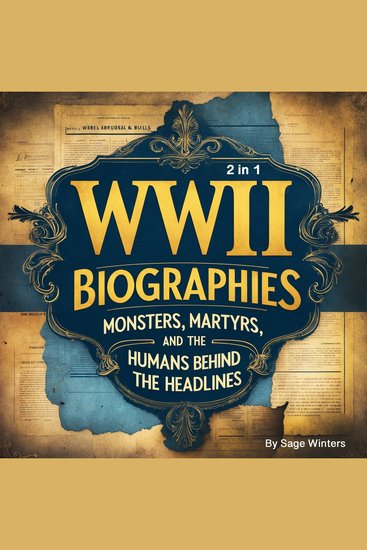
  • WWII Biographies - Monsters Martyrs and the Humans Behind the Headlines (2 in 1) - cover

    WWII Biographies - Monsters...

    Sage Winters

    • 0
    • 0
    • 0
    This book consists of two biographies, related to World War II: 
    Churchill's War - Winston Churchill is remembered as one of history’s most formidable leaders, a man whose unwavering resolve and stirring oratory inspired a beleaguered nation to withstand its darkest hour. Rising to prominence during one of humanity’s most perilous times, Churchill’s leadership during World War II not only shaped the fate of Britain but left an indelible mark on the global landscape. His life and career encapsulate the qualities of resilience, vision, and adaptability that are crucial during moments of profound crisis. Born into an aristocratic family in 1874, Churchill's early life was one of privilege, yet his path to greatness was anything but guaranteed. Despite academic struggles and initial failures, he demonstrated remarkable tenacity, carving out a career as a soldier, journalist, and eventually a politician. His varied experiences—whether charging on horseback in colonial campaigns or reporting from the frontlines—imbued him with a deep understanding of courage and strategy, traits that would serve him well in the years to come. However, he also had a dark side: The Bangledesh famine was partially or mostly to blame on his negligence. 
    Patton's Push - General George S. Patton was one of the most influential military leaders of the 20th century, his name forever linked with boldness, aggression, and relentless pursuit of victory. His legacy as a tactical genius in World War II is undisputed, particularly for his innovative strategies and dynamic leadership during key campaigns in Europe. Patton’s approach to warfare, characterized by rapid movement, audacity, and the application of psychological warfare, was a departure from traditional military doctrine and left an indelible mark on modern military tactics.
    Show book
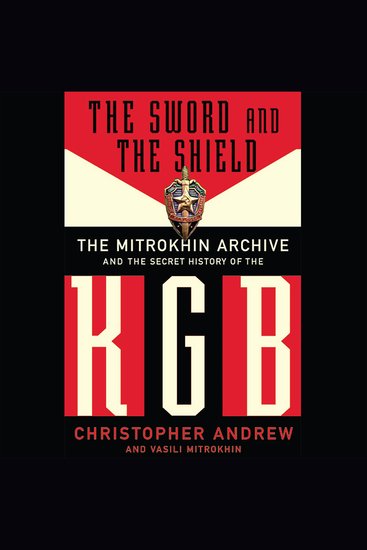
  • The Sword and the Shield - The Mitrokhin Archive and the Secret History of the KGB - cover

    The Sword and the Shield - The...

    Christopher Andrews, Vasili...

    • 0
    • 0
    • 0
    The Sword and the Shield is a compelling—and historically significant—narrative destined to cast new light on the Soviet era.
    Show book
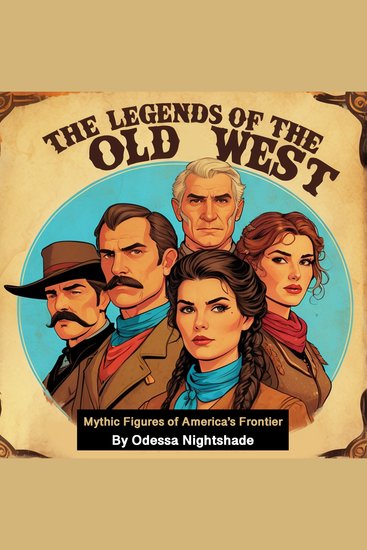
  • The Legends of the Old West - Mythic Figures of America's Frontier - cover

    The Legends of the Old West -...

    Odessa Nightshade

    • 0
    • 0
    • 0
    The American Old West has long been a land of legend, where history and myth intertwine to create some of the most enduring figures in popular culture. From daring gunslingers to fearless lawmen, from resilient pioneers to courageous Native American leaders, the frontier was home to individuals whose stories have been told and retold for generations. But how much of what we believe about these figures is true? Where does history end and legend begin?  
      
    The Wild West holds a unique place in American identity. It represents freedom, adventure, and the spirit of perseverance. However, the romanticized image of the frontier often overshadows the reality of life in those times. The stories of infamous outlaws and heroic sheriffs were frequently exaggerated by dime novels, traveling shows, and later, Hollywood films. While many of these characters did exist, their exploits were often transformed into grandiose tales, making them larger than life. The result is a blurred line between fact and fiction, leaving us to wonder: Were these individuals truly as heroic—or as villainous—as they are remembered?  
      
    One of the most fascinating aspects of Old West legends is their ability to evolve. A figure like Jesse James, once considered a ruthless outlaw, became a folk hero to some, seen as a rebel against authority. Likewise, lawmen like Wyatt Earp, whose life was filled with both victories and controversies, were later immortalized as fearless defenders of justice. The process of mythmaking has not only shaped how we view the past but has also influenced modern storytelling in Western films, books, and television. 
    Show book
  • Neuropsychology - Cognitive Science and Subconscious Mind Mastery (2 in 1) - cover

    Neuropsychology - Cognitive...

    Marcio Ortíz, Miguel Vaquero

    • 0
    • 0
    • 0
    This title contains 2 books about similar topics, which are the following: 
    1: Your subconscious is a priceless potential repository of information, insight, and wisdom. But the majority of us never use that talent to its fullest. 
    Using hypnosis, you can access your subconscious. You can communicate with it immediately when under hypnosis. This can assist you in obtaining important knowledge and bringing about positive changes in your life. 
    Your subconscious is the area of your mind that generally escapes your awareness yet has a significant impact on how you live. 
    For instance, your subconscious has a role in controlling such essential bodily processes as breathing and heartbeat. 
    When you shake your head unconsciously, look away when lying, or suddenly get an inspiring thought "out of the blue," these are all signs that your subconscious is at work. 
    Additionally, you may not even be aware of the ideas and emotions stored in your subconscious, yet they can have a significant impact on your behavior and general well-being. 
    2: The study of the anatomy and operation of the nervous system and the brain is known as neuroscience. To map the brain mechanistically, neuroscientists draw on cellular and molecular biology, anatomy and physiology, human behavior and cognition, and other fields. 
    Each neuron, or brain cell, in an adult human has an estimated 100 billion connections to other neurons. The mapping of all the cell-to-cell communication networks—the brain circuits that process all ideas, feelings, and behaviors—remains one of the major difficulties of contemporary neuroscience. The resulting image that gradually forms is referred described as "the connectome". All learning is based on the brain's capacity to build new neural circuits and connections, or neuroplasticity".
    Show book