Join us on a literary world trip!
Add this book to bookshelf
Grey
Write a new comment Default profile 50px
Grey
Subscribe to read the full book or read the first pages for free!
All characters reduced
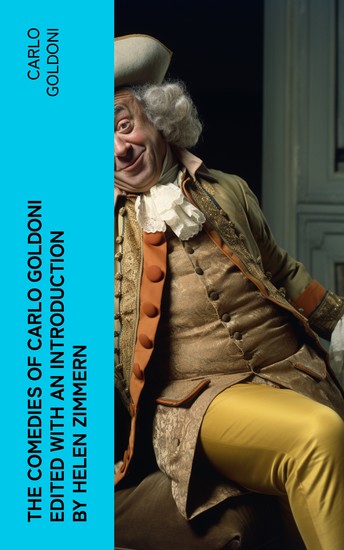
The Comedies of Carlo Goldoni edited with an introduction by Helen Zimmern - cover

The Comedies of Carlo Goldoni edited with an introduction by Helen Zimmern

Carlo Goldoni

Publisher: e-artnow

  • 0
  • 0
  • 0

Summary

"The Comedies of Carlo Goldoni edited with an introduction by Helen Zimmern" by Carlo Goldoni. Published by e-artnow. e-artnow publishes a wide range of titles that encompasses every genre. From well-known classics & literary fiction and non-fiction to forgotten−or yet undiscovered gems−of world literature, we issue the books that need to be read. Each e-artnow edition has been meticulously edited and formatted to boost readability for all e-readers and devices. Our goal is to produce eBooks that are user-friendly and accessible to everyone in a high-quality digital format.
Available since: 11/24/2023.
Print length: 242 pages.
Other books that might interest you

  • Federigo's Falcon - From their pens to your ears genius in every story - cover

    Federigo's Falcon - From their...

    Boccasio Giovanni

    • 0
    • 0
    • 0
    The bookshelves of European literature are incredible collections that have gathered together centuries of very talented authors.  From this continent their fame spread and whilst among their number many are now forgotten or neglected their talents endure.  Among them is Boccasio Giovanni.
    Show book
  • Top 10 Short Stories The - Eastern Europe - The top ten short stories of all time written by authors from Eastern Europe - cover

    Top 10 Short Stories The -...

    Franz Kafka, Anton Chekhov,...

    • 0
    • 0
    • 0
    The Top 10 – Eastern Europe - An Introduction 
     
    From the Central plain of Europe to the Urals, many thousands of miles away, the nations of Eastern Europe have risen to become Empires and fallen underfoot to others.  Their literary tradition has always been strong and vibrant, bold and beguiling.  Within the many cultures and societies the narrative of the human condition is told in many startling and beautiful ways. 
     
    Short stories have always been a sort of instant access into an author’s brain, their soul and heart.  A few pages can lift our lives into locations, people and experiences with a sweep of landscape, narration, feelings and emotions that is difficult to achieve elsewhere. 
     
    In this series we try to offer up tried and trusted ‘Top Tens’ across many different themes and authors. But any anthology will immediately throw up the questions – Why that story? Why that author?  
     
    The theme itself will form the boundaries for our stories which range from well-known classics, newly told, to stories that modern times have overlooked but perfectly exemplify the theme.  Throughout the volume our authors whether of instant recognition or new to you are all leviathans of literature. 
     
    Some you may disagree with but they will get you thinking; about our choices and about those you would have made.  If this volume takes you on a path to discover more of these miniature masterpieces then we have all gained something. 
     
    Some you may disagree with but they will get you thinking; about our choices and about those you would have made.  If this volume takes you on a path to discover more of these miniature masterpieces then we have all gained something. 
     
    1 - The Top Ten - Eastern Europe - An Introduction 
    2 - A Hunger Artist by Franz Kafka 
    3 - The Lady with the Dog by Anton Chekhov 
    4 - The Cloak by Nikolai Gogol also known as 'The Overcoat' 
    5 - The District Doctor by Ivan Turgenev 
    6 - The Shot by Alexander Pushkin 
    7 - A Legend of Old Egypt by Boleslaw Prus 
    8 - Hide And Seek or Pliatki by Fyodor Sologub 
    9 - Silence by Leonid Nikolaevich Andreyev 
    10 - The Bundle of Letters by Moritz Jokai 
    11 - The Chamomile Drops by Jaroslav Hasek
    Show book
  • The Man Who Was Through With the World - cover

    The Man Who Was Through With the...

    D H Lawrence

    • 0
    • 0
    • 0
    'The Man Who Was Through With the World' picks up the same themes as in Lawrence's short story 'The Man Who Loved Islands'. He asks if we can ever withdraw from the world, no matter how much it disgusts us. The ironic part of this fragment is that the hermit vainly seeks to think holy thoughts while all around him is the natural world which could provide his life with meaning. The fragment is unfinished leaving the reader to wonder if the hero would return to the world, would the world come to him or would nature take its course and let him die in his hut.
    Show book
  • In the French-Flemish Country (Unabridged) - cover

    In the French-Flemish Country...

    Charles Dickens

    • 0
    • 0
    • 0
    Charles Dickens was a writer and social critic who created some of the world's best-known fictional characters and is regarded as the greatest novelist of the Victorian era. His works enjoyed unprecedented popularity during his lifetime, and by the twentieth century critics and scholars had recognised him as a literary genius. His novels and short stories enjoy lasting popularity.
    IN THE FRENCH-FLEMISH COUNTRY: What part in my decision was borne by Monsieur P. Salcy, is of no moment, though I own to encountering that gentleman's name on a red bill on the wall, before I made up my mind. Monsieur P. Salcy, 'par permission de M. le Maire,' had established his theatre in the whitewashed Hôtel de Ville, on the steps of which illustrious edifice I stood.
    Show book
  • A Society - From their pens to your ears genius in every story - cover

    A Society - From their pens to...

    Virginia Woolf

    • 0
    • 0
    • 0
    Adeline Virginia Woolf was born on the 25th January 1882 in South Kensington in London. 
    Although lauded as a founder of modernist writing with such classics as ‘Orlando’, ‘Mrs Dalloway’ and ‘To the Lighthouse’ and, of course, many classic short stories, her background is filled with elements of tragedy that she somehow overcame to become such a revered writer.   Her mother died when she was 13, her half-sister Stella two years later and with it her first of several nervous breakdowns.  Appallingly it was later found that three of her half-brothers had sexually abused her so darkness must have seemed ever present.   
    She began writing professionally at age 20 but her father’s death two years later brought a complete mental collapse and she was briefly institutionalised.  Somehow she found within herself a literary career and with it great innovations in writing; she was a pioneer of “stream of consciousness”.    
    Her tight circle of friends were the founders of the Bloomsbury Group, a movement whose legacy still influences across the arts and society in many way to this day.   
    Whilst the dark periods continued to interrupt her emotional state her rate of work never ceased.  Until, on 28th March 1941, Woolf put on her overcoat, filled up its pockets with stones, and walked into the River Ouse, in Lewes, East Sussex and drowned herself.  Her body was not recovered until the 18th April.  She was 59. 
    She left behind a note which read in part “Dearest, I feel certain that I am going mad again.  I feel we can't go through another of those terrible times.  And I shan't recover this time.  I begin to hear voices, and I can't concentrate.  So I am doing what seems the best thing to do”.
    Show book
  • Christmas Formula - From their pens to your ears genius in every story - cover

    Christmas Formula - From their...

    Stella Benson

    • 0
    • 0
    • 0
    Stella Benson was born on the 6th January 1892 in Easthope, Shropshire to parents who were landed gentry. 
    Her early years involved frequent household moves which was difficult for the child as she suffered from ill-health.  Some of her early education was spent at schools in Germany and Switzerland and by 10 she had developed a lifelong habit of keeping a diary. 
    In the following years her parents separated, and she rarely saw her father. When she did, he encouraged to pause her writing until she had further experience and could better make sense of the world.  When he died, she learned he had been an alcoholic. 
    A winter spent in the West Indies provided material for her first novel ‘I Pose’ published the following year in 1915. 
    During the War years she became involved in the women's suffrage movement and dedicated time outside of writing to support the troops and help the poor. 
    In 1918 she decided to travel spending much time in California, where she also tutored at the University of California, and continued to write.  In China she met her future husband and after marrying in London, journeyed with him to his various Custom postings through Nanning, Beihai, and Hong Kong and the Far East. 
    The works continued to flow novels, short stories, travel essays all helped to build a deserved and burgeoning reputation. 
    Although her works are now in the forgotten and neglected department her writing style, characters, and narratives more than capably demonstrate her obvious talents.   
    Stella Benson died of pneumonia on the 7th December 1933, at Hạ Long in the Vietnamese province of Tonkin.  She was 40.
    Show book