Join us on a literary world trip!
Add this book to bookshelf
Grey
Write a new comment Default profile 50px
Grey
Subscribe to read the full book or read the first pages for free!
All characters reduced
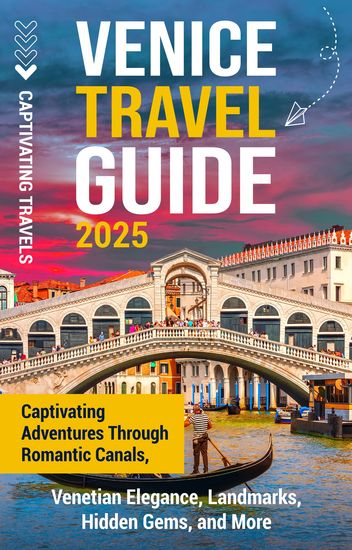
Venice Travel Guide - Captivating Adventures Through Romantic Canals Venetian Elegance Landmarks Hidden Gems and More - cover

Venice Travel Guide - Captivating Adventures Through Romantic Canals Venetian Elegance Landmarks Hidden Gems and More

Captivating Travels

Publisher: Captivating Travels

  • 0
  • 0
  • 0

Summary

Venice Travel Guide: Images, Interactive QR Codes & Detailed Maps for an Unforgettable Trip

Packed with  80+ images and maps and  40+ QR codes for easy access to key locations, this guide makes exploring Venice effortless. Whether it's your first visit or you're returning to uncover more, this book provides everything you need to experience the city's history, landmarks, and cultural treasures.

What You'll Discover Inside: 

- Famous Landmarks & Must-See Locations  – From  St. Mark's Square to the hidden corners of Venice's historic districts. 
- Easy-to-Use QR Codes  – Instantly access maps, directions, and additional travel resources. 
- High-Quality Images & Maps  – Visual guides to help you explore with confidence. 
- History & Culture  – Gain a deeper understanding of Venice's past, artistic heritage, and architectural wonders. 
- Day Trip Ideas & Ready-Made Itineraries  – Thoughtfully crafted routes to help you make the most of your visit. 
- Essential Italian Phrases  – A quick guide to help you communicate and navigate with ease. 
 
With detailed insights, interactive features, and carefully curated information, this guidebook makes planning and exploring Venice both simple and enjoyable.

Ready to Discover Venice? 

Add to cart now and start your journey today!
Available since: 03/17/2025.
Print length: 190 pages.


Other books that might interest you

  • Planepack - cover

    Planepack

    Slobodanka Graham

    • 0
    • 0
    • 0
    I fly and travel with carry-on luggage only. That's 7 kgs. And yes, you can do it too!At Planepack, discover the art of light travel: skip the queues; hop in and out of trains, boats and planes. Lose your addiction to heavy cases and you too will be a liberated light traveler.I write and review light travel essentials, packing guides, travel tips - and how to travel with style and ease.Planepack is perfect for anyone wanting to enjoy their travel experience - and not be burdened with luggage. I hope this book inspires you too to travel light.
    Show book
  • RV - Everything You Should Know Before You Begin Your Life on the Road - cover

    RV - Everything You Should Know...

    Daniel Shore

    • 0
    • 0
    • 0
    In this guide, we embark on a journey beyond the confines of traditional living. Through these pages, you'll discover the allure of life on the road, where every mile holds the promise of adventure and every destination becomes a new chapter in your story. Whether you're a seasoned traveler or a curious wanderer, this book is your companion, offering insights into choosing the right RV, mastering the art of campground etiquette, and embracing the freedom of a life untethered. 
      
    But the RV lifestyle is more than just a mode of travel—it's a community, a culture, and a way of life. You'll meet fellow nomads who share their experiences, from breathtaking vistas to unexpected challenges, weaving a tapestry of camaraderie that transcends borders and backgrounds. From solo explorers to families on the go, everyone finds their place in the vibrant tapestry of RV living. 
      
    With practical advice, inspiring anecdotes, and expert guidance, This book is basically your passport to a world of endless possibilities. So buckle up, hit the road, and prepare to discover the extraordinary joys of life on wheels. Your adventure begins now.
    Show book
  • The Han Dynasty - Golden Age of Chinese Civilization - cover

    The Han Dynasty - Golden Age of...

    Jun Liu

    • 0
    • 0
    • 0
    The Han Dynasty, one of the most influential periods in Chinese history, emerged from the collapse of the Qin Dynasty in 206 BCE. After years of harsh rule under Qin Shi Huang, widespread unrest and rebellion led to the fall of the Qin. In the power vacuum that followed, Liu Bang, a commoner-turned-military leader, rose to prominence and ultimately established the Han Dynasty. His leadership and political acumen laid the foundation for a dynasty that would last over four centuries, shaping China’s governance, culture, and identity. 
    Liu Bang, later known as Emperor Gaozu, was originally a minor official under the Qin. Unlike his aristocratic rivals, he came from humble origins, making him a unique figure in Chinese history. As the Qin administration crumbled due to heavy taxation and forced labor policies, numerous factions vied for control. The most significant of these was the Chu-Han Contention, a prolonged struggle between Liu Bang and Xiang Yu, a powerful general of noble descent. Liu Bang, known for his ability to rally support from various social classes, ultimately defeated Xiang Yu at the Battle of Gaixia in 202 BCE. This victory marked the official beginning of the Han Dynasty, with Liu Bang declaring himself emperor. 
    Once in power, Liu Bang sought to distance his rule from the harsh legalist policies of the Qin. He adopted a more lenient and pragmatic approach, blending Confucian ideals with centralized governance. Although he retained elements of Qin’s bureaucratic structure, he reduced the severity of laws and punishments, earning the trust of the people. To ensure stability, he granted land and titles to his loyal followers, creating a semi-feudal system that allowed regional kings to govern under the central authority of the emperor. This balance between centralization and decentralization was a defining characteristic of early Han rule.
    Show book
  • Why You Should Go to Petra - cover

    Why You Should Go to Petra

    Mark Ferdinand

    • 0
    • 0
    • 0
    Petra is one of the world’s greatest wonders—a city carved from rose-red rock that still stirs awe thousands of years after its creation. Hidden in the Jordanian desert, this ancient Nabataean capital feels like stepping into another world, where towering sandstone facades glow in the shifting light and narrow canyons lead to breathtaking discoveries. 
    Mark Ferdinand takes you through Petra’s unforgettable highlights: the dramatic approach through the Siq, the majestic Treasury, the sprawling Royal Tombs, and the climb to the Monastery with its sweeping desert views. Along the way, you’ll uncover the history, legends, and enduring magic that make Petra more than a destination—it’s an experience of wonder and timeless beauty.
    Show book
  • History of Machu Picchu - The Greatest Symbol of the Inca Empire - cover

    History of Machu Picchu - The...

    Kelly Mass

    • 0
    • 0
    • 0
    Machu Picchu, one of the most iconic symbols of Inca civilization, is a 15th-century fortress perched high on a mountain crest in southern Peru's Eastern Cordillera. Sitting at an altitude of 2,430 meters (7,970 feet), it is located 80 kilometers (50 miles) northwest of Cusco, within the Machupicchu District of Urubamba Province. The fortress overlooks the Sacred Valley, and the Urubamba River winds through the valley below, cutting through the Cordillera and forming a tropical mountain canyon. This stunning geographical setting has made Machu Picchu one of the most visited and revered archaeological sites in the world. 
    Unlike the Mayans, the Incas had no written language, and thus, no records of the site existed during its operation. The first Europeans to visit Machu Picchu did so only in the 19th century, and as a result, much of its history remained shrouded in mystery. Modern archaeologists, relying on tangible evidence such as graves and structural remains, have attributed names and proposed functions for the buildings, but much of the site’s exact purpose remains speculative. 
    Most contemporary archaeologists believe that Machu Picchu was built as a royal estate for the Inca emperor Pachacuti, who ruled from 1438 to 1472. Constructed in 1450, the site functioned as a private residence for the emperor and his court. Over time, Machu Picchu became the most well-known image of Inca civilization and is often referred to as the "Lost City of the Incas." However, the estate was abandoned in the early 16th century, following the Spanish conquest of the Inca Empire. Recent radiocarbon dating indicates that the site was occupied from around 1420 to 1532.
    Show book
  • Egyptian Science - Innovations and Discoveries of the Ancient World (3 in 1) - cover

    Egyptian Science - Innovations...

    Omar Khalil

    • 0
    • 0
    • 0
    Egyptian Science – Innovations and Discoveries of the Ancient World (3 in 1) offers a captivating dive into the scientific brilliance of ancient Egypt, revealing how a civilization often known for its mysticism was also a beacon of practical knowledge and invention. This collection highlights the remarkable advancements made by Egyptian scholars, physicians, engineers, and astronomers—centuries before many of these concepts reached the rest of the world. 
    The first section explores medicine and anatomy, showcasing how ancient Egyptian doctors performed surgeries, treated wounds, and understood diseases with a surprisingly systematic approach. Medical texts, herbal remedies, and anatomical observations formed the foundation of a health system deeply intertwined with both empirical knowledge and spiritual beliefs. 
    In the second section, readers uncover the mathematical and engineering feats that made the construction of monumental structures like pyramids and temples possible. Discover how Egyptians used geometry, surveying tools, and complex planning techniques to design precise buildings and manage the Nile’s life-giving floods. Their grasp of weights, measurements, and balance was essential to everything from agriculture to architecture. 
    The final section reveals the Egyptians' advanced understanding of astronomy and timekeeping. They charted celestial movements, created solar calendars, and aligned structures with astronomical events. Whether for agricultural cycles, religious ceremonies, or royal rituals, their scientific innovations were closely tied to their spiritual worldview. This volume shows how ancient Egypt’s legacy is not only in stone but also in knowledge that shaped civilizations to come.
    Show book