Join us on a literary world trip!
Add this book to bookshelf
Grey
Write a new comment Default profile 50px
Grey
Subscribe to read the full book or read the first pages for free!
All characters reduced
The Real Pirates of the Caribbean (Complete Edition: Volume 1&2) - Unraveling the Swashbuckling Stories of Caribbean Pirates - cover

The Real Pirates of the Caribbean (Complete Edition: Volume 1&2) - Unraveling the Swashbuckling Stories of Caribbean Pirates

Captain Charles Johnson

Publisher: Good Press

  • 0
  • 0
  • 0

Summary

In "The Real Pirates of the Caribbean (Complete Edition: Volume 1&2)," Captain Charles Johnson embarks on a captivating exploration of the infamous pirates who roamed the Caribbean seas during the Golden Age of Piracy. Through a rich narrative that intertwines historical accounts with vivid storytelling, Johnson provides readers with an authentic portrayal of these rogue adventurers. His use of detailed character sketches, arresting anecdotes, and well-researched maritime history situates the reader in a world where treachery and treasure coalesced amid the tumult of the 17th and 18th centuries. This literary work not only entertains but also serves as an invaluable resource for understanding the societal dynamics and cultural implications of piracy in colonial times. Captain Charles Johnson, an enigmatic figure whose true identity remains subject to speculation, is often regarded as one of the foremost chroniclers of maritime lore. His extensive knowledge of nautical life, combined with his access to firsthand accounts from sailors and outlaws, enriched his narrative, lending a gritty authenticity to his depiction of pirates such as Blackbeard and Bartholomew Roberts. Johnson's background as a sailor himself likely informed his unique insights into the pirate code and the allure of the high seas, evoking both fascination and fear. "The Real Pirates of the Caribbean" is an essential read for those captivated by the allure of the sea and the complexities of human nature. Scholars, history enthusiasts, and casual readers alike will find Johnson's vivid portrayals and meticulous research to be a treasure trove of knowledge and entertainment. Delve into these volumes to uncover the real stories behind the legendary figures who shaped the mythos of piracy, and experience the thrill of adventure through the eyes of one who dared to chronicle it.
Available since: 01/16/2024.
Print length: 555 pages.

Other books that might interest you

  • Solitude - The Science and Power of Being Alone - cover

    Solitude - The Science and Power...

    Thuy-vy T. Nguyen, Heather...

    • 0
    • 0
    • 0
    The average adult spends nearly one-third of their waking life alone. How do we overcome the stigma of solitude and find strength in going it alone? Whether we love it or try to avoid it, we can make better use of that time. The science of solitude shows that alone time can be a powerful space used to tap into countless benefits. Translating key research findings into actionable facts and advice, this book shows that alone time can boost well-being. From relaxation and recharging to problem solving and emotional regulation, solitude can benefit personal growth, contentment, creativity, and our relationships with ourselves and others. By learning what makes us better at spending time alone, you can use these principles to move toward your best possible self.
    Show book
  • Sahih Al Bukhari English Translation Volume 3 Book 26-54 Hadith 1773-2737 of 7563 - Most Authentic Hadith English Translation (Audio Collection) - cover

    Sahih Al Bukhari English...

    Imam Bukhari, Translator - Dr....

    • 0
    • 0
    • 0
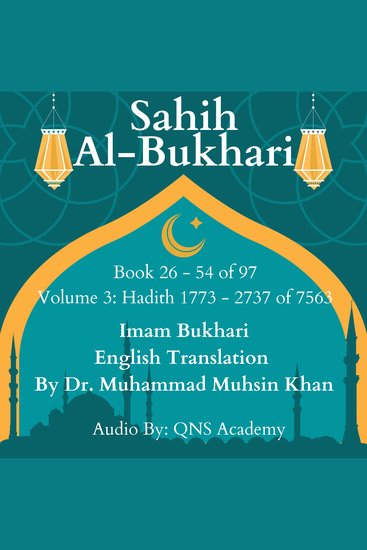
    Ṣaḥīḥ al-Bukhārī is a collection of hadīth compiled by Abu Abdullāh Muhammad Ibn Ismā`īl al-Bukhārī(rahimahullāh). The translation provided here is by Dr. M. Muhsin Khan. 
    Volume 3 contains hadith 1773-2737 of 7563 in book 26-54: 
    26 Al-Umrah (Minor pilgrimage) Hadith 1773-1805 
    27 Al-Muhsar (Pilgrims Prevented from Completing the Pilgrimage) H 1806-1820 
    28 penalty for hunting (by a muhrim) and similar things Hadith 1821-1866 
    29 Virtues of Madinah Hadith 1867-1890 
    30 The Fasting (As Saum) Hadith 1891-2007 
    31 Taraweeh Prayers at Night in Ramadaan Hadith 2008-2013 
    32 Superiority of the Night of Qadr Hadith 2014-2024 
    33 Retiring to a Mosque for Remembrance of Allah (Itikaf) Hadith 2025-2046 
    34 Sales (Bargains) Hadith 2047-2238 
    35 The Sales in Which a Price is Paid for Goods to be Delivered Later(As-Salam) Hadith 2239-2256 
    36 Right of First Refusal, re-emption (ash-shuf'a) Hadith 2257-2259 
    37 Hiring (Concerning Hiring) Hadith 2260-2286 
    38 Transferance of a Debt from One Person to Another (Al-Hawaalat) H 2287-2289 
    39 Kafalah Hadith 2290-2298 
    40 Representation (or Authorization) Hadith 2299-2319 
    41 Cultivation and Agriculture Hadith 2320-2350 
    42 Watering (Distribution of Water) Hadith 2351-2384 
    43 Loans, payment of loans, Freezing of Property, Bankruptcy Hadith 2385-2409 
    44 quarrels, disputes Hadith 2410-2425 
    45 Lost Things Picked up by Someone (Al-Luqatah) Hadith 2426-2439 
    46 Oppressions, Injustices (Al-Mazalim) Hadith 2440-2482 
    47 Partnership Hadith 2483-2507 
    48 mortgaging in places occupied by settled population Hadith 2508-2516 
    49 Manumission of Slaves Hadith 2517-2559 
    50 Al Mukatab Hadith 2560-2565 
    51 gifts and the superiority of giving gifts H 2566-2636 
    52 Witnesses, Testimonies Hadith 2637-2689 
    53 Peacemaking, Reconciliation Hadith 2690-2710 
    54 Conditions Hadith 2711-2737
    Show book
  • Know We Are Here - Voices of Native California Resistance - cover

    Know We Are Here - Voices of...

    Terria Smith

    • 0
    • 0
    • 0
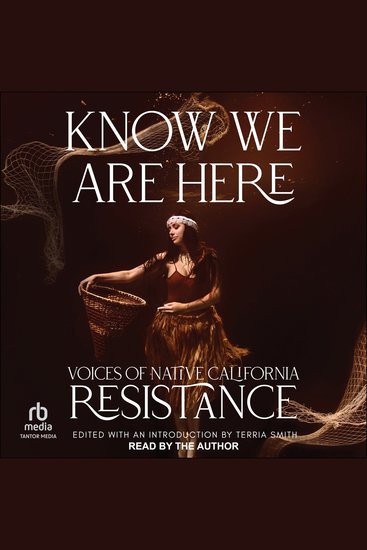
    Collecting over twenty-five essays written by more than twenty California Indian authors, Know We Are Here surveys many of the ways California's Indigenous communities are resisting the legacies of genocide. Focusing on the particular histories, challenges, and dynamics of life in Native California—which are often very different from elsewhere in the United States—the book collects essays from writers across the state. It encompasses the perspectives of both elders and the rising generation, and the contributors include activists, academics, students, memoirists, and tribal leaders. The collection examines histories of resistance to colonialism in California, the reclaiming of cultures and languages, the connection of place and nature to wellness in tribal communities, efforts to overhaul the racist presentation of California Indians in classrooms and popular culture, and the meanings of solidarity in Native California. Unifying the book is an introduction by Terria Smith (Torres Martinez Desert Cahuilla Indians), editor of the renowned and long-running magazine News from Native California. This book is an indispensable resource for California Indian listeners, educators of all levels in California, and students in Native studies courses nationally.
    Show book
  • The Voting Rights Act of 1965 - cover

    The Voting Rights Act of 1965

    Various

    • 0
    • 0
    • 0
    This program is read by an AI-based synthesized voice.
    Show book
  • Up from Slavery; an Unfinished Jouney - cover

    Up from Slavery; an Unfinished...

    Archie Morris III

    • 0
    • 0
    • 0
    For a period of 85 years, the M Street/Dunbar High School was an academically elite, all-black public high school in Washington, D.C.  As far back as 1899, its students came in first in citywide tests given in both black and white schools.  Over this 85-year span, approximately 80 percent of M Street/Dunbar’s graduates went on to college, even though most Americans, white or black, did not attend college at all. Faculty and students were mutually respectful to one another, and disruptions in the classroom were not tolerated. Yet, in this era of best practices, this public high school, whose founders experienced slavery and segregation firsthand, has received virtually no attention in the literature or in policy considerations for inner-city education.  The purpose of this study is to explore the history of a high school that was successful in teaching black children from families at all income levels to excel and to determine if the learning model employed in the past could be successful in a modern inner-city public education environment.
    Show book
  • Intimidation - Using Fear or Threats to Control or Influence Others - cover

    Intimidation - Using Fear or...

    Cito Harder

    • 0
    • 0
    • 0
    Intimidation is a powerful tool used to control, manipulate, or influence others through fear, coercion, or the threat of consequences. It is a fundamental aspect of power dynamics in human interactions, appearing in personal relationships, workplaces, politics, and even entire societies. While often associated with overt threats and aggressive behavior, intimidation can also be subtle, manifesting through psychological pressure, social exclusion, or implied consequences rather than direct violence. Regardless of its form, intimidation serves as a means of asserting dominance and shaping the behavior of individuals or groups. 
    Throughout history, intimidation has played a crucial role in maintaining authority and enforcing societal norms. Rulers, military leaders, and institutions have long relied on fear to deter opposition and ensure obedience. From ancient empires using public punishments to instill fear in the masses to modern governments leveraging surveillance and propaganda, intimidation remains a key strategy for those in power. However, it is not limited to large-scale societal control—intimidation also operates at the personal level, where individuals use fear to manipulate or silence others in personal, professional, and social settings. 
    The effectiveness of intimidation lies in its ability to exploit human psychology. Fear is a primal emotion, hardwired into the brain as a survival mechanism. When people perceive a threat—whether physical, emotional, or social—they often become more compliant, seeking to avoid harm or conflict. This reaction can be seen in various contexts, such as an employee hesitating to speak out against an abusive manager, a student fearing retaliation from a school bully, or a population complying with oppressive laws due to the threat of punishment.
    Show book