Join us on a literary world trip!
Add this book to bookshelf
Grey
Write a new comment Default profile 50px
Grey
Subscribe to read the full book or read the first pages for free!
All characters reduced
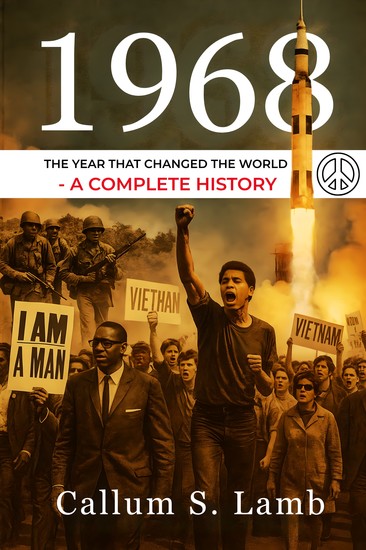
1968 - The Year That Changed the World - A Complete History - cover

1968 - The Year That Changed the World - A Complete History

Callum S. Lamb

Publisher: SeaHorse Pub

  • 0
  • 0
  • 0

Summary

The year that changed everything. The story America needs to remember.
 
In twelve explosive months, the United States was torn apart and rebuilt. From the jungles of Vietnam to the streets of Chicago, from the hallowed halls of Columbia University to the Olympic podium in Mexico City, 1968 witnessed a nation convulsing with unprecedented upheaval that would reshape American society forever.
 
1968: The Year That Changed the World takes you inside the most turbulent year in modern American history, when assassins' bullets claimed two of the nation's most beloved leaders, student revolutionaries occupied university campuses, and television cameras captured police beating protesters in the streets of Chicago. This meticulously researched narrative reveals how Martin Luther King Jr.'s murder ignited cities across America, how Robert Kennedy's assassination shattered liberal dreams, and how Richard Nixon's stunning political comeback changed the course of American politics.
 
From the Tet Offensive that exposed the lies about Vietnam to the Prague Spring crushed by Soviet tanks, from the Democratic National Convention that devolved into chaos to the raised fists at the Olympics that defined a generation's defiance, every pivotal moment comes alive through intimate character portraits and gripping storytelling.
 
Drawing on declassified documents, personal interviews, and eyewitness accounts, this powerful chronicle reveals how ordinary Americans—students, soldiers, activists, and politicians—navigated twelve months that tested the very foundations of democracy. Discover the untold stories behind the headlines: the secret machinations in the White House, the courage of civil rights workers facing deadly violence, and the determination of young people who refused to accept the status quo.
 
More than just history, this is the story of how America transformed from the confident nation of the early 1960s into the divided country we recognize today. 1968: The Year That Rocked the World is essential reading for anyone seeking to understand how we became who we are—and where we might be heading.
 
A masterpiece of historical narrative that reads like a thriller and resonates like prophecy.
 
 
Available since: 08/15/2025.
Print length: 326 pages.
Other books that might interest you

  • Understanding Feminism - cover

    Understanding Feminism

    Marie-Hélène Bourcier

    • 0
    • 0
    • 0
    The male/female dichotomy is not obvious, and the feminist “we” is far from self-evident; its definition changes according to currents and ideologies. As well as fighting male domination, feminism can also defend different expressions of gender and sexuality. By examining the ideas defended by the different currents and how they fit into the social landscape, this book clarifies the direction in which they must unite if feminism is to remain a historically fertile movement.
    Show book
  • How to Be a Good Manipulator: Using Psychology Biology and Authority to Bend People Without Breaking Them - cover

    How to Be a Good Manipulator:...

    A.A. Castor

    • 0
    • 0
    • 0
    What if manipulation wasn't evil—just effective? 
    How to Be a Good Manipulator is not a guide for the moral or the meek. It's for readers who want to understand the psychology, biology, and brutal mechanics of control—whether to resist it or wield it. 
    In this unapologetic breakdown of influence and deception, author A.A. Castor doesn't offer comfort—he offers clarity. Through real psychological principles, dark behavioral tactics, and disturbingly familiar case studies, this book teaches how people are shaped, steered, and sometimes enslaved without ever realizing it. 
    From cult leaders to corporate climbers, from toxic relationships to spiritual influencers, this guide explores:How fear, shame, and hope override logicHow to frame reality and become the voice of "truth"Why people follow confidence—not correctnessThe emotional addiction of "love-bombing and withdrawal"How to use charisma, guilt, authority, and confusion to bend behaviorWhy freedom is often just a prettier cage—and how to make them love it 
    Whether you want to recognize the tactics being used on you or become the one pulling the strings, this book is a mirror, a manual, and a weapon. 
    Disturbingly honest. Laughably real. Absolutely lethal..
    Show book
  • Reconsidering Reparations - cover

    Reconsidering Reparations

    Olúfẹ́mi Táíwò

    • 0
    • 0
    • 0
    Reparations for slavery have become a reinvigorated topic for public debate over the last decade. Most theorizing about reparations treats it as a social justice project—either rooted in reconciliatory justice focused on making amends in the present; or, they focus on the past, emphasizing restitution for historical wrongs. Olúfémi O. Táíwò argues that neither approach is optimal, and advances a different case for reparations—one rooted in a hopeful future that tackles the issue of climate change head on, with distributive justice at its core. This view, which he calls the "constructive" view of reparations, argues that reparations should be seen as a future-oriented project engaged in building a better social order; and that the costs of building a more equitable world should be distributed more to those who have inherited the moral liabilities of past injustices. 


    This approach to reparations, as Táíwò shows, has deep and surprising roots in the thought of Black political thinkers such as James Baldwin, Martin Luther King Jr, and Nkechi Taifa, as well as mainstream political philosophers like John Rawls, Charles Mills, and Elizabeth Anderson. Táíwò's project has wide implications for our views of justice, racism, the legacy of colonialism, and climate change policy.
    Show book
  • SAT Grammar Secrets - "Ace your SAT with dynamic audio lessons that unlock grammar secrets for peak test performance!" - cover

    SAT Grammar Secrets - "Ace your...

    Bramwell Ashford

    • 0
    • 0
    • 0
    Audiobook Title: SAT Grammar Secrets: A Simplified Guide with Clear Explanations 
    Are you eager to advance in your academic journey and strengthen your foundation in grammar to excel in the SAT? 
    Searching for an all-inclusive guide that covers everything you need to ace the SAT? 
    Your quest ends here! 
    This audiobook acts as your ultimate resource for enhancing your understanding, applying your skills, and engaging in practical exercises. With this guide, you're set for success. 
    Updated for the SAT 2024-2025 Exam Format. 
    Key highlights of this enhanced guide: 
    - In-depth insights into the SAT 2024-2025 Exam 
    - Comprehensive breakdown of essential grammar rules 
    - Effective strategies for preparation and tackling the exam 
    Our guide stands out with its thorough coverage, which is crucial for your success. Concepts are not just briefly mentioned; they are explored in detail and with accuracy. 
    Please remember, this guide is not connected to any official SAT organization and is meant solely as a valuable independent resource for you. 
    Crafted with a logical structure and straightforward language, our SAT Exam Guide ensures seamless transitions between topics. Say goodbye to convoluted jargon and welcome clear, precise, and technically sound content. 
    So, why hesitate? Click the BUY NOW button, secure your guide, and embark on your path to success in the SAT 2024-2025! 
    Start your journey to academic excellence today!
    Show book
  • Rome’s Best Emperors: The History and Legacy of the Roman Empire’s Most Able Leaders - cover

    Rome’s Best Emperors: The...

    Editors Charles River

    • 0
    • 0
    • 0
    The importance of Gaius Julius Caesar Augustus (or as he was known from birth, Gaius Octavius “Octavian” Thurinus) to the course of Western history is hard to overstate. His life, his rise to power, his political, and his social and military achievements all laid the foundations for the creation of an empire which would endure for almost five centuries, and whose traditions, laws, architecture and art continue to influence much of Europe and the world today. Octavian was the first true Roman Emperor, and the first man since the Etruscan Tarquins five centuries earlier to establish a successful hereditary ruling dynasty in what had been a proud Republic for over half a millennium. He was a canny strategist, an excellent orator, a fine writer, a generous patron of the arts and enthusiastic promoter of public works, but above all he was a master politician. Octavian’s great-uncle (and adoptive father) Julius Caesar was a great general, and his rival Mark Antony was a great soldier, but as a politician Octavian outmatched them all. He still stands in bronze on Rome’s Via dei Fori Imperiali to this day, along with the likes of Caesar, Hadrian, Trajan and Marcus Aurelius, and he is forever immortalized in all Western calendars as the patron of the month of August, which was dedicated to him when he was deified, following his death, as Divus Augustus.  
    	“The Five Good Emperors,” a reference to the five emperors who ruled the Roman Empire between 96 and 180 CE (Nerva, Trajan, Hadrian, Antoninus Pius, and Marcus Aurelius), was a term first coined by Machiavelli and later adopted and popularized by historian Edward Gibbon, who said that under these men, the Roman Empire “was governed by absolute power under the guidance of wisdom and virtue.” This period of 84 years is generally regarded as the high point of the Roman Empire, at least after Augustus.
    Show book
  • The Shocking Truth about Economic Inequality - cover

    The Shocking Truth about...

    Zoey Fraisers

    • 0
    • 0
    • 0
    Economic inequality is one of the most pressing issues of our time. While some individuals amass enormous wealth, millions struggle to afford basic necessities. The gap between the rich and the poor has widened significantly over the past few decades, raising concerns about fairness, economic stability, and the future of society. This growing divide affects nearly every aspect of life, from access to education and healthcare to political representation and social mobility. Understanding the causes and consequences of economic inequality is essential to addressing the challenges it presents.  
      
    Historically, economic disparities have existed in every civilization, but modern inequality has taken on new dimensions. The rise of globalization, rapid technological advancements, and financial deregulation have contributed to an economic system that disproportionately benefits the wealthy. While free markets have driven innovation and lifted millions out of poverty, they have also concentrated wealth and power in the hands of a few. In many countries, the middle class—once the backbone of economic stability—has eroded, leaving a stark contrast between the privileged elite and those struggling to keep up.  
    Government policies play a crucial role in shaping economic inequality. Tax structures, labor laws, and social welfare programs determine how wealth is distributed within a society. In some cases, policies favor large corporations and high-income individuals, exacerbating disparities. Meanwhile, stagnant wages, the decline of labor unions, and rising costs of living make it increasingly difficult for working-class families to get ahead. The debate over economic inequality is not just about wealth but about opportunity. When financial barriers prevent people from accessing quality education, healthcare, and stable employment, economic mobility declines, reinforcing cycles of poverty. 
    Show book