Join us on a literary world trip!
Add this book to bookshelf
Grey
Write a new comment Default profile 50px
Grey
Subscribe to read the full book or read the first pages for free!
All characters reduced
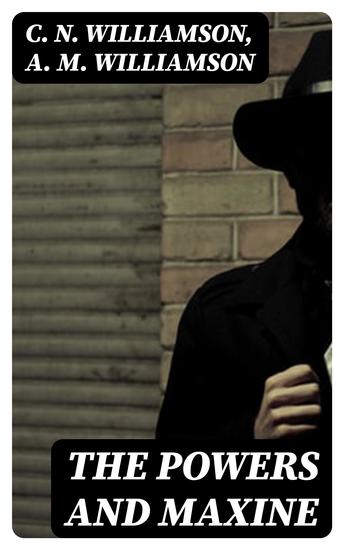
The Powers and Maxine - cover

The Powers and Maxine

C. N. Williamson, A. M. Williamson

Publisher: DigiCat

  • 0
  • 0
  • 0

Summary

"The Powers and Maxine" presents a vibrant tapestry woven with threads of intrigue, romance, and early 20th-century societal dynamics. This anthology navigates through variances in tone and theme, capturing the essence of an epoch characterized by both subtlety and spectacle. The stories within explore the interplay of power and personality, immersing readers in a myriad of experiences from whimsical narrative arcs to profound character studies. Noteworthy among them are pieces that challenge patriarchal norms while cleverly satirizing the mores of the time, showcasing the versatility and depth of the collection. Contributors C. N. Williamson and A. M. Williamson bring an eclectic array of perspectives that echo broader cultural and literary movements of their era. Known for their unique ability to blend adventure and emotional depth, the Williamsons deftly capture the spirit of the Edwardian period, marked by transformative social change and the rise of individual agency. Their works within this anthology are tied to progressive thought, offering a lens into both the aspirational and the quotidian through character-driven narratives that speak to universal truths and personal revelations. Readers are invited to engage with "The Powers and Maxine" not only as a literary exploration but as a critical commentary on themes that transcend time. Encounter diverse voices and storytelling mastery within a compendium that balances entertainment with insights, nostalgia, and modernity. This anthology stands as a quintessential read for those yearning to appreciate the timeless dialogue between power, identity, and the art of storytelling, making it a salient addition to any collection dedicated to the exploration of literary brilliance and societal discourse.
Available since: 09/16/2022.
Print length: 164 pages.

Other books that might interest you

  • La Grande Bretèche - The Great Breach - cover

    La Grande Bretèche - The Great...

    Honoré de Balzac

    • 0
    • 0
    • 0
    In a quiet French town, a crumbling, locked-up manor stirs the curiosity of all who pass it. No one enters. No one speaks of what happened inside. But behind the overgrown garden and shuttered windows lies a story of love, betrayal, and a chilling act of vengeance. 
    When a visiting doctor presses for answers, he uncovers a tale that was meant to stay buried. A jealous husband. A secret lover. A sealed fate. The mystery of La Grande Bretèche reveals itself slowly, with devastating clarity. 
    Told through layers of memory and local legend, Balzac’s short story delivers a compact, suspenseful narrative with a deeply haunting payoff. 
    Perfect for fans of dark romantic suspense, gothic tales, and French literature with a sharp psychological edge. 
    Audio edited by Mike Toda
    Show book
  • A Source of Irritation - From their pens to your ears genius in every story - cover

    A Source of Irritation - From...

    Stacy Aumonier

    • 0
    • 0
    • 0
    The bookshelves of British literature are incredible collections that have gathered together centuries of very talented authors.  From these Isles their fame spread and whilst among their number many are now forgotten or neglected their talents endure.  Among them is Stacy Aumonier.
    Show book
  • A Profitable Weakness - From their pens to your ears genius in every story - cover

    A Profitable Weakness - From...

    George Gissing

    • 0
    • 0
    • 0
    George Robert Gissing was born on November 22nd, 1857 in Wakefield, Yorkshire.  
    He was educated at Back Lane School in Wakefield. Gissing loved school. He was enthusiastic with a thirst for learning and always diligent.  By the age of ten he was reading Dickens, a lifelong hero. 
    In 1872 Gissing won a scholarship to Owens College. Whilst there Gissing worked hard but remained solitary. Unfortunately, he had run short of funds and stole from his fellow students. He was arrested, prosecuted, found guilty, expelled and sentenced to a month's hard labour in 1876. 
    On release he decided to start over.  In September 1876 he travelled to the United States. Here he wrote short stories for the Chicago Tribune and other newspapers. On his return home he was ready for novels. 
    Gissing self-published his first novel but it failed to sell.  His second was acquired but never published. His writing career was static.  Something had to change.  And it did. 
    By 1884 The Unclassed was published.  Now everything he wrote was published. Both Isabel Clarendon and Demos appeared in 1886. He mined the lives of the working class as diligently as any capitalist. 
    In 1889 Gissing used the proceeds from the sale of The Nether World to go to Italy. This trip formed the basis for his 1890 work The Emancipated. 
    Gissing's works began to command higher payments. New Grub Street (1891) brought a fee of £250.  
    Short stories followed and in 1895, three novellas were published; Eve's Ransom, The Paying Guest and Sleeping Fires. Gissing was careful to keep up with the changing attitudes of his audience.  
    Unfortunately, he was also diagnosed as suffering from emphysema. The last years of his life were spent as a semi-invalid in France but he continued to write. 1899; The Crown of Life. Our Friend the Charlatan appeared in 1901, followed two years later by The Private Papers of Henry Ryecroft. 
    George Robert Gissing died aged 46 on December 28th, 1903 after catching a chill on a winter walk.
    Show book
  • Whereyouwantogoto - cover

    Whereyouwantogoto

    E. Nesbit

    • 0
    • 0
    • 0
    Selim and Thomasina are very put out that they must stay in London during the summer holidays, instead of going to the seaside, just because their aunt and uncle are coming to stay.  (They're not even the nice kind of aunt and uncle!) The hot summer becomes more bearable when an India-rubber ball takes them to Whereyouwantogoto, a magical seaside place where there are no grown-ups around to tell children what to do.  The only condition for staying in this dreamland is that the children must continue to be good, but being good is easy when you're happy… or is it?    Whereyouwantogoto was first published in Nine Unlikely Tales, 1901.
    Show book
  • Delilah and Mr Bircumshaw - cover

    Delilah and Mr Bircumshaw

    D H Lawrence

    • 0
    • 0
    • 0
    'Delilah and Mr Bircumshaw was written by D H Lawrence in 1912. Lawrence is beginning to move away from his working class roots in this story, and exploring the relationship of a middle-class couple who have a slight argument, egged on by the wife's friend. Bircumshaw loses his dignity and self-respect for the comforts of married life. For all his insights into women, the misogynist in Lawrence can be detected.
    Show book
  • The Ghost in the Cupboard Room - From their pens to your ears genius in every story - cover

    The Ghost in the Cupboard Room -...

    Wilkie Collins

    • 0
    • 0
    • 0
    Wilkie Collins was born on 8th January 1824 in Marylebone, London.  
    The family moved several times in his early years before, at 12, they travelled to France and Italy for 2 years where the sights and atmosphere made a deep and lasting impression on him. 
    He resumed his education at Mr Cole’s private boarding school in Highbury, Islington.  Here, he began his literary career under unusual circumstances: the school bully would give him no peace until he had been told a bedtime story.  This ‘little brute’ helped create one of England’s greatest writers.  
    On leaving school, in 1841, he became a clerk at a tea merchant before, 2 years later, publishing his first short story.  However, his first novel was rejected and remained so during his lifetime.  
    A brief stint at Lincoln’s Inn to please his father and to acquire a steady income was halted by his father’s death.  Collins then wrote and published his fathers’ memoirs.  He then completed his legal education though he would never practice.  
    In March 1851, he was introduced to Charles Dickens and there now started a period of sustained literary output and a remarkable lifelong friendship.  His stories were published in Dicken’s magazines, and he toured with Dicken’s theatrical before the two of them travelled to the Continent. 
    By the early 1860’s worrying signs of ill-health appeared with rheumatic gout.  As it worsened, he sought respite and cures in German spa towns and gave up writing to help his recuperation. 
    His personal life had become very complicated.  He was living with the widowed Caroline Graves and conducting an affair with a much younger Martha Rudd.  With the serialised release of ‘The Moonstone’ and vicious attacks of gout Caroline left him and married another.  Collins was now prescribed opium and was soon its lifelong dependent.  Martha bore him two children and with the return of a now divorced Caroline Graves he now divided his time between the two women. 
    In 1874 he set aside writing to tour North America on a reading tour. 
    Throughout his later years he continued to write and publish.  In all 30 novels, 14 plays, 60 short stories and over a 100 non-fiction essays as well as many more collaborations with Dickens. 
    In 1884 the Society of Authors elected him as it’s Vice-President. 
    Wilkie Collins died from a paralytic stroke on September 23rd, 1889, in London. He was 65.
    Show book