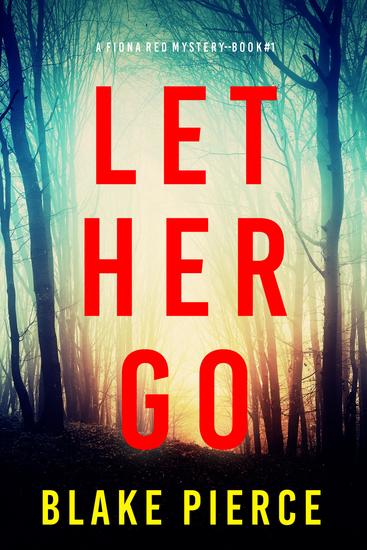
Let Her Go (A Fiona Red FBI...
Blake Pierce
When a new serial killer strikes, the FBI, stumped, turns to its brilliant forensic examiner and entomologist, Fiona Red, with her unparalleled genius and ability to offer insights at crime scenes based on her insect expertise. When another victim turns up in a stretch of rural woods covered in unusual bugs, Fiona knows right away that something doesn't add up. In this master game of wits, Fiona may have finally met her match.

"A masterpiece of thriller and mystery."
—Books and Movie Reviews, Roberto Mattos (re Once Gone)
⭐⭐⭐⭐⭐

This is book #1 in a long-anticipated new series by #1 bestseller and USA Today bestselling author Blake Pierce, whose bestsellers have received over 7,000 five star ratings and reviews.

Fiona Red, a brilliant but quirky FBI loner, spends most of her time in the lab or at crime scenes. She comes from a family used to being around death and bodies, her parents having ran a funeral parlor, and she would have ran the family business if not for a tragedy in her past: her sister was abducted when she was a teenager, and never found.

Fiona remains determined to crack her sister's case. But in the meantime, as an FBI agent, she applies her brilliance to catching killers and cracking cases that no one else can, as bugs are the first visitors to dead bodies.

With her FBI partner out in the field, Fiona expects to stay behind the scenes.

But Fiona, obsessed with catching killers, takes it one step too far, and may just find herself in the crosshairs of a killer herself.

A page-turning and harrowing crime thriller featuring a brilliant and tortured FBI agent, the series is a riveting mystery, packed with non-stop action, suspense, twists and turns, revelations, and driven by a breakneck pace that will keep you flipping pages late into the night. Fans of Rachel Caine, Teresa Driscoll and Robert Dugoni are sure to fall in love.

Future books in the series are also available!

"An edge of your seat thriller in a new series that keeps you turning pages! ...So many twists, turns and red herrings… I can't wait to see what happens next."
—Reader review (Her Last Wish)
⭐⭐⭐⭐⭐

"A strong, complex story about two FBI agents trying to stop a serial killer. If you want an author to capture your attention and have you guessing, yet trying to put the pieces together, Pierce is your author!"
—Reader review (Her Last Wish)
⭐⭐⭐⭐⭐

"A typical Blake Pierce twisting, turning, roller coaster ride suspense thriller. Will have you turning the pages to the last sentence of the last chapter!!!"
—Reader review (City of Prey)
⭐⭐⭐⭐⭐

"Right from the start we have an unusual protagonist that I haven't seen done in this genre before. The action is nonstop… A very atmospheric novel that will keep you turning pages well into the wee hours."
—Reader review (City of Prey)
⭐⭐⭐⭐⭐

"Everything that I look for in a book… a great plot, interesting characters, and grabs your interest right away. The book moves along at a breakneck pace and stays that way until the end. Now on go I to book two!"
—Reader review (Girl, Alone)
⭐⭐⭐⭐⭐

"Exciting, heart pounding, edge of your seat book… a must read for mystery and suspense readers!"
—Reader review (Girl, Alone)
⭐⭐⭐⭐⭐
Show book