Join us on a literary world trip!
Add this book to bookshelf
Grey
Write a new comment Default profile 50px
Grey
Subscribe to read the full book or read the first pages for free!
All characters reduced
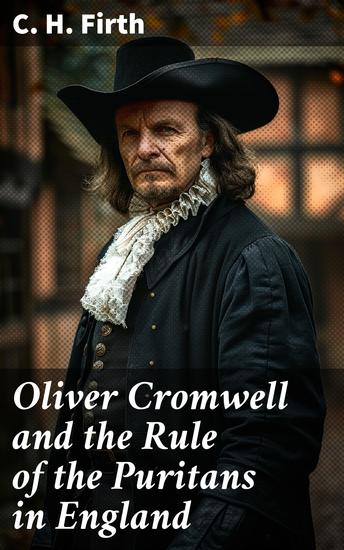
Oliver Cromwell and the Rule of the Puritans in England - Unveiling the Puritan Commonwealth: Insights into Cromwell's Rule and English Society - cover

Oliver Cromwell and the Rule of the Puritans in England - Unveiling the Puritan Commonwealth: Insights into Cromwell's Rule and English Society

C. H. Firth

Publisher: Good Press

  • 0
  • 0
  • 0

Summary

In "Oliver Cromwell and the Rule of the Puritans in England," C. H. Firth intricately examines the complex political and theological landscape during the era of Cromwell's leadership. Firth's narrative employs a blend of historical analysis and biographical detail, offering readers insight into the Puritan ethos that influenced governance during this tumultuous period. His writing is characterized by meticulous research and a clear, engaging style, situating Cromwell not only as a military leader but also as a significant figure in Puritan reform and English history, examining the power struggles and ideological battles that shaped the nation. C. H. Firth, a prominent historian and scholar of the English Civil War, draws from extensive archival work and contemporary sources to illuminate the moral and ethical dimensions of Cromwell's reign. His background as an advocate for historical accuracy and social reform informs his perspective, leading him to explore the connection between governance and religious belief. Firth'Äôs scholarly contributions have made him a respected figure in the study of early modern England, and this book encapsulates his deep engagement with Cromwell'Äôs legacy. This work is essential for anyone interested in the intersections of politics and religion in 17th-century England. Firth'Äôs examination not only enriches our understanding of Oliver Cromwell as a ruler but also delves into the broader implications of Puritan ideology on the English state. Recommended for historians, students, and general readers alike, this book serves as a profound exploration of an era that still resonates in contemporary discussions of governance and morality.
Available since: 11/11/2023.
Print length: 378 pages.
Other books that might interest you

  • Spanish and Portuguese in the New World The: The History and Legacy of the First European Rivalry in the Americas - cover

    Spanish and Portuguese in the...

    Editors Charles River

    • 0
    • 0
    • 0
    In 1451, Prince Henry the Navigator helped fund and develop a new type of ship, the caravel, that featured triangular lateen sails and would be able to travel in the open ocean and sail against the wind. In 1488, Bartholomew Diaz rounded the southern tip of Africa, named the Cape of Good Hope by King John of Portugal, and entered the Indian Ocean from the Atlantic. 
    One explorer, Christopher Columbus, sought funding from the Portuguese to search for a passage to Asia by sailing westwards, but he was rejected. At this time in the late 15th century, Portugal’s domination of the western African sea routes prompted the neighboring Crown of Castile and the Catholic monarchs in modern Spain to search for an alternative route to south and east Asia (termed Indies), so they provided Columbus with the funding he required. By the time Christopher Columbus started setting back east from the New World after landing there in October 1492, he had explored San Salvador in the Bahamas (which he thought was Japan), Cuba (which he thought was China), and Hispaniola, the source of gold. As the common story goes, Columbus, en route back to Spain from his first journey, called in at Lisbon as a courtesy to brief the Portuguese King John II of his discovery of the New World. King John subsequently protested that according to the 1479 Treaty of Alcáçovas, which divided the Atlantic Ocean between Spanish and Portuguese spheres of influence, the newly discovered lands rightly belonged to Portugal. To make clear the point, a Portuguese fleet was authorized and dispatched west from the Tagus to lay claim to the “Indies,” which prompted a flurry of diplomatic activity in the court of Ferdinand and Isabella.
    Show book
  • European History - In the 20th Century - cover

    European History - In the 20th...

    Secrets of History

    • 0
    • 0
    • 0
    Welcome to the exciting world of European history!  
    Are you looking for a comprehensive yet easy-to-read overview of the key events that shaped the continent?  
    If so, then you’re in luck.  
    This book about the History of Europe, from WW1 and beyond, provides an accessible and comprehensive look at some of the most important events in modern European history. 
      
    This book covers a vast range of topics including: 
     • The causes and consequences of World War I 
     • The Russian Revolution  
    • The Rise of Fascism in Italy and Germany 
     • The Treaty of Versailles and its aftermath  
    • World War II and its aftermath  
    • The Cold War era, including the fall of communism 
      
    This book is perfect for anyone looking to get an overall understanding of European history from 1914 to present day. It offers readers a complete picture into Europe’s past — from the battlefields to the boardrooms — as well as how these historic events still shape our lives today. It also provides detailed coverage on how different countries responded to major historical turning points such as World War I, the Russian Revolution, and the rise of fascism in Italy and Germany. 
    So do not wait any longer — get your copy today!
    Show book
  • Girl Archaeologist - Sisterhood in a Sexist Profession - cover

    Girl Archaeologist - Sisterhood...

    Alice Beck Kehoe

    • 0
    • 0
    • 0
    Girl Archaeologist recounts Alice Kehoe's life, begun in an era very different from the twenty-first century in which she retired as an honored elder archaeologist. She persisted against entrenched patriarchy in her childhood, at Harvard University, and as she did fieldwork with her husband in the northern plains. A senior male professor attempted to quash Kehoe's career by raping her. Her Harvard professors refused to allow her to write a dissertation in archaeology. Universities paid her less than her male counterparts. Her husband refused to participate in housework or childcare. 


    Working in archaeology and in the histories of American First Nations, Kehoe published a series of groundbreaking books and articles. Although she was denied a conventional career, through her unconventional breadth of research and her empathy with First Nations people she gained a wide circle of collaborators and colleagues. Throughout her career Kehoe found and fostered a sisterhood of feminists—strong, bright women archaeologists, anthropologists, and ethnohistorians who have been essential to the field. 


    Girl Archaeologist is the story of how one woman pursued a professional career in a male-dominated field during a time of great change in American middle-class expectations for women.
    Show book
  • Qin Dynasty The: A History of China - cover

    Qin Dynasty The: A History of China

    Hui Wang

    • 0
    • 0
    • 0
    "The Qin Dynasty: A History of China" takes you on a journey through one of the most dramatic chapters in Chinese history. From the unification of the warring states to the iron rule of Qin Shi Huang, this book dives deep into the empire that set the foundation for China's future. The First Emperor built a centralized government, enforced strict laws, and undertook grand projects like the Great Wall and his massive underground mausoleum. But his rule was also marked by fear—the infamous Burning of Books and Burying of Scholars, heavy taxation, and forced labor that pushed people to their limits. When Qin Shi Huang passed away, his successors struggled to hold the empire together, and cracks began to show. 
    As unrest spread, a single spark ignited a rebellion that would shake the empire to its core. Chen Sheng and Wu Guang, two common soldiers, defied orders and rose up, setting off a wave of uprisings across the land. The once-unbreakable Qin Dynasty faced challenge after challenge, as ambitious warlords seized the opportunity to fight for power. Among them, two figures stood out—Liu Bang, a clever and adaptable leader with a commoner's background, and Xiang Yu, a fearsome warrior whose strength was unmatched. Their rivalry would turn into a fierce battle for control over China, each determined to claim victory in their own way. 
    Through shifting alliances, brilliant strategies, and brutal clashes, the struggle between these two giants shaped the fate of an empire. As cities fell and armies clashed, their contrasting styles of leadership and personal ambitions drove them toward an inevitable showdown. Would brute force or cunning strategy decide the future of China? As tensions rose, betrayal lurked in the shadows, and the tide of war could change in an instant.
    Show book
  • Women's Diaries of the Westward Journey - cover

    Women's Diaries of the Westward...

    Lillian Schlissel, Mary Clearman...

    • 0
    • 0
    • 0
    More than a quarter of a million Americans crossed the continental United States between 1840 and 1870, going west in one of the greatest migrations of modern times. The frontiersmen have become an integral part of our history and folklore, but the Westering experiences of American women are equally central to an accurate picture of what life was like on the frontier. 


    Through the diaries, letters, and reminiscences of women who participated in this migration, Women's Diaries of the Westward Journey gives us primary source material on the lives of these women, who kept campfires burning with buffalo chips and dried weeds, gave birth to and cared for children along primitive and dangerous roads, drove teams of oxen, picked berries, milked cows, and cooked meals in the middle of a wilderness that was a far cry from the homes they had left back east. Still (and often under the disapproving eyes of their husbands) they found time to write brave letters home or to jot a few weary lines at night into the diaries that continue to enthrall us. 


    In her new foreword, Professor Mary Clearman Blew explores the enduring fascination with this subject among both historians and the general public, and places Schlissel's groundbreaking work into an intriguing historical and cultural context.
    Show book
  • Stoicism - A Very Short Introduction - cover

    Stoicism - A Very Short...

    Brad Inwood

    • 0
    • 0
    • 0
    Stoicism is two things: a long past philosophical school of ancient Greece and Rome, and an enduring philosophical movement that still inspires people in the twenty-first century to rethink and reorganize their lives in order to achieve personal satisfaction. What is the connection between them? 


    This Very Short Introduction provides an introductory account of Stoic philosophy, and tells the story of how ancient Stoicism survived and evolved into the movement we see today. Exploring the roots of the school in the philosophy of fourth century BCE Greece, Brad Inwood examines its basic history and doctrines and its relationship to the thought of Plato, Aristotle, and his successors, and the Epicureans. Sketching the history of the school's reception in the western tradition, he argues that, despite the differences between ancient and contemporary Stoics, there is a common core of philosophical insight that unites the modern version not just to Seneca, Epictetus, and Marcus Aurelius but also to the school's original founders, Zeno, Cleanthes, and Chrysippus. Inwood concludes by considering the place of Stoicism in modern life.
    Show book