Join us on a literary world trip!
Add this book to bookshelf
Grey
Write a new comment Default profile 50px
Grey
Subscribe to read the full book or read the first pages for free!
All characters reduced
The Assault on Mount Everest 1922 - cover

The Assault on Mount Everest 1922

C. G. Bruce

Publisher: The Expedition Press

  • 0
  • 0
  • 0

Summary

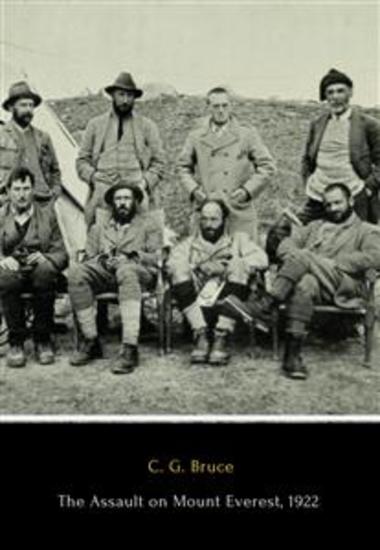
The Assault on Mount Everest, 1922 tells the story of the 1922 British Mount Everest expedition; the first mountaineering expedition with the express aim of making a successful ascent of Mount Everest. It was planned and financed by the Mount Everest Committee, which appointed the ebullient Brigadier General C.G. Bruce to be its leader, and it was he who subsequently wrote this compelling account of the expedition.
Available since: 06/15/2024.

Other books that might interest you

  • The Shocking Truth about Cultural Appropriation - cover

    The Shocking Truth about...

    Zoey Fraisers

    • 0
    • 0
    • 0
    Cultural appropriation is the act of taking or borrowing elements of one culture by members of another culture, typically without permission or proper understanding. This often occurs when a dominant culture adopts aspects of a marginalized or minority culture, without recognizing the significance or history behind these cultural symbols, practices, or traditions. While some might argue that cultural exchange is a natural part of globalization, cultural appropriation is controversial because it is frequently associated with power imbalances, exploitation, and the erasure of the identities of those whose culture is being borrowed. 
    At its core, cultural appropriation is not about borrowing something for appreciation or respect, but rather taking something from another culture in a way that is exploitative or disrespectful. For example, wearing traditional garments like a kimono or a Native American headdress as fashion statements, without understanding their cultural importance or context, is often cited as an example of cultural appropriation. These items are not just clothes or accessories; they carry deep meanings and are often tied to spiritual, ceremonial, or political significance. 
    One of the key aspects that distinguishes cultural appropriation from cultural appreciation is power dynamics. The group that appropriates tends to have more social, political, or economic power, while the culture being appropriated is often marginalized. This power imbalance is evident in many cases where elements of minority cultures are commodified and turned into trends or products, while the people from those cultures continue to face oppression, discrimination, and lack of recognition.
    Show book
  • Demographic Deception - Exposing the Overpopulation Myth and Building a Resilient Future - cover

    Demographic Deception - Exposing...

    Dustin Whitney

    • 0
    • 0
    • 0
    When global headlines declared that the world had surpassed 8 billion people, concerns around overpopulation and its impact on our planet escalated.But beneath the surface, after digging through that data and statistics, evidence reveals that a different kind of population crisis is looming.Demographic Deception unveils the truth that challenges our assumptions. It reveals that our real concern is not overpopulation but underpopulation.This book dismantles the overpopulation myth, explores the consequences of aging societies and shrinking populations, and ignites a conversation about proactive solutions. It emphasizes the urgency of planning and innovation, offering a glimpse of potential opportunities.The numbers are playing out before our eyes. It's up to us to see them and take action. Demographic Deception is your guide to understanding this critical issue and shaping a resilient future.
    Show book
  • The Samurai - The History of Japan’s Legendary Warrior Caste - cover

    The Samurai - The History of...

    Rod Johnson

    • 0
    • 0
    • 0
    The Samurai are the legendary warrior class of Japan. They played a crucial role in the country's history, politics and religion and their legacy continues to hold immense sway over popular culture. 
     
    In this fascinating history, author Rod Johnson takes us through the rise and fall of the Samurai in Japanese society from the emergence of the new class in the eighth century through the turbulent periods of the Mongol invasions and the civil wars of the Sengoku period to the attempts of the class to adapt to a changing world after the Meiji restoration in the nineteenth century. 
     
    With features on key events, battles and figures in the history of the Samurai, this beautifully illustrated volume serves as the perfect reference for anyone who wants to know more about these fascinating people.
    Show book
  • Pythagoras - The Philosopher of Numbers and the Universe - cover

    Pythagoras - The Philosopher of...

    Hector Davidson

    • 0
    • 0
    • 0
    Pythagoras of Samos, one of the most enigmatic and influential figures in the history of philosophy and mathematics, is a person whose legacy continues to shape various disciplines. Born around 570 BCE on the Greek island of Samos, Pythagoras became famous not only for his contributions to mathematics but also for his unique approach to life, religion, and the natural world. His teachings, although shrouded in mystery due to the scarcity of historical records, have left an indelible mark on Western thought, especially in the realms of mathematics, music, ethics, and cosmology. 
    As a philosopher and mathematician, Pythagoras is perhaps best known for the Pythagorean Theorem, a fundamental principle in geometry that has influenced the study of mathematics for over two millennia. However, his impact extends far beyond the confines of geometry. Pythagoras is often credited with transforming numbers from mere tools of calculation into a system that mirrors the structure and harmony of the universe. For him, numbers were not just abstract symbols but the very essence of reality, governing everything from the motions of the stars to the patterns in music. His belief in the mystical and metaphysical significance of numbers laid the groundwork for later developments in philosophy, particularly the idea that the world is not a chaotic, random place but a cosmos governed by rational and harmonious principles. 
    Pythagoras also founded a community known as the Pythagorean Brotherhood, a school that combined elements of philosophy, religion, and science. This group not only explored intellectual pursuits but also engaged in practices aimed at moral and spiritual purification. Through this community, Pythagoras introduced the idea of the soul’s immortality and its journey of reincarnation, concepts that would influence the course of Greek philosophy and eventually early Christian thought.
    Show book
  • Mississippian Culture The: The History and Legacy of the Ancient Indigenous Culture in North America - cover

    Mississippian Culture The: The...

    Editors Charles River

    • 0
    • 0
    • 0
    When most people think of “ancient American civilizations,” the Aztec, Maya, or Inca cultures probably come to mind immediately, because the societies in Mesoamerica have left behind permanent structures for millions of visitors from around the world to see each year. At the same time, however, from about 1000-1500 CE, an equally complex culture formed along the banks of the Mississippi, Missouri, and Ohio Rivers. From Red Wing, Minnesota to Greenhouse, Louisiana, and from Spiro, Oklahoma to Macon, Georgia, societies built impressive mound structures that served as ritual platforms, burial sites, and residences for the elites. These mounds also served as the focal points of urban areas of varying sizes that were connected to each other through trade and ideology, forming a culture that modern historians have since designated the “Mississippian culture.”  
    	It has only been recently that modern archaeological, anthropological, and historical methods were utilized to create a somewhat accurate image of the Mississippian culture’s reach and importance in the wider contexts of American and world history. Today, historians have a much better understanding of many aspects of Mississippian culture, including its chronology, the religion of the people, urbanization, and how the people lived, and the fact that there were fully functioning complex societies that had sophisticated forms of government and long-distance trade networks. 	The mounds they made, which continue to serve as standing testaments to their extraordinary accomplishments, continue to be studied by experts who still have plenty of questions about the societies that produced them. But one thing’s for sure: with no evidence of a written language and a high probability that the groups spoke different languages (based on the earliest lingual patterns encountered from each region), what the Mississippian culture accomplished in the span of a few centuries is nothing short of phenomenal. 
    Show book
  • Heaven Help Us - How Faith Communities Inspire Hope Strengthen Neighborhoods and Build the Future - cover

    Heaven Help Us - How Faith...

    John Kasich

    • 0
    • 0
    • 0
    Read by the author.  
    Discover the antidote to cynicism and despair in this dynamic, revelatory, hope-inducing exploration of the extraordinary work and extraordinary people who are transforming communities around the country--motivated by faith. 
    The mother of a man with autism manages a network of group homes through her local Greek Orthodox congregation. The director of an Islamic cultural center hosts a national interfaith conference to foster better relationships with the Jewish community. A student counselor starts a free immigration services program through her church. Sometimes we forget that good is not only happening in America, it is flourishing--in the fertile soil of our churches, synagogues, and mosques. 
    Few people are better poised to speak to the value of religious institutions in civic life than former Ohio governor and presidential candidate John Kasich, who is both a public servant and a man of faith. In Heaven Help Us, Kasich reminds us through gripping stories that faith communities are vital to healthy communities and our nation. Heaven Help Us offers:Unforgettable stories of people making an extraordinary difference because of their faith communitiesInsights into what sets faith institutions that transform their neighborhoods apart from those that don'tPractical ideas for making positive changes in our own communitiesHope to dream about what is possible in our country instead of what is impossibleEncouragement that religion can bring us together rather than break us apart 
      
    As Kasich shows us, faith institutions can magnify the power of an individual in ways that almost always exceed the expectations of the person who jump-started the initiative in the first place. More than a collection of "feel-good" stories, Heaven Help Us reminds us of the resourcefulness and ingenuity of our fellow congregants and religious leaders that make it possible to turn our good intentions into even better outcomes. Good is happening in our country. Join in.
    Show book