

Join us on a literary world trip!
Add this book to bookshelf
Grey
Write a new comment Default profile 50px
Grey
Subscribe to read the full book or read the first pages for free!
All characters reduced
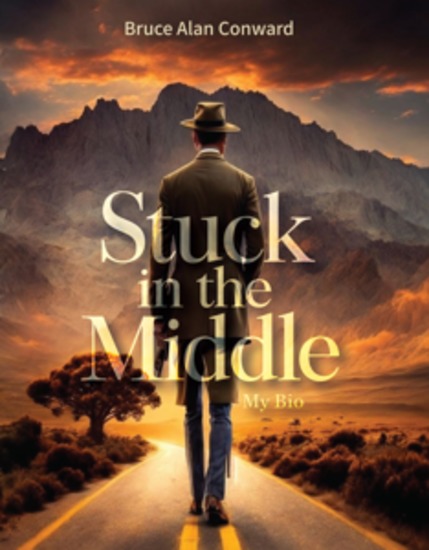
Stuck in the Middle - My Bio - cover

Stuck in the Middle - My Bio

Bruce Alan Conward

Publisher: Spines

  • 0
  • 0
  • 0

Summary

This memoir traces a man's life through the triumphs and trials of family, love, and faith. Surrounded by the warmth of kinship and the challenge of societal changes, he wrestles with the joys and sorrows of adolescence, the pursuit of identity in a divided world, and the complexities of young adulthood. Balancing the expectations of fatherhood and the search for self, he finds solace in music, strength in faith, and clarity in love, emerging stronger and more self-aware as he crafts his unique life's narrative.
Available since: 06/03/2025.
Print length: 312 pages.

Other books that might interest you

  • Chola Empire : 9th to 12th Century - cover

    Chola Empire : 9th to 12th Century

    Saurabh Kumar

    • 0
    • 0
    • 0
    The book takes us through the era of the Great Chola Empire between the 9th and 12th centuries and also throws light on the era of Rajaraja and Rajendra I.
    Show book
  • The Wari Empire - Pre-Incan Conquerors and the Engineers of South America - cover

    The Wari Empire - Pre-Incan...

    Rolf Hedger

    • 0
    • 0
    • 0
    The Wari Empire emerged as one of the most influential pre-Incan civilizations in the Andean region, setting the foundation for future Andean states, including the Inca. Its origins can be traced back to the highlands of present-day Peru, where early societies laid the groundwork for its rise. The unique combination of environmental adaptation, cultural influences, and political innovation allowed the Wari to establish a powerful state that would dominate much of the central Andes for centuries. 
    Before the Wari civilization took shape, the Andean region was home to various cultures that contributed to its development. Among these, the Chavín culture, which thrived from around 900 to 200 BCE, played a crucial role in spreading religious and artistic traditions that later influenced Wari art and iconography. The Nazca civilization, known for its intricate geoglyphs and advanced irrigation techniques, also left an imprint on Wari agricultural and engineering practices. However, it was the lesser-known Huarpa culture of the Ayacucho Valley that provided the most direct influence on early Wari society. The Huarpa people developed small-scale irrigation systems, terraced farming, and distinct ceramic styles, all of which became defining features of Wari civilization. 
    Sometime between 500 and 600 CE, the Wari began to expand beyond their heartland in the Ayacucho region. This expansion was driven by both environmental necessity and strategic ambition. The high-altitude valleys of the central Andes provided fertile land for agriculture, but they were also subject to fluctuating climatic conditions. To mitigate these challenges, Wari elites developed large-scale irrigation systems and storage facilities, ensuring food security for growing populations. This ability to manage resources effectively gave them an advantage over neighboring groups, allowing them to assert dominance through both diplomacy and military conquest.
    Show book
  • The Art of Conflict-Free Negotiations - 6 Steps to Winning Without Conflict How to Analyze People and Understand Their True Intentions Dreams and Desires - cover

    The Art of Conflict-Free...

    Halbert Ward

    • 0
    • 0
    • 0
    Say Goodbye to Deadlocks and Hello to Deals! 
    Wanna know how to read the room better, be good at assessing relationships, and be an expert in resolving conflicts? 
    Want to coach someone and be a mediator between two parties but are unsure of what to do or ask? 
    Finding ways how to know if you're winning their side without any verbal cues? 
    If any of these questions prompted a yes from you please read on... 
    Ever since we were young, we have been dealing with conflicts and negotiations without even realizing what we're doing is the actual thing. Getting good grades, more time to spend with our friends during weekends, and a better salary benefit the moment we start our lives as working individuals. We've been doing negotiations every time... the question is, are you always getting the best of it? 
    Whether you are dealing with workplace conflicts, brokering deals, or simply striving for mutually beneficial outcomes, the ability to negotiate effectively is a fundamental asset. Let Halbert Ward be your guru, as he presents "The Art of Conflict - Free Negotiations," a finely crafted manual that will teach you successful negotiation skills, the proper mindset of a negotiator, and how to deal with emotions. Let him be your guide on how to do negotiations with finesse and integrity, ensuring mutually beneficial outcomes and sustainable relationships in every interaction. 
    Packed with insider tips, real-world examples, and actionable strategies, "The Art of Conflict-Free Negotiations" empowers you to negotiate with confidence, integrity, and effectiveness, ensuring win-win outcomes and fostering lasting relationships in any negotiation scenario. Keep one handy, polish those negotiation skills, and who knows? Maybe this is the key to getting that "Yes" you've been waiting for!
    Show book
  • The Woketopus - The Dark Money Cabal Manipulating the Federal Government - cover

    The Woketopus - The Dark Money...

    Tyler O'Neil

    • 0
    • 0
    • 0
    Why did the Biden White House celebrate Transgender Day of Visibility on Easter Sunday? Why is the bureaucracy prioritizing electric vehicles and less reliable forms of energy when Americans struggle to pay the bills amid historic inflation and higher gas prices? 


    America's bureaucrats appear to live on a different planet from the working class in this country, and that's no accident. The Woketopus explains how America's elites are pulling the strings in Washington to prioritize their pet projects over the needs of the American people. O'Neil's prose reveals how the left's NGO apparatus pursues its woke agenda, maneuvering like an octopus by circumventing Congress and entrenching its interests in the federal government. 


    Discover how the donors who helped prop up the anti-Israel protests on college campuses are impacting policy in Washington; pull back the curtain on how federal agencies became engines of cultural change; and find out how the Left's dark money influences federal law enforcement to demonize conservatives in an attempt to silence anyone who wants to criticize this agenda.
    Show book
  • The Notebook - A History of Thinking on Paper - cover

    The Notebook - A History of...

    Roland Allen

    • 0
    • 0
    • 0
    A Kirkus Most Anticipated Book of Fall 2024 


    We see notebooks everywhere we go. But where did these indispensable implements come from? How did they revolutionize our lives? And how can using a notebook help change the way you think? In this wide-ranging history, Roland Allen reveals how the notebook became our most dependable and versatile tool for creative thinking. He tells the notebook stories of Leonardo and Frida Kahlo, Isaac Newton and Marie Curie, and writers from Chaucer to Henry James; shows how Darwin developed his theory of evolution in tiny pocket books and Agatha Christie plotted a hundred murders in scrappy exercise books; and introduces a host of cooks, kings, sailors, fishermen, musicians, engineers, politicians, adventurers, and mathematicians, all of whom used their notebooks as a space to think—and in doing so, shaped the modern world. 


    In an age of AI and digital overload, the humble notebook is more relevant than ever. Allen shows how bullet points can combat ADHD, journals can ease PTSD, and patient diaries soften the trauma of reawakening from coma. The everyday act of moving a pen across paper, he finds, can have profound consequences, changing the way we think and feel: making us more creative, more productive—and maybe even happier.
    Show book
  • Baikonur Man - Space Science American Ambition and Soviet Chaos at the Cold War's End - cover

    Baikonur Man - Space Science...

    Barry L. Stoddard

    • 0
    • 0
    • 0
    Against the backdrop of the late Cold War, a tiny American start-up company forged a secret deal to place American scientific payloads aboard the Soviet space station MIR. Born out of sheer desperation after the Challenger explosion and grounding of the United States space shuttle program, the agreement was negotiated and approved behind the backs of NASA and Congress, with the help of United States government officials inside the Commerce and Defense departments. 


    On a cold gray morning in February 1988, the company founder met with three graduate students and their professor at the Massachusetts Institute of Technology to put his plans into action. Baikonur Man, written by one of those students, recounts the subsequent five-year saga of how science, comradery, hardship, drama, and occasional lunacy led to the first American experiments and payloads to fly on Russian rockets.
    Show book
