Join us on a literary world trip!
Add this book to bookshelf
Grey
Write a new comment Default profile 50px
Grey
Subscribe to read the full book or read the first pages for free!
All characters reduced
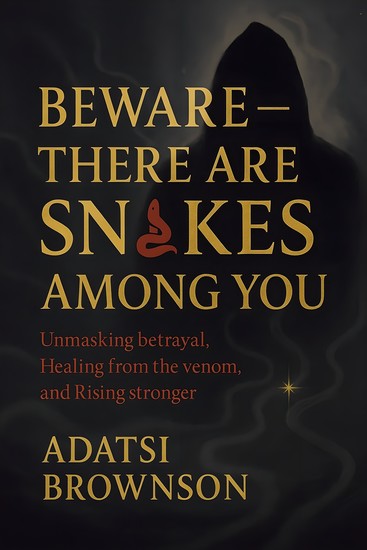
Beware – There Are Snakes Among You - Unmasking Betrayal Healing from the Venom and Rising Stronger - cover

Beware – There Are Snakes Among You - Unmasking Betrayal Healing from the Venom and Rising Stronger

Brownson Adatsi

Publisher: Publishdrive

  • 0
  • 0
  • 0

Summary

Not all snakes hiss. Some smile. Some say “sorry.” Some stay silent when you’re bleeding.
 
In Beware — There Are Snakes Among You, Adatsi Brownson unpacks the raw, relatable realities of betrayal — from friends, lovers, leaders, and even yourself. Blending memoir and reflection, this book is a guide for those who have been hurt, silenced, or manipulated.
 
This is not just a story of pain. It’s a blueprint for healing, setting boundaries, and walking boldly into wholeness.
Available since: 07/15/2025.
Print length: 178 pages.


Other books that might interest you

  • Calm in the Chaos - True Tales from Elite US Navy Aviation Rescue Swimmers - cover

    Calm in the Chaos - True Tales...

    Brian Dickinson

    • 0
    • 0
    • 0
    From an elite Navy rescue swimmer comes this insider perspective on what it takes to survive some of the most dangerous situations imaginable—and how the lessons learned can help overcome other momentous challenges. 


    Brian Dickinson, famously known for having climbed down Mt. Everest while completely snow blind, is often asked how he managed the incredible feat. He has always attributed it to his faith and to his U.S. Navy Search and Rescue Training. For the first time, Brian takes an in-depth look at the training that saved his life and the missions—both his and others'—where these skills were put to the test to save other people. 


    Over two decades after being honorably discharged from the Navy, Brian is compelled to share his unique military training and experiences. He believes that sharing the training that he received to overcome adversity in the most extreme scenarios can help others to overcome their own personal Everest. Even beyond mountaineering, the military training has rewired Brian's ability to navigate difficult business, financial, health, and relationship challenges. With the chaos of the world continuing to expand, these stories from U.S. Navy rescue swimmers provide a fresh perspective on what it takes to survive some of the most dangerous situations, and how that shapes the rest of a person's life.
    Show book
  • Reclaiming Our Democracy - Every Citizen’s Guide to Transformational Advocacy 2024 Edition - cover

    Reclaiming Our Democracy - Every...

    Sam Daley-Harris

    • 0
    • 0
    • 0
    Almost everyone shies away from advocacy as a way to make a difference. We donate to climate change organizations, but we don’t meet with a member of Congress or write a letter to the editor. We donate to groups working to end gun violence, anti-hunger organizations, groups dedicated to racial justice, and many others, but we don’t become advocates on those issues beyond signing an online petition or going to an occasional rally.   
    	Why? Because most of us see advocacy as too hard or too frustrating, too complicated, or too partisan, too dirty or too time-consuming, too ineffective or too costly. 
    	But what if that’s all wrong? What if deep engagement dissolves discouragement and can actually bring joy? What if you can become an advocate for a cause you care about and feel fulfilled, not frustrated? And what if engaging as an advocate is essential to protecting our democracy? 
    	President Jimmy Carter called the first edition of Reclaiming Our Democracy “A road map for global involvement in planning a better future.” In this completely revised and updated 2024 edition, Sam Daley-Harris uses his decades of experience leading and coaching citizens’ advocacy groups to expand that road map and create an indispensable guide to engaged citizenship, an inspiring master class in transformational advocacy. 
    	Reclaiming Our Democracy provides a powerful way to make a difference and heal our democracy in the process. It’s not the only solution needed, but is one essential, missing piece: citizens awakening to their power.
    Show book
  • Spanish Empire in the Americas The: The History of Spain’s Colonization across Central America and South America - cover

    Spanish Empire in the Americas...

    Editors Charles River

    • 0
    • 0
    • 0
    By the time Christopher Columbus started setting east from the New World, he had explored San Salvador in the Bahamas (which he thought was Japan), Cuba (which he thought was China), and Hispaniola, the source of gold. As the common story goes, Columbus, en route back to Spain from his first journey, called in at Lisbon as a courtesy to brief the Portuguese King John II of his discovery of the New World. King John subsequently protested that according to the 1479 Treaty of Alcáçovas, which divided the Atlantic Ocean between Spanish and Portuguese spheres of influence, the newly discovered lands rightly belonged to Portugal. To make clear the point, a Portuguese fleet was authorized and dispatched west from the Tagus to lay claim to the “Indies,” which prompted a flurry of diplomatic activity in the court of Ferdinand and Isabella. At the time, Spain lacked the naval power to prevent Portugal from acting on this threat, and the result was the hugely influential 1494 Treaty of Tordesillas. 
    	The Treaty of Tordesillas was one of the most important documents of its kind of the age, for it established the essential parameters of the two competing empires, the first of the major European imperial entities. The Treaty of Tordesillas drew an imaginary line from pole to pole, running 100 leagues west of the westernmost islands of the Azores. According to the terms of a supporting papal bull, all the lands to the west of that belonged to Spain, and all of those to the east belonged to Portugal. What this meant in practical terms was that Portugal was given Africa and the Indian Ocean while Spain was granted all the lands to the west, including the Americas and the Caribbean, all collectively known as the “Indies,” or the New World. Perhaps inevitably, a regional rivalry had developed as the Portuguese began to establish a colony in Brazil and push its boundaries southwards. 
    Show book
  • Laura Ingalls Wilder - A Storybook Life - cover

    Laura Ingalls Wilder - A...

    Janet Benge, Geoff Benge

    • 0
    • 0
    • 0
    Laura stared at the black cloud blotting out the sun. The cloud was unlike anything she had ever seen. As it got closer, it made a strange noise, like hail pelting the ground. Suddenly the sky began to rain grasshoppers. The bugs clung to Laura's hair and clothes and peered at her with bulging eyes. Soon they began destroying Papa's crops. From the big woods of Wisconsin to the Indian country of the Great Plains, new adventures and landscapes filled the rich childhood of Laura Ingalls Wilder. On a frontier steeped in both danger and great possibility, Laura would grow up to witness firsthand the rapid transformation of the West as pioneers and covered wagons gave way to farms, towns, and railroads. A pioneer, teacher, farmer's wife, and storyteller, Laura Ingalls Wilder experienced one of the most exciting times in American history -- history that this gifted writer brought to life for millions and preserved for generations to come.
    Show book
  • The Prince - cover

    The Prince

    Niccolò Machiavelli

    • 0
    • 0
    • 0
    The Prince is a 16th-century political treatise by the Italian diplomat and political theorist Niccolo Machiavelli. From correspondence a version appears to have been distributed in 1513, using a Latin title, De Principatibus (Of Principalities). However, the printed version was not published until 1532, five years after Machiavelli's death. This was done with the permission of the Medici pope Clement VII, but "long before then, in fact since the first appearance of The Prince in manuscript, controversy had swirled about his writings". Although it was written as if it were a traditional work in the mirrors for princes style, it is generally agreed that it was especially innovative. Niccolò Machiavelli, belongs to such prominent Florentines as Dante Alighieri, Petrarch, Giovanni Boccaccio, Michelangelo, Leonardo da Vinci and Botticelli
    Show book
  • The Occult Significance of Blood - cover

    The Occult Significance of Blood

    Rudolf Steiner

    • 0
    • 0
    • 0
    Why is it that throughout the ages - across countless cults, cultures and civilizations - blood has held so much importance? From mate selection and maintaining lineages, to alleged "deals with the devil", blood sacrifices and other rites, clearly there is some hidden or secret significance to the blood that courses throughout our bodies. With this work, prolific author-scholar Rudolf Steiner offers us his insightful investigations.
    Show book