Join us on a literary world trip!
Add this book to bookshelf
Grey
Write a new comment Default profile 50px
Grey
Subscribe to read the full book or read the first pages for free!
All characters reduced
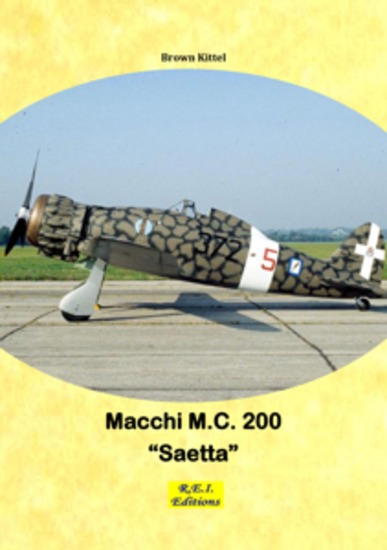
Macchi MC 200 "Saetta" - cover

Macchi MC 200 "Saetta"

Brown Kittel

Publisher: R.E.I. Editions

  • 0
  • 0
  • 0

Summary

The Macchi M.C. 200 “Saetta”, designed by the famous engineer Mario Castoldi, represented a significant evolution in the production of Italian fighter aircraft.Compared to the Fiat CR 32 and Fiat CR 42 biplanes, which still constituted the backbone of Italian fighter squadrons at the beginning of the Second World War, the Macchi M.C. 200 was characterized, together with its contemporary Fiat G.50, by a low-wing configuration and an all-metal structure.It made its first flight on 24 December 1937 and entered service in 1939: although equipped with a low-powered engine and armed only with a pair of 12.7 mm Breda-SAFAT machine guns, the Saetta’s design was very valid.	The Macchi M.C. 200 had no particular defects and was equipped with excellent capabilities for close combat.In fact, its handling was excellent and its stability in high-speed dives was exceptional: it could thus duel with the best Allied fighters and come out undefeated.	Only the Supermarine Spitfire could outperform it in a climb.On the other hand, its good flight characteristics were offset by low engine power, a barely sufficient horizontal speed and inadequate armament of only two 12.7 mm machine guns in the fuselage, synchronized for firing through the propeller.With the insignia of the Regia Aeronautica, it operated on almost all fronts of the Second World War, from the Mediterranean Sea to Africa, the Balkans and on the Eastern Front.The Macchi M.C. 200s were built:	By Aer.Macchi: 395 examples.	By Breda, which actually built the largest number: 556 examples.	By SAI Ambrosini: 223 examples. 
Available since: 03/05/2025.
Print length: 114 pages.
Other books that might interest you

  • No Son of Mine - A Memoir - cover

    No Son of Mine - A Memoir

    Jonathan Corcoran

    • 0
    • 0
    • 0
    Jonathan Corcoran was the youngest and only son of three siblings in a family balanced on the precipice of poverty. His mother, a traditional, evangelical, and insular woman who had survived abuse and abandonment, was often his only ally. Together they navigated a strained homelife dominated by his distant, gambling-addicted father and shared a seemingly unbreakable bond. 


    When Corcoran left home to attend Brown University, a chasm between his upbringing and his reality began to open. As his horizons and experiences expanded, he met the upper-middle-class Jewish man who would become his husband. But this authentic life would not be easy, and Corcoran was forever changed when his mother disowned him after discovering his truth. In the ensuing fifteen years, the two would come together only to violently spring apart. As the COVID-19 pandemic raged in 2020, the cycle finally ended when he received the news that his mother had died. 


    In No Son of Mine, Corcoran traces his messy estrangement from his mother through lost geographies as well as the lost relationships with friends and family and the sense of home that were stripped away when she said he was no longer her son. Through grief, anger, questioning, and growth, Corcoran explores the entwined yet separate histories and identities of his mother and himself.
    Show book
  • Village Labourer 1760-1832 The: A Study in the Government of England before the Reform Bill - cover

    Village Labourer 1760-1832 The:...

    James L Hammond, Barbara...

    • 0
    • 0
    • 0
    Many histories have been written of the governing class that ruled England with such absolute power during the last century of the old régime. Those histories have shown how that class conducted war, how it governed its colonies, how it behaved to the continental Powers, how it managed the first critical chapters of our relations with India, how it treated Ireland, how it developed the Parliamentary system, how it saved Europe from Napoleon. One history has only been sketched in outline: it is the history of the way in which this class governed England. The writers of this book have here attempted to describe the life of the poor during this period. It is their object to show what was in fact happening to the working classes under a government in which they had no share. They found, on searching through the material for such a study, that the subject was too large for a single book; they have accordingly confined themselves in this volume to the treatment of the village poor, leaving the town worker for separate treatment. It is necessary to mention this, for it helps to explain certain omissions that may strike the reader.The growth and direction of economic opinion, for example, are an important part of any examination of this question, but the writers have been obliged to reserve the consideration of that subject for their later volume, to which it seems more appropriate. The writers have also found it necessary to leave entirely on one side for the present the movement for Parliamentary Reform which was alive throughout this period, and very active, of course, during its later stages.Two subjects are discussed fully in this volume, they believe, for the first time. One is the actual method and procedure of Parliamentary Enclosure; the other the labourers’ rising of 1830. Nowhere can the student find a full analysis of the procedure and stages by which the old village age was destroyed. The rising of 1830 is covered as well.
    Show book
  • Trail of Tears - The Cruel Forced Displacement of 60000 American Natives - cover

    Trail of Tears - The Cruel...

    Kelly Mass

    • 0
    • 0
    • 0
    The Trail of Tears was a harrowing series of forced relocations that took place between 1830 and 1850, impacting approximately 60,000 American Indians from the so-called "Five Civilized Tribes." These tribes, which included the Cherokee, Muscogee (Creek), Seminole, Chickasaw, and Choctaw nations, were driven from their ancestral lands in the Southeastern United States to designated areas west of the Mississippi River, an event orchestrated by the United States government. The forced removal was the culmination of a decades-long process of ethnic cleansing that occurred gradually, as tribes were stripped of their homelands, cultural identities, and livelihoods. Alongside them, thousands of African American slaves owned by these tribes were also relocated, compounding the tragedy. 
    The Indian Removal Act, passed in 1830, paved the way for the systematic relocation of these tribes. It was during this period that the Cherokee removal in 1838—often considered the most infamous and final forced relocation east of the Mississippi—occurred. This event was largely triggered by the discovery of gold in Dahlonega, Georgia, in 1828, which sparked the Georgia Gold Rush. The prospect of wealth led state officials and settlers to covet Cherokee land, ultimately resulting in the forced march to the newly designated "Indian Territory" in what is now Oklahoma.
    Show book
  • Extortion 17’s Why - An Analysis of Narratives by Alan Howell Parrot - cover

    Extortion 17’s Why - An Analysis...

    Align Kaizen, Alan Hallow...

    • 0
    • 0
    • 0
    On August 6, 2011, a tragic event unfolded when Extortion 17, a Chinook helicopter, was shot down, resulting in the loss of 30 American servicemen, including 17 Navy SEALs from the legendary SEAL Team 6. It marked the largest loss of life during the War on Terror, a war America was told started because of Osama bin Laden and 9/11. 
    In Alan Parrot's narratives, an oral history captured by Nick Noe, he puts tragic events, including 9/11, Benghazi, and Extortion 17, into perspective. Alan, an Arabist, spent much of his life with royalty in the Middle East and learned about such national tragedies through observation, conversations, and omission. He explains how diplomatic immunity played a role in 9/11 and details the weapons transfer that resulted in the tragedy in Benghazi.  
    Behind these heart-wrenching incidents lies a web of secrecy and deception. Startling revelations have come to light, thanks to the evidence shared with the grief-stricken Gold Star families during the debrief. Astonishingly, it appears that Extortion 17 was not a random act of war, but rather a meticulously orchestrated setup. The threads of this conspiracy can be traced back to the historic Osama bin Laden raid, a mere three months prior, and thus 9/11. 
    Within the pages of this gripping book, you will embark on an extraordinary journey of discovery. Delve into the enigmatic concept of diya, the key that unlocks the truth behind Extortion 17. Unveiling secrets known to only a privileged few, Extortion 17's Why illuminates the darkest corners of a clandestine world. 
    Prepare to be captivated by a tale that challenges your perception of reality and sheds light on the shadows. Are you ready to unravel the mysteries and uncover the untold story of Extortion 17?
    Show book
  • Unmasking Deception - A Modern Guide to Media Literacy in an Age of Misinformation - cover

    Unmasking Deception - A Modern...

    Aaron Jaeger

    • 0
    • 0
    • 0
    In a world flooded with fake news, clickbait, and manipulated narratives, how do we separate truth from deception? This book takes you on a journey through the murky waters of modern media and politics, exposing the tactics used to misinform and divide us. 
    From Orwellian levels of doublespeak to the rise of AI-generated propaganda, Unmasking Deception offers a no-nonsense, deeply critical look at how we got here - and how we can fight back. Drawing on history, psychology, and the author's two decades of media experience, this guide arms readers with the tools to spot manipulation, challenge disinformation, and build bridges in an ever increasingly polarised world. 
    Packed with real-world examples, practical takeaways, and sharp insights, this book is not just a call to action - it’s a toolkit for anyone ready to champion truth in an era of misinformation and lies. 
    Knowledge is power. Action is freedom. It’s time to unmask the lies.
    Show book
  • Ӕthelflӕd - The Lady of the Mercians - cover

    Ӕthelflӕd - The Lady of the...

    Tim Clarkson

    • 0
    • 0
    • 0
    This Dark Ages biography chronicles the life of one of the period's most famous women: the ruler of Mercia who took England back from the Vikings. 


    At the end of the ninth century, a large part of what is now England was controlled by the Vikings—warlike Scandinavians who had been attacking the British Isles for more than a hundred years. Alfred the Great, king of Wessex, was determined to regain the conquered lands. But when he died in 899 A.D., the task passed to his son Edward. In the early 900s, Edward led a great fight against the Viking armies, assisted by the English rulers of Mercia: Lord Æthelred and his wife Æthelflæd, who was also Edward's sister. 


    After her husband's death, Æthelflæd ruled Mercia on her own, leading the army to war and working with her brother to achieve their father's aims. Known to history as the Lady of the Mercians, she earned a reputation as a capable general who was feared by her enemies. In this authoritative biography, Tim Clarkson tells her remarkable life story from childhood to her vital role in saving England from the Vikings.
    Show book