Join us on a literary world trip!
Add this book to bookshelf
Grey
Write a new comment Default profile 50px
Grey
Subscribe to read the full book or read the first pages for free!
All characters reduced
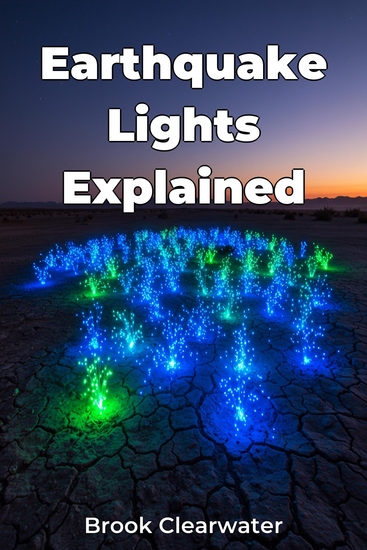
Earthquake Lights Explained - cover

Earthquake Lights Explained

Brook Clearwater

Translator A AI

Publisher: Publifye

  • 0
  • 0
  • 0

Summary

Earthquake Lights Explained explores the intriguing phenomenon of earthquake lights (EQLs), luminous displays sometimes seen before or during seismic events. These unusual geophysical events have captivated observers for centuries, and this book delves into the science behind them, examining eyewitness accounts, competing theories, and laboratory experiments. While the exact cause of EQLs remains a subject of debate, research suggests they are a real phenomenon, potentially linked to tectonic stresses and the electrical properties of rocks. Some theories propose that stress-induced charge separation or the piezoelectric effect could play a role, generating electrical fields that produce light. 

 
The book takes a comprehensive approach, starting with the historical context of EQL sightings and introducing key concepts from seismology and geophysics. It analyzes eyewitness reports, evaluates the reliability of the evidence, and explores various scientific theories attempting to explain EQLs. Laboratory experiments designed to simulate earthquake conditions provide valuable insights into the possible mechanisms behind these lights. The book progresses through analyzing evidence, exploring scientific theories, and presenting findings from lab experiments. 

 
By connecting EQL research to fields like atmospheric science and materials science, Earthquake Lights Explained offers a unique interdisciplinary perspective. Understanding EQLs could potentially contribute to improved earthquake early warning systems, highlighting the real-world applications of this fascinating area of earth science.
Available since: 05/01/2025.
Print length: 77 pages.

Other books that might interest you

  • Secrets of the Forest: Unearthing Hidden Wisdom - Unlock Forest Secrets: Use Our Audio Insights to Master Hidden Wisdom Efficiently! - cover

    Secrets of the Forest:...

    Heath Rowan

    • 0
    • 0
    • 0
    Explore professionally as you delve into the mysteries of the forest and uncover its hidden wisdom. 
    Are you eager to advance in your professional life and deepen your knowledge by exploring the secrets of nature? 
    Looking for an all-inclusive guide that equips you with the insights gleaned from the forest's mysteries? 
    Look no further! 
    This resource is your ultimate guide to enhancing your understanding, applying your skills, and participating in hands-on exercises. Prepare yourself for a journey of discovery. 
    Updated with the latest understandings from the forest's secrets. 
    Key features of this comprehensive guide: 
    - Deep insights inspired by nature 
    - Detailed explanations of the profound wisdom hidden within the forest 
    - Effective strategies for embracing and applying these natural revelations 
    Our guide stands out by providing extensive coverage, essential for mastering the insights derived from nature. Ideas are not superficially covered; they are explored with great depth and accuracy. 
    Please note, this guide is an independent resource designed purely for your enrichment and is not affiliated with any official forest authority. 
    Crafted in an organized structure and straightforward language, our guide ensures smooth transitions between topics. Say goodbye to complex language and welcome clear, precise, and technically accurate content. 
    So, why wait? Click the BUY NOW button, secure your copy, and embark on your journey to unlocking the wisdom of the forest! 
    Discover the secrets nestled within forest depths and transform your understanding today!
    Show book
  • From Big Bang to Black Holes - The Influence of Dark Space - cover

    From Big Bang to Black Holes -...

    Dirk Fallon

    • 0
    • 0
    • 0
    The origins of the universe are a subject of profound scientific interest and philosophical debate. The most widely accepted explanation for the birth of the cosmos is the Big Bang Theory. According to this theory, the universe began as an incredibly hot, dense point around 13.8 billion years ago. This singularity contained all of the matter and energy that would eventually form stars, galaxies, planets, and everything else that makes up the cosmos. 
    The event itself wasn’t an explosion in the traditional sense but a rapid expansion of space itself. Immediately following the Big Bang, the universe began to expand exponentially, a process known as cosmic inflation. During this phase, the universe grew from smaller than the size of an atom to a vast, nearly infinite expanse in an instant. The rapid expansion allowed matter and energy to cool, leading to the formation of elementary particles such as quarks, electrons, and neutrinos. As the universe continued to expand and cool, quarks combined to form protons and neutrons, which eventually led to the creation of simple atomic nuclei like hydrogen and helium. 
    After hundreds of thousands of years, the universe cooled enough for electrons to combine with protons and form neutral hydrogen atoms. This allowed light to travel freely, marking the beginning of what is known as the "cosmic dark ages." During this time, the universe was nearly invisible to the human eye, as light was scattered by free electrons. Eventually, gravity began to take hold, pulling matter together to form the first stars and galaxies.
    Show book
  • Swing Trading for Beginners - cover

    Swing Trading for Beginners

    Ryan Martinez

    • 0
    • 0
    • 0
    #1 Book on Swing TradingHow successful you are at swing trading does not depend on the number of hours you put into it, but rather your overall skills and discipline as a trader. This book shall help you get started on the right track and then progress into the more advanced level later on.Each chapter contains a thorough discussion of the general principles of swing trading so that you will have a solid foundation where you could build and develop your trading strategies and plan.Topics that are covered in this book are as follow:Creating a trading plan that worksHelpful tips for beginner tradersList of critical mistakes to avoid in swing tradingHighly recommended trading tools, platforms, and other resourcesFiguring out the right trading approach, style, and strategyUnderstanding and analyzing stock chartsApplying technical indicators on market analysisStrategies for trend trading and trading rangesManaging risks on an individual security and portfolio levelsEvaluating trades as a means of further improving as a swing traderSwing trading can be a profitable and rewarding endeavor if you know what you are doing. Let’s get you closer towards that ideal by going over each chapter and paying attention to the lessons that you may extract from real-world examples given across different chapters of this book.
    Show book
  • Creating Space - Story Reflection and Practice in Healthcare Chaplaincy - cover

    Creating Space - Story...

    Sacha Pearce, Jan Collis

    • 0
    • 0
    • 0
    Creating Space tells a professional and personal story of healthcare chaplaincy and models the way in which practice development emerges from reflecting on the human story. This book reveals to healthcare, the Church and the community, the unique role of the chaplain’s experiences as a resource to others. It is written for professional practitioners, prompting their own contextual learning and development, whether as chaplains, pastoral carers, parish clergy, lay ministers, volunteers in any caring context, those who work in listening therapies, those who provide care and support to others of any kind, or those who use or teach reflective practice.
    
     
    The authors connect in a straightforward way their view of healthcare chaplaincy as a model of practical theology, based on key practical theologians who see the human story as a source of learning. They outline their own reflective practice tool for learning and share the way in which they see each pastoral encounter as a reflective source of learning. They discover how their experiences have developed the discernment process for chaplaincy vocation, urging the Church to see beyond the parish model in today’s world.
    Show book
  • Chiropractics - The Art and Science of Chiropractic Care - cover

    Chiropractics - The Art and...

    Kevin Thorley

    • 0
    • 0
    • 0
    The evolution of chiropractic practices reflects a broader trend towards integrating alternative and complementary therapies into mainstream healthcare, emphasizing a more holistic and patient-centered approach. 
    Evidence-based practice (EBP) in healthcare, including chiropractic care, involves integrating the best available research evidence with clinical expertise and patient preferences to make informed decisions about patient care. This approach aims to ensure that treatments and interventions are effective, safe, and tailored to individual patient needs. 
      
    EBP relies on three main components: the best available research evidence, clinical expertise, and patient preferences and values. The best available research evidence refers to high-quality, peer-reviewed studies and clinical trials that provide reliable data on the effectiveness and safety of various treatments and interventions. Systematic reviews and meta-analyses are particularly valuable as they synthesize findings from multiple studies, offering a comprehensive overview of the evidence. 
      
    Clinical expertise encompasses the knowledge and skills of healthcare professionals in interpreting research evidence and applying it to individual patient cases. It involves understanding the nuances of different conditions, recognizing which treatments are most appropriate, and adapting interventions based on patient responses.
    Show book
  • Mining - The Technology and Engineering of Mining - cover

    Mining - The Technology and...

    Daniel Shore

    • 0
    • 0
    • 0
    Mining is the process of extracting valuable minerals or other geological materials from the earth. It involves various techniques such as drilling, blasting, and excavation to access deposits underground or from the surface. These minerals can include coal, metals, gemstones, and oil shale, among others. Mining plays a crucial role in supplying raw materials for various industries, from construction to manufacturing, but it also poses environmental and social challenges that require careful management and regulation.
    Show book