Junte-se a nós em uma viagem ao mundo dos livros!
Adicionar este livro à prateleira
Grey
Deixe um novo comentário Default profile 50px
Grey
Assine para ler o livro completo ou leia as primeiras páginas de graça!
All characters reduced
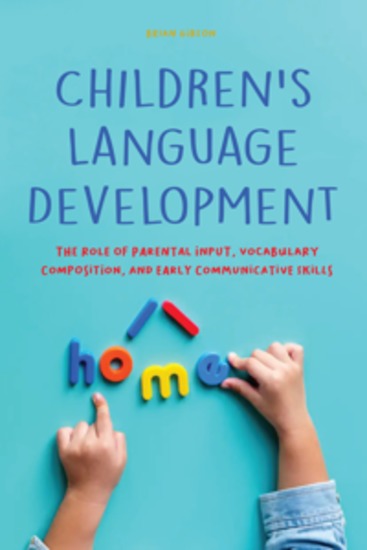
Children's Language Development - cover
LER

Children's Language Development

Brian Gibson

Editora: Brian Gibson

  • 0
  • 0
  • 0

Sinopse

Children's Language Development: The Role of Parental Input, Vocabulary Composition, and Early Communicative Skills explores how young children acquire language through early interactions with caregivers. Drawing on research in developmental psychology and linguistics, this book highlights parents' critical role in shaping vocabulary growth, sentence complexity, and communicative competence during the earliest years of life. Through evidence-based insights and real-world examples, it offers practical guidance for fostering rich language environments that support strong cognitive and social outcomes.
Disponível desde: 06/05/2025.

Outros livros que poderiam interessá-lo

  • Doomsday: The End Is Near - cover

    Doomsday: The End Is Near

    Raphael Terra

    • 0
    • 0
    • 0
    This audiobook has been recorded using Text to speech (TTS). 
     
    According to the Doomsday Clock, we, as a planet populated by humans with nowhere else to go, have 100 seconds left to live. 
     
    Humanity teeters on the brink of self-destruction. While this sounds like the start of an apocalyptic disaster movie, it is in fact, reality. This is the worrying fact of life in the 21st Century. 
     
    The Doomsday Clock is a warning of man’s ability to create something that could destroy everything - humanity’s very existence. It is a count-down timer to the point of no return – humanity’s doomsday. 
     
    It symbolizes how close we, as a species, have come to destroying the world with dangerous man-made technologies. The deadline of Midnight represents the moment of apocalypse, and how close the clock is set to that deadline warns how close humanity is to ultimate disaster. 
     
    With the intention of warning the public and inspiring action, the clock’s hands are set in accordance to how great is the threat of destruction. 
     
    Now, in the 21st century we are closer to Doomsday than ever before.
    Ver livro
  • From Aristotle to Christ - How Aristotelian Thought Clarified the Christian Faith - cover

    From Aristotle to Christ - How...

    Louis Markos

    • 0
    • 0
    • 0
    Credo Book Award Winner—Natural Theology
    Discover how Aristotelian thought has shaped Christianity through history and remains relevant for Christians today
    When Christians of any age, country, or denomination debate the nature of the good life, the soul, free will, or design, Aristotle lies behind their logic as well as their rhetoric. Although Aristotle did not have access to the Bible's special revelation, he made full use of general revelation to arrive at deep truths about the nature of God, human identity, and the universe. In the Catholic Middle Ages the spiritual vision that undergirded Dante's Divine Comedy was strongly indebted to Aristotle's cosmology, and in the Protestant Reformation and Enlightenment the social vision of a well-run state was equally indebted to his political science.
    In a follow up to his well-loved book From Plato to Christ, renowned scholar Louis Markos takes us on a vigorous and celebratory journey through the work of Plato's greatest student, demonstrating Aristotle's often unacknowledged influence on the Christian faith. In Markos's hands, Aristotle is far from an irrelevant ancient philosopher but is instead an important conversation partner for some of history's greatest Christian thinkers and a thoughtful guide to today's most challenging questions.
    With this book, you'll:
    
    - Consider the influence of Aristotle's thought on the Christian faith,
    - Carefully analyze several of Aristotle's best-known texts,
    - Trace Aristotle's influence upon many key theologians in Christian history, and
    - Understand Aristotle's continuing importance for Christians today.
    This book is a perfect addition to any classroom that seeks to understand how classical thought intersects with Christianity, both past and present. Grab your copy today and explore the relationship between Aristotelian philosophy and Christianity.
    Ver livro
  • The Legacy of Akhenaten - The Heretic Pharaoh and His Revolution - cover

    The Legacy of Akhenaten - The...

    Omar Khalil

    • 0
    • 0
    • 0
    Akhenaten, originally named Amenhotep IV, emerged as one of ancient Egypt’s most enigmatic and controversial pharaohs. His rise to power marked the beginning of a transformative period in Egyptian history, characterized by significant religious, cultural, and political changes. Born into the illustrious 18th Dynasty, Akhenaten was the son of Amenhotep III and Queen Tiye. As a young prince, he was not initially destined for the throne, but circumstances eventually positioned him as the successor. 
    Upon ascending to the throne, Akhenaten quickly distinguished himself from his predecessors. Unlike his father, whose reign was marked by prosperity and relative stability, Akhenaten pursued a path that would challenge long-established traditions. Initially, he ruled under the name Amenhotep IV, signifying continuity with the Amun-centric religious practices. However, early in his reign, he began to favor the worship of Aten, the sun disk, over the traditional pantheon. This inclination marked the first signs of his radical departure from convention. 
    One of the most significant acts of his reign was the changing of his name from Amenhotep IV to Akhenaten, which means "Effective for Aten." This change was not merely symbolic but an open declaration of his devotion to Aten, marking a clear break from the established worship of Amun and other deities. By adopting this new identity, Akhenaten positioned himself as the earthly representative of the sun disk, consolidating both religious and political authority in his hands.
    Ver livro
  • The Museum - A Short History of Crisis and Resilience - cover

    The Museum - A Short History of...

    Samuel J. Redman

    • 0
    • 0
    • 0
    On an afternoon in January 1865, a roaring fire swept through the Smithsonian Institution. Dazed soldiers and worried citizens could only watch as the flames engulfed the museum's castle. Rare objects and valuable paintings were destroyed. The flames at the Smithsonian were not the first—and certainly would not be the last—disaster to upend a museum in the United States. 


    The Museum explores the concepts of "crisis" as it relates to museums, and how these historic institutions have dealt with challenges ranging from depression and war to pandemic and philosophical uncertainty. With chapters exploring World War I and the 1918 influenza pandemic, the Great Depression, World War II, the 1970 Art Strike in New York City, and recent controversies in American museums, this book takes a new approach to understanding museum history. By diving deeper into the changes that emerged from these key challenges, Samuel J. Redman argues that cultural institutions can—and should—use their history to prepare for challenges and solidify their identity going forward. A captivating examination of crisis moments in US museum history from the early years of the twentieth century to the present day, The Museum offers inspiration in the resilience and longevity of America's most prized cultural institutions.
    Ver livro
  • Executive Functioning and Psychotherapy - The New Neuroscience of Adaptive Intelligence - cover

    Executive Functioning and...

    Louis Cozolino, Carly Trissler,...

    • 0
    • 0
    • 0
    A new model of executive functioning which illuminates the somatic, social, and emotional influences on how we make decisions. 
     
    Executive functioning (EF) can be defined as a person's ability to successfully navigate their physical, intellectual, and social worlds. Interest in EF is expanding within psychotherapy, but like many scientific concepts which are adapted to the consulting room, there is a great deal of confusion and misinformation surrounding EF within clinical and lay communities. 
     
    In this book, Louis Cozolino—a master of translating complex neuroscientific concepts into digestible, applicable literature for therapists and laypeople alike—is joined by experts Chloe Drulis and Carly Trissler to illuminate how our brains and minds successfully navigate the challenges of day—to—day life. The book offers a new, neurodynamic model of EF that explains the three main executive systems in the brain and the specific ways that they influence how we think, focus, and solve problems. This neurobiological framework highlights the interconnectedness of cognition, emotion, and relationships, providing readers with a deeper understanding of how humans function and strategies to improve outcomes in therapy, parenting, executive coaching, and personal development.
    Ver livro
  • Baltic Mythology Collection - cover

    Baltic Mythology Collection

    Niina Niskanen

    • 0
    • 0
    • 0
    Baltic mythology, rooted in the ancient traditions of the Latvian and Lithuanian peoples, offers a fascinating glimpse into the beliefs, values, and spiritual practices that shaped the lives of their ancestors. This collection brings together a wealth of stories that have been passed down through generations, revealing a world where the forces of nature, deities, and mythical beings play central roles in the human experience. 
    The Baltic region, encompassing the modern nations of Latvia and Lithuania, has a rich cultural heritage that is deeply intertwined with its mythology. Unlike many other European mythologies that have been heavily influenced by outside cultures, Baltic mythology has retained a remarkable degree of authenticity, preserving the essence of its pre-Christian beliefs. This collection is a celebration of that heritage, offering readers an opportunity to explore the unique and often mysterious world of Baltic myths. 
    This book is an invitation to explore the rich tapestry of Baltic mythology, to discover the stories that have shaped the identity of the Latvian and Lithuanian peoples, and to appreciate the depth and beauty of this ancient tradition. Whether you are a scholar, a folklore enthusiast, or simply curious about the myths that have shaped this region, this collection will provide you with a deeper understanding of the Baltic world and its enduring legacy.
    Ver livro