Join us on a literary world trip!
Add this book to bookshelf
Grey
Write a new comment Default profile 50px
Grey
Subscribe to read the full book or read the first pages for free!
All characters reduced
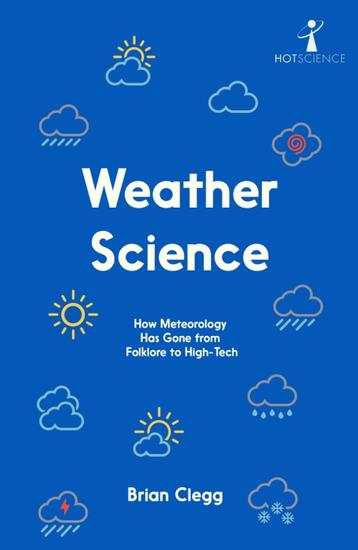
Weather Science - How Meteorology Has Gone from Folklore to High-Tech - cover

Weather Science - How Meteorology Has Gone from Folklore to High-Tech

Brian Clegg

Publisher: Icon Books

  • 0
  • 0
  • 0

Summary

Everyone has an interest in the weather, whether it's to check the prospects for a day out or to know when best to harvest a crop. The Earth's weather systems also provide some of the most dramatic forces of nature, from the vast release of energy in a lightning flash to the devastating impact of tornadoes and hurricanes.

For centuries, our only real guide to future weather was folklore, but with the introduction of the first weather forecasts and maps in Victorian times, attempts were made to give some warning of the weather to come. Until relatively recently, these forecasts could be wildly inaccurate - think of Michael Fish's denial that there was a storm on the way the night before the UK's great storm of 1987. This was due to the mathematically chaotic nature of weather systems, first discovered in the 1960s, the understanding of which would transform forecasting from the 1990s and mean that meteorologists became some of the foremost users of supercomputers.

From the crystalline perfection of the snowflake to the transfer of energy from the Sun, science lies at the heart of the weather and our understanding of it. In recent years, weather science has moved to the leading edge with advanced modelling, versatile use of satellite data and a better understanding of mathematical chaos. This is a true example of hot science at work.
Available since: 07/18/2024.
Print length: 192 pages.

Other books that might interest you

  • Our Once and Future Planet - Restoring the World in the Climate Change Century - cover

    Our Once and Future Planet -...

    Paddy Woodworth

    • 0
    • 0
    • 0
    The environmental movement is plagued by pessimism. And that’s not unreasonable: with so many complicated, seemingly intractable problems facing the planet, coupled with a need to convince people of the dangers we face, it’s hard not to focus on the negative But that paints an unbalanced—and overly disheartening—picture of what’s going on with environmental stewardship today. There are success stories, and Our Once and Future Planet delivers a fascinating account of one of the most impressive areas of current environmental experimentation and innovation: ecological restoration. Veteran investigative reporter Paddy Woodworth has spent years traveling the globe and talking with people—scientists, politicians, and ordinary citizens—who are working on the front lines of the battle against environmental degradation. At sites ranging from Mexico to New Zealand and Chicago to Cape Town, Woodworth shows us the striking successes (and a few humbling failures) of groups that are attempting to use cutting-edge science to restore blighted, polluted, and otherwise troubled landscapes to states of ecological health—and, in some of the most controversial cases, to particular moments in historical time, before widespread human intervention. His firsthand field reports and interviews with participants reveal the promise, power, and limitations of restoration. Ecological restoration alone won’t solve the myriad problems facing our environment. But Our Once and Future Planet demonstrates the role it can play, and the hope, inspiration, and new knowledge that can come from saving even one small patch of earth.
    Show book
  • Forex Trading Fundamentals - A Comprehensive Guide to Currency Market Success - cover

    Forex Trading Fundamentals - A...

    Michael Lewis

    • 0
    • 0
    • 0
    Expertly written, "Forex Trading Fundamentals: A Comprehensive Guide to Currency Market Success" aims to simplify the intricacies of the foreign exchange market. This book is for both experienced traders trying to improve their tactics and novices ready to start trading Forex. It provides a complete foundation in the ideas and procedures necessary for properly negotiating the international currency markets. 
    A historical summary of Forex trading at the start of the book prepares readers for a more in-depth examination of its development and importance in the modern financial environment. The structure of the Forex market is explained to readers, together with the responsibilities of important participants, including central banks, financial institutions, and individual traders. In her careful explanations of basic ideas, the author highlights how interest rates, exchange rates, and economic indices affect the values of currencies. 
    "Forex Trading Fundamentals" offers fundamental information together with useful advice on creating winning trading plans. Because it combines fundamental and technical analysis, readers may confidently analyze market movements and data. With techniques to reduce possible losses and improve trading results, the book also discusses the vital need for risk management. 
     This book stands out in part because it emphasizes the psychological aspects of trading. Knowing that trading success is mainly determined by attitude, the book looks at methods for preserving emotional control and discipline. 
     Rich with case studies and real-world examples, "Forex Trading Fundamentals" is a complete toolset for everyone who is serious about learning the Forex market. Any trader's library would benefit from it since it gives readers the information and abilities they need to succeed in the currency market.
    Show book
  • Machine Learning with Python - Advanced Methods and Strategies to Learn Machine Learning with Python - cover

    Machine Learning with Python -...

    Alexander Cane

    • 0
    • 0
    • 0
    Ways to combat retraining depend on the algorithm and consist of the correct values of the trainer's met parameters. In practice, model estimation is not performed on the same input data that was used to train the model. Divide 10-20% of all available data into a separate set and call it a set for evaluation. We will bring the other 10-20% into the set for ratification, and 60-80% of the remaining ones will be given to the trainer. The principle of data sharing depends on the data and the task. Random sampling is often a good method if inputs are independent of each other, and there is no strong imbalance between the number of positive and negative entries. 
    The intuitive analogy here is the same as with university studies: the teacher solves some problems with students in pairs and gives other’s similar tasks in the exam. What is important here (both in teaching students and models) is that these tasks are varied, and students cannot simply memorize the answers, and those who have mastered the material (similar tasks) will be able to repeat the thought process and answer correctly. 
    In machine learning, we split into data two sets: we will use the evaluation set to evaluate each model we train, using different approaches, algorithms, and model types to select the best one. That is, for each model, we will have two precision values - precision on the training dataset and precision on the evaluation dataset. It is normal for the former to be higher than the second, but not significantly. A big difference indicates retraining.
    Show book
  • Garden To Save The World - Grow Your Own Save Money and Help the Planet - cover

    Garden To Save The World - Grow...

    Joe Clark

    • 0
    • 0
    • 0
    Read by the author, Joe Clark, and featuring an exclusive Q&A with Joe's top gardening tips.No matter your space, gardening expert and social media sensation Joe Clark will help you find joy and peace in the natural world.Nature enthusiast Joe Clark is here to help you make the most of the outdoors, whether or not you have a garden of your own. Garden to Save the World covers everything from growing your own food and eating seasonally to keeping vital ecosystems alive by encouraging wildlife and appreciating all nature has to offer.Garden to Save the World showcases just how fantastic the natural world is, both for your physical and mental health. It’s a fun, positive guide to the joys of the natural world as a haven for all. The book is complete with practical takeaways on how to make an urban bee hotel, zero waste tips, going wild, using your garden as a supermarket and more. There are fun facts and surprising stories about what your garden can do for you, your community and the planet. Perfect for any budding or seasoned nature lover.Joe has a brilliant community of nearly 2 million online, where he shares top tips on his Joesgarden platforms.
    Show book
  • Kundalini Awakening Activation Shaktipat Sleep Meditation - cover

    Kundalini Awakening Activation...

    Kundalini Masters

    • 0
    • 0
    • 0
    This transformative audiobook guides you through the profound experience of Shaktipat, awakening your inner Kundalini energy through gentle resonance. As you listen, you will be guided into a state of deep relaxation, where your inner consciousness is stirred, allowing your Kundalini to rise and flow through your chakras. This gentle activation brings healing, balance, and enlightenment to your entire being. Through soothing narration, you will find yourself in a peaceful sanctuary, where each breath and visualization enhances your spiritual journey. Embrace this sacred practice and awaken your true potential with each listen.
    Show book
  • Ballistic - The New Science of Injury-Free Athletic Performance - cover

    Ballistic - The New Science of...

    Henry Abbott

    • 0
    • 0
    • 0
    Blending cutting-edge science with gripping storytelling, award-winning data journalist and competitive amateur athlete Henry Abbott reveals that we are on the cusp of a new era in sports medicine, built around the science of ballistic movements—leaping and landing—and the unique fingerprint of your body's physics. 


    Abbott's inspiring narrative tells the story of sports scientist Dr. Marcus Elliott and the Peak Performance Project (P3), who use technology to study how athletes move and why they get hurt. Applying machine learning and lessons from biomechanics, medicine, and physiology, doctors at P3 can now detect elevated risk of an ACL tear or a pulled hamstring like an echocardiogram can see warning signs of a heart attack. 


    Through riveting stories of elite athletes overcoming injuries and pushing themselves to the limit, Abbott presents an evidence-based case for intervening early to protect our bodies. And he suggests that we can all harness the science of ballistic movement not just to run fast or jump high but to move with joy and lead fulfilling athletic lives.
    Show book