Join us on a literary world trip!
Add this book to bookshelf
Grey
Write a new comment Default profile 50px
Grey
Subscribe to read the full book or read the first pages for free!
All characters reduced
In Search of Madness - A Psychiatrist's Travels Through the History of Mental Illness - cover

In Search of Madness - A Psychiatrist's Travels Through the History of Mental Illness

Brendan Kelly

Publisher: Gill Books

  • 0
  • 0
  • 0

Summary

Who is 'Mad'? Who is Not? And Who Decides?
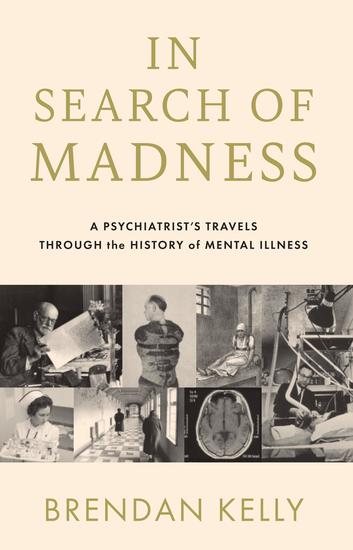
In this fascinating new exploration of mental illness, Professor Brendan Kelly examines 'madness' in history and how we have responded to it over the centuries.
We travel from the psychiatric institutions of modern India to scientific studies of the brain in Victorian England. We discover the beginnings of formal asylum care and witness the experimental therapies of the cavernous psychiatric hospitals of the nineteenth and early twentieth centuries in Ireland, England, Belgium, Italy, Germany and the United States.
Covering lobotomy and the Nazis' Aktion T4 campaign, as well as Freud, psychoanalysis, cognitive behavioural therapy and neuroscience, In Search of Madness examines the shift in recent times from 'psychobabble' to 'neurobabble'.
This is an all encompassing history of one of the most basic fears to haunt the human psyche – madness – and it concludes with a passionate manifesto for change: four proposals to make mental health services more effective, accessible and just.
Available since: 04/14/2022.
Print length: 336 pages.

Other books that might interest you

  • Empiricism - Knowledge Through Experience - cover

    Empiricism - Knowledge Through...

    Hector Davidson

    • 0
    • 0
    • 0
    Empiricism, as a philosophical doctrine, asserts that knowledge is primarily derived from sensory experience. This perspective contrasts sharply with rationalism, which emphasizes reason and innate knowledge. Empiricism has shaped our understanding of the world and influenced numerous fields, from the natural sciences to ethics and epistemology. The essence of empiricism lies in the conviction that the mind begins as a "blank slate" (tabula rasa) and that experience, rather than pre-existing ideas or concepts, forms the foundation of all knowledge. 
    At the heart of empiricist thought is the belief that all human knowledge starts with perception. We acquire information about the world through our senses—sight, hearing, touch, taste, and smell—which provide the raw data from which we form concepts and beliefs. For empiricists, knowledge is not something we discover internally, but something we gather from external reality. This view stands in contrast to the rationalist emphasis on a priori knowledge, which is independent of experience and accessible only through reason. 
    Empiricism's roots can be traced back to ancient philosophy, with early proponents like Aristotle, who argued that all knowledge comes from sensory observation. However, the modern development of empiricism is largely credited to three major figures: John Locke, George Berkeley, and David Hume. Locke introduced the idea of the mind as a tabula rasa, arguing that individuals are born without innate ideas and that all knowledge comes from experience. Berkeley took this further by suggesting that even the existence of the external world depends on perception, encapsulating the notion that "to be is to be perceived." Hume, the most radical empiricist of the three, questioned the very basis of causality and inductive reasoning, asserting that our beliefs in cause-and-effect relationships were not rationally justified but arose from habitual experience.
    Show book
  • Hope for Your Homeschool - Start Strong Stay the Course and Finish with Joy - cover

    Hope for Your Homeschool - Start...

    September A McCarthy

    • 0
    • 0
    • 0
    You weren’t meant to do this on your own. Whether it’s day one or year ten of your homeschooling journey, you can draw from this well of wisdom and encouragement! Homeschooling can be rich and rewarding. But it can also be exhausting and lonely. You may have questions or doubts swirling in your head or from outside family and friends:I am not a teacher � I don’t know where to begin � Will my kids have friends? � Will I ever have time for me? � Will this get any easier? � Should I keep doing this? � And more.These are good thoughts and questions. It’s important to consider them and find answers. In Hope for Your Homeschool, September McCarthy—seasoned homeschooling mom of ten children and twelve grandchildren—addresses the fears and concerns that accompany homeschooling. And she provides a successful, well-tested plan! Through biblical insight and personal stories, September shows us how to create a culture at home that will fortify hearts and sharpen young minds. September gives us practical steps to follow and mistakes to avoid.Your days will be infused with joy and strength. As you draw from the wisdom of this homeschooling friend, your mothering heart will find hope, guidance, and encouragement for the daily work of homeschooling well.
    Show book
  • Anarchism: The Basics - An Introduction to the Philosophy and Principles of Anarchy - cover

    Anarchism: The Basics - An...

    Arlo Holders

    • 0
    • 0
    • 0
    Anarchism is often misunderstood as simply chaos or disorder, but it is, in fact, a political and philosophical ideology that seeks the abolition of unjust systems of power, particularly the state and hierarchical structures. At its core, anarchism advocates for a society based on voluntary cooperation, mutual aid, and the dismantling of coercive institutions. It emphasizes individual freedom, collective responsibility, and the rejection of authority in all its forms, whether governmental, economic, or social. 
    The roots of anarchist thought can be traced back to the early 19th century, with thinkers like Pierre-Joseph Proudhon, who famously declared that "property is theft," and later, figures like Mikhail Bakunin and Peter Kropotkin. These early anarchists critiqued the existing state, capitalism, and organized religion, arguing that they were inherently oppressive and exploitative. Anarchism, for these thinkers, was not just about rejecting government, but also about challenging societal norms that perpetuate inequality and injustice. 
    One of the most important aspects of anarchism is its emphasis on direct action and the creation of alternative systems of organization. Anarchists believe that meaningful change does not come from traditional political structures like elections or parliamentary processes, but through grassroots action and community-based solutions. This can involve protests, strikes, and other forms of resistance, but also the establishment of cooperative enterprises, mutual aid networks, and non-hierarchical communities.
    Show book
  • Western Civilization: A Captivating Guide to Ancient Greek and Roman Civilizations Christianity Medieval Europe and Modern Times - cover

    Western Civilization: A...

    Captivating History

    • 0
    • 0
    • 0
    Did you know that Western civilization has influenced the lives of almost everyone alive today? 
    What do you know about Western civilization? It might sound like a funny question to ask, but a lot of people don’t realize how much the West has impacted the world. The values of Western civilization have influenced laws, people’s sense of individuality, and even our morals. 
    This audiobook will trace Western civilization back to its roots. In this epic quest, we head all the way back to Greece when Greek philosophers like Socrates and Plato pondered the very meaning of life. Explore the depths of knowledge that were probed by Greek schools of thought, such as the Stoics and the Cynics. 
    Was it better to stoically grin and bear the troubles of life as the Stoics advised, or was it better to simply shrug one’s shoulders and declare everything to be pointless, stupid, and absurd? 
    And in the middle of these philosophers’ quest, a missionary from Judea named Paul of Tarsus stepped in to spread the “good news” of the Gospels. Christianity and other schools of thought converged, and the Roman Empire helped to facilitate the spread of these ideas far and wide. Soon, the foundations for Western civilization had been firmly established. 
    These ideas would later undergo renaissances, reformations, and scientific revolutions, but the basic foundation has remained in place. Here, in this audiobook, we explore all of the fascinating aspects of the great framework upon which our modern Western civilization rests. 
    In this audiobook, you will learn the following:Greek philosophical and scientific discoveriesThe convergence of Greco-Roman and Christian beliefsHow Western civilization transformed during the Middle AgesAnd much more! 
    Scroll up and click the “add to cart” button to learn more about Western civilization!
    Show book
  • Ethnic Identity - Bringing Your Full Self to God - cover

    Ethnic Identity - Bringing Your...

    Steve Tamayo

    • 0
    • 0
    • 0
    Did you know that the Bible has a great deal to say about ethnicity?
    Through the Bible, God shapes the way we engage with ethnicity. A biblical perspective on ethnicity gives us confidence to explore our own ethnic identities.
    In this eight-session LifeGuide® Bible Study, Steve Tamayo takes us through passages that open us up to difficult yet important conversations about race, culture, and ethnicity. If ethnicity is a gift from God, engaging this material may deeply transform the way we interact with family, friends, and enemies.
    For over three decades LifeGuide Bible Studies have provided solid biblical content and raised thought-provoking questions—making for a one-of-a-kind Bible study experience for individuals and groups. This series has more than 130 titles on Old and New Testament books, character studies, and topical studies.
    Show book
  • Dispersals - On Plants Borders and Belonging - cover

    Dispersals - On Plants Borders...

    Jessica J. Lee

    • 0
    • 0
    • 0
    A prize-winning memoirist and nature writer turns to the lives of plants entangled in our human world to explore belonging, displacement, identity, and the truths of our shared future 


    A seed slips beyond a garden wall. A tree is planted on a precarious border. A shrub is stolen from its culture and its land. What happens when these plants leave their original homes and put down roots elsewhere? 


    In fourteen essays, Dispersals explores the entanglements of the plant and human worlds: from species considered invasive, like giant hogweed; to those vilified but intimate, like soy; and those like kelp, on which our futures depend. Each of the plants considered in this collection are somehow perceived as being "out of place"—weeds, samples collected through imperial science, crops introduced and transformed by our hand. Combining memoir, history, and scientific research in poetic prose, Jessica J. Lee meditates on the question of how both plants and people come to belong, why both cross borders, and how our futures are more entwined than we might imagine.
    Show book