Unisciti a noi in un viaggio nel mondo dei libri!
Aggiungi questo libro allo scaffale
Grey
Scrivi un nuovo commento Default profile 50px
Grey
Iscriviti per leggere l'intero libro o leggi le prime pagine gratuitamente!
All characters reduced
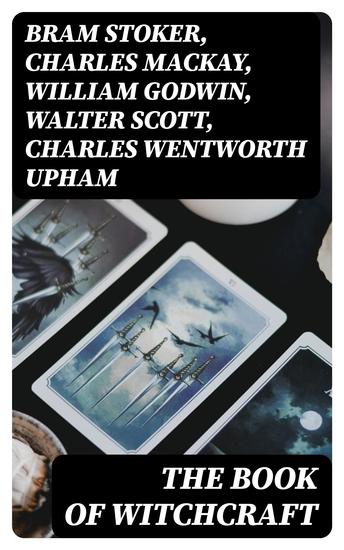
The Book of Witchcraft - cover

The Book of Witchcraft

Bram Stoker, Charles Mackay, William Godwin, Walter Scott, Charles Wentworth Upham, Jules Michelet, John Ashton, Howard Williams, Increase Mather, Cotton Mather, Allen Putnam, George Moir, Frederick George Lee, James Thacher, M. V. B. Perley, Wilhelm Meinhold, John M. Taylor, E. Lynn Linton, William P. Upham, W. H. Davenport Adams, M. Schele de Vere, St. John D. Seymour, John G. Campbell, John Maxwell Wood, Samuel Roberts Wells, Margaret Murray

Traduttore Jane Wilde, Lucie Duff-Gordon, Lionel James Trotter

Casa editrice: DigiCat

  • 0
  • 0
  • 0

Sinossi

The Book of Witchcraft is a rich tapestry of narratives, essays, and historical accounts that collectively explore the multifaceted phenomenon of witchcraft through an array of literary styles. It seamlessly blends folklore, sociology, and cultural analysis to unveil the haunting allure and societal fears surrounding witches across centuries. In this anthology, readers encounter spellbinding tales and meticulous historical recollections that reveal the pervasive influence of witchcraft in literature and history. Some pieces stand out for their vivid storytelling and critical insight, offering a lush panorama of themes such as power, subversion, and the supernatural. The anthology gathers works from an impressive roster of authors, including Bram Stoker, Walter Scott, and Margaret Murray, who each contribute to a complex dialogue on witchcraft's role in shaping cultural and historical paradigms. These writers, with origins and perspectives rooted in various literary, cultural, and historical traditions, enrich the reader's understanding of witchcraft's diverse interpretations. The collection not only aligns with periods such as the Romantic and Gothic movements but also draws from the Enlightenment's quest for truth, thereby representing the zeitgeist of different eras while maintaining a cohesive thematic focus. As an essential compendium for those intrigued by the occult, The Book of Witchcraft offers a unique opportunity to explore a multiplicity of perspectives and styles within a single volume. This anthology provides invaluable educational insights and encourages a thoughtful examination of how witchcraft has been perceived and portrayed across time. By engaging with the storied past and nuanced interpretations these works present, readers will find themselves invited into an enriching dialogue that transcends the pages, sparking intellectual curiosity and an appreciation for the intricate dance between myth and reality.
Disponibile da: 03/06/2022.
Lunghezza di stampa: 6249 pagine.

Altri libri che potrebbero interessarti

  • Subterranean Secrets - Unveiling the Restricted Underworld Beneath the City of Light - cover

    Subterranean Secrets - Unveiling...

    John Harpoon

    • 0
    • 0
    • 0
    Paris, often known as the "City of Light," is renowned for its iconic landmarks, romantic ambiance, and vibrant culture. Yet, beneath its grand boulevards and charming streets, lies an entirely different world—an underground labyrinth that has shaped the city in ways few know or understand. From ancient Roman origins to the modern-day metro system, Paris’s subterranean spaces are a testament to the ingenuity, mystery, and resilience of the city. 
    The underground world of Paris is not merely a collection of tunnels and chambers; it is a complex network that has served multiple purposes throughout the ages. Some of these spaces were created for practical reasons—such as the quarries that provided building materials for the city's growing skyline—while others evolved into places of mystique and darkness, such as the famous Catacombs, now home to the remains of millions. What began as a means of resource extraction gradually became a vault of history, culture, and secrets. 
    This book delves into the hidden depths beneath Paris’s streets, exploring the lesser-known aspects of the city's subterranean heritage. It examines the origins of these tunnels, from the Romans who first began to carve through the limestone to the workers who later expanded them into extensive catacombs. It also explores the multifaceted role these spaces have played throughout history: as a refuge during times of war, as a setting for revolutionary movements, and as a sanctuary for those who choose to live outside the city's mainstream society.
    Mostra libro
  • Phoenician Language and Writing: The History and Legacy of the Ancient World’s Most Influential Script - cover

    Phoenician Language and Writing:...

    Editors Charles River

    • 0
    • 0
    • 0
    There is no doubt that the alphabets and forms of writing employed by most European languages comes directly from the Phoenicians, but the process by which that took place is still a mystery. Some of the ancient historians provided theories concerning how the Phoenicians gave their alphabet and system of writing to the Greeks, and Herodotus offered an account that is probably more accurate than most. He claimed, “The Phoenicians who came with Cadmus – amongst whom were the Gephyraei – introduced into Greece, after their settlement in the country, a number of accomplishments, of which the most important was writing, an art till then, I think, unknown to the Greeks. At first, they used the same characters as all the other Phoenicians, but as time went on, and they changed their language, they also changed the shape of their letters. At that period most of the Greeks in the neighborhood were Ionians; they were also taught these letters by the Phoenicians and adopted them, with a few alterations, for their own use, continuing to refer to them as Phoenician characters – as was only right, as the Phoenicians had introduced them.”  
    Like many of Herodotus’ other passages in Histories, there is truth wrapped with some errors. The Greeks certainly knew of the concept of writing before the Phoenicians, as the Mycenaeans used the Linear B script, but that knowledge had vanished at the end of the Bronze Age (Morkot 1996, 18). Perhaps what makes Herodotus’ account accurate and most interesting is his description of how the writing evolved. He mentions how the Greeks “changed the shape of their letters”, which is the normal course when any group of people adopts a script to write their native language. For example, there are slight variations in the Latin script employed by most modern Western European languages, such as the umlauts in German or the various accents in French and Spanish.
    Mostra libro
  • The Acharnians - cover

    The Acharnians

    Aristophanes

    • 0
    • 0
    • 0
    The Acharnians, one of Aristophanes’ earliest surviving comedies, is a sharp and entertaining critique of war and politics in ancient Athens. Written during the Peloponnesian War, the play follows Dicaeopolis, a weary farmer who takes matters into his own hands by negotiating a private peace with Sparta, defying the city’s warmongering leaders. As he enjoys the benefits of peace—wine, trade, and personal freedom—he faces opposition from the chorus of Acharnian charcoal-burners, staunch supporters of the war. Through absurdity, satire, and bold humor, Aristophanes challenges Athenian militarism and exposes the folly of political opportunism. Blending fantasy with pointed social commentary, The Acharnians champions individual reason and peace over nationalistic zeal, offering a timeless reflection on the costs of war and the courage to seek alternatives.
    Mostra libro
  • Political Choice in a Polarized America - How Elite Polarization Shapes Mass Behavior - cover

    Political Choice in a Polarized...

    Joshua N. Zingher

    • 0
    • 0
    • 0
    What motivates citizens to support one party over the other? Do they carefully weigh all of the relevant issues and assess which party or candidate best matches their own positions? Or do people look at politics as something more akin to a team sport—the specifics do not matter as long as you know what side your team is on? Answering these questions requires us to think about how much the average American knows about politics. Many scholars of public opinion believe that the majority of Americans only pay passing attention to politics. Thus the electorate's apparent lack of political competence presents a direct challenge to normative theories of democracy. How are citizens supposed to exert control over the government if they have no idea what is going on? 


    In Political Choice in a Polarized America, Joshua N. Zingher argues that these fears are overblown. Not only do individuals have core beliefs about what the government should or should not do, but individuals have become more likely to support the party that best matches their policy attitudes by both identifying as a member of that party and voting for that party in elections. However, as Zingher demonstrates, voters' ability to match their attitudes to a party or candidate varies according to signals sent by elites and increases as parties become more polarized.
    Mostra libro
  • Evolution Is Wrong - A Radical Approach to the Origin and Transformation of Life - cover

    Evolution Is Wrong - A Radical...

    Erich von Däniken

    • 0
    • 0
    • 0
    A Fascinating Exploration on Why the Darwinists’ Theory No Longer Explains EverythingThere was once a set of ideas called the theory of evolution, conceived by clever people and confirmed by countless scientists. Then people discovered the electron microscope. This made it possible to make the molecules within the cell visible, and suddenly questions about evolution arose that were not possible before. Which force actually bundles the atoms in the right order? What moves the molecular chains into the correct position? How did the first living unit within the cell actually come about? How does inheritance work, how does information pass on to the next generation? Did humans descend only and exclusively from primates—as Charles Darwin and countless other great minds assumed—or did additional “engines” intervene in evolution? Today it is clear: countless questions can no longer be answered with the previous theory of evolution. There is a form of life called “Blob” (Physarum polycephalum). The “thing” has neither eyes nor ears, neither a mouth nor a nose or even a brain. Nevertheless, it takes in food, overcomes obstacles by the shortest route and exchanges information with other “blobs.” The “blob” contradicts any evolutionary thought that one develops from the other. Or the “gastric-brooding frogs” (Rheobatrachus) found in Australia. They hatch their young in the stomach. Impossible in a slow, evolutionary process. Everywhere there are characteristics of animals that do not want to fit into the theory of evolution anywhere. And man? Are we really the most adapted life-form on this planet? Today, more and more scientists who contradict the previous theory of evolution speak out. The theory fits the changes within the species, but it can no longer be reconciled with the inner workings of the cell. Some other influence that has so far escaped us is affecting evolution. It is called “Intelligent Design.” Intelligent planning is suspected behind this. Anyone or anything—a spirit of the universe? Aliens?—could be behind this planning. Erich von Däniken uses countless examples to demonstrate the impossibility of the previous evolutionary idea. He quotes scientists who argue against the previous teaching, but also those who defend it. Unfortunately, established science still refuses to look at discrepancies and holes in the theory of evolution, even though it is quite obvious that there is more going on with regard to the development of all species, as well as human culture, than could be explained by the theory of evolution alone.
    Mostra libro
  • The Anti-Greed Gospel - Why the Love of Money Is the Root of Racism and How the Church Can Create a New Way Forward - cover

    The Anti-Greed Gospel - Why the...

    Malcolm Foley

    • 0
    • 0
    • 0
    "A forceful call to recognize the roots of American inequality and a solid starting point for Christians who want to help fix them." —Publishers Weekly 


    Racism is not about hate and ignorance. It's about greed. And it always has been. 


    Black Christian historian Malcolm Foley explores this idea in The Anti-Greed Gospel, showing how the desire for power and money—what some call "racial capitalism"—causes violence and exploitation. 


    Foley reviews the history of racial violence in the United States and connects the killings of modern-day Black Americans to the history of lynching in America. He helps the contemporary church wrestle with the questions racial violence brings up: How can we become communities that show generosity and resist greed? What is the next step in the journey for racial justice? 


    Listeners will walk away with a better understanding of how they can resist greed that exploits others, love their neighbor more completely, and build communities of deep solidarity, anti-violence, and truth telling.
    Mostra libro