Join us on a literary world trip!
Add this book to bookshelf
Grey
Write a new comment Default profile 50px
Grey
Subscribe to read the full book or read the first pages for free!
All characters reduced
International May Day and American Labor Day - A Comprehensive Analysis of Worker Solidarity and Labor Rights - cover

International May Day and American Labor Day - A Comprehensive Analysis of Worker Solidarity and Labor Rights

Boris Reinstein

Publisher: Good Press

  • 0
  • 0
  • 0

Summary

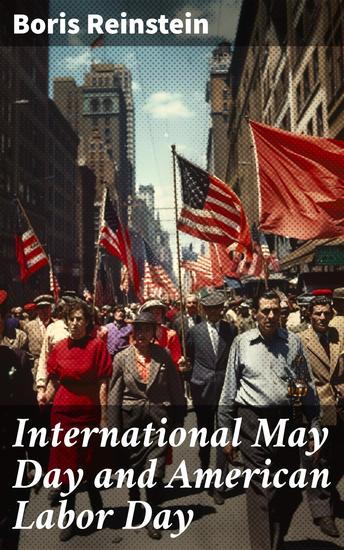
In "International May Day and American Labor Day," Boris Reinstein offers a meticulously researched exploration of the origins, significance, and evolving interpretations of these two pivotal observances of labor. Through a nuanced literary style, Reinstein weaves together historical narratives, sociopolitical contexts, and cultural critiques, presenting a comprehensive analysis that reveals how May Day and Labor Day reflect the struggles and achievements of the working class across different geographical and temporal landscapes. The book examines the interplay of nationalism, workers' rights movements, and the broader implications of labor struggles in the context of globalization, making it a critical addition to labor history scholarship. Boris Reinstein, an esteemed scholar in labor studies, draws upon his extensive background in sociology and history to provide readers with profound insights into labor movements. His scholarly pursuits are informed by a commitment to social justice, which may stem from his personal experiences within various labor environments. Reinstein's expertise enables him to articulate the complex relationship between socio-political events and labor movements, fostering a deep understanding of their interconnectedness. This book is highly recommended for scholars, students, and all those interested in labor history, social movements, and the ongoing struggle for workers' rights. Reinstein's work not only illuminates the importance of May Day and Labor Day but also encourages readers to reflect on the contemporary relevance of these observances in today'Äôs socio-economic landscape.
Available since: 11/01/2023.
Print length: 23 pages.


Other books that might interest you

  • John Adams - The American Statesman Diplomat Writer and Founding Father - cover

    John Adams - The American...

    Kelly Mass

    • 0
    • 0
    • 0
    John Adams was the 2nd president of the United States, serving from 1797 to 1801. He was an American leader, lawyer, diplomat, author, and Founding Father. He was the first vice president of the U.S.A. and a leader of the American Revolution, which caused the nation's independence from Great Britain. Adams kept a journal and communicated with certain crucial individuals in early American history, including his marriage partner and consultant Abigail Adams and Thomas Jefferson. 
    Prior to the revolution, Adams was an attorney and political activist who had faith in the right to counsel and the assumption of innocence. He withstood anti-British belief by effectively protecting British warriors implicated of murder in the Boston Massacre. 
    Adams was an agent from Massachusetts to the Continental Congress who rose to end up being an advanced leader. In the year 1776, he helped make up the Declaration. As a diplomat in Europe, he contributed to negotiating a peace handle the UK and protecting vital federal government loans. Adams was the primary writer of the Massachusetts Constitution, which affected the USA Constitution, as did his post Thoughts on Federal government, which was released in the year 1780. 
    Let’s learn more about this prominent historical figure.
    Show book
  • Clowns & Acrobats - cover

    Clowns & Acrobats

    Seamus Cashman

    • 0
    • 0
    • 0
    How close are we to myth, race memory? Do they infiltrate our minds? 
    Seamus Cashman's new collection, Clowns & Acrobats, swerves headily into a modern world of questionings, parenthood, relationships, conscience and death, while eyeing the poet;s close personal sense of history and celebratory myth. The exercise of power, the eccentricity of ideas, the magic of imaginings, the flow of language, an incredible musicality and the use – and abuse – of traditional forms here merge to delight the reader. 
    - 
    Audiobook recorded by Adam Shanahan, Dublin, Ireland.
    Show book
  • JFK Assassination - What They Told Me - cover

    JFK Assassination - What They...

    William Holiday

    • 0
    • 0
    • 0
    "JFK Assassination—What They Told Me" unveils a treasury of knowledge crafted by William Holiday, a dedicated educator with a passion for unraveling the truths behind the JFK assassination. In this book lies an extensive compendium of photographs, film segments, interviews, recordings, and documents, offering listeners a journey through the event's multifaceted dimensions. 
    A career educator, not a traditional researcher, William Holiday spent over five decades sharing his profound insights with students. From his years at Dummerston Elementary School to Brattleboro Union High School, and through his tenure at Keene State College and Castleton University, he fostered intellectual growth. His teachings on the JFK assassination, which spanned more than 50 years, extended most recently to the CALL Program at Keene State, where his classes often involved field studies in Dallas, Texas. 
    Notably, Holiday refrains from adopting the labels of "conspiracy theorist" or a staunch advocate of the "lone nut assassin" theory endorsed by the Warren Commission. Instead, he serves as a conduit for the firsthand accounts he has accumulated over time. The witnesses he introduces, ranging from researchers to doctors, provide unique perspectives that challenge conventional narratives. The book echoes the voices of those who were on the scene, including a young lady, an ambulance driver, an automobile salesman, and a deaf observer—all of whom recount their experiences in Dealey Plaza on November 22. 
    PLEASE NOTE: When you purchase this title, the accompanying PDF will be available in your Audible Library along with the audio.
    Show book
  • The Zong - A Massacre the Law & the End of Slavery - cover

    The Zong - A Massacre the Law &...

    James Walvin

    • 0
    • 0
    • 0
    The first full review of the mass murder by crew members on the slave ship Zong and the lasting repercussions of this horrifying event 


    On November 29, 1781, Captain Collingwood of the British ship Zong commanded his crew to throw overboard one-third of his cargo: a shipment of Africans bound for slavery in America. The captain believed his ship was off course, and he feared there was not enough drinking water to last until landfall. This book is the first to examine in detail the deplorable killings on the Zong, the lawsuit that ensued, how the murder of 132 slaves affected debates about slavery, and the way we remember the infamous Zong today. 


    Historian James Walvin explores all aspects of the Zong's voyage and the subsequent trial—a case brought to court not for the murder of the slaves but as a suit against the insurers who denied the owners' claim that their "cargo" had been necessarily jettisoned. The scandalous case prompted wide debate and fueled Britain's awakening abolition movement. Without the episode of the Zong, Walvin contends, the process of ending the slave trade would have taken an entirely different moral and political trajectory. He concludes with a fascinating discussion of how the case of the Zong, though unique in the history of slave ships, has come to be understood as typical of life on all such ships.
    Show book
  • Transient and Strange - Notes on the Science of Life - cover

    Transient and Strange - Notes on...

    Nell Greenfieldboyce

    • 0
    • 0
    • 0
    In her career as a science reporter, Nell Greenfieldboyce has reported from inside a space shuttle, the bottom of a coal mine, and the control room of a particle collider; she's presented news on the color of dinosaur eggs, ice worms that live on mountaintop glaciers, and signs of life on Venus. In this, her debut book, she delivers a wholly original collection of powerful, emotionally raw, and unforgettable personal essays that probe the places where science touches our lives most intimately. 


    Expertly weaving her own experiences of motherhood and marriage with an almost devotional attention to the natural world, Greenfieldboyce grapples with the weighty dualities of life: birth and death, constancy and impermanence, memory and doubt, love and aging. She looks for a connection to the universe by embarking on a search for the otherworldly glint of a micrometeorite in the dust, consults meteorologists and storm chasers on the eerie power of tornadoes to soothe her children's anxieties, and processes her adolescent oblivion through the startling discovery of black holes. 


    A beautiful blend of explanatory science, original reporting, and personal experience, Transient and Strange captures the ache of ordinary life, offering resonant insights into both the world around us and the worlds within us. 


    Two bonus stories, "Santa" and "Paperclips," are featured at the end of the audiobook.
    Show book
  • Delhi Sultanate - Muslim Dynasties That Shaped Medieval India - cover

    Delhi Sultanate - Muslim...

    Rolf Hedger

    • 0
    • 0
    • 0
    The Delhi Sultanate was a defining era in Indian history, marking the establishment of Muslim rule in northern India. Its rise was shaped by a series of invasions, strategic conquests, and the formation of a centralized administration. The foundation of the Sultanate can be traced back to the late 12th century when Muslim forces, primarily from Central Asia, began making inroads into the Indian subcontinent. These incursions set the stage for a new political order that would influence the region for centuries. 
    One of the earliest significant Muslim invasions was led by Mahmud of Ghazni in the 11th century. Although he did not establish permanent rule, his raids weakened Indian kingdoms and demonstrated the vulnerability of the region. However, it was Muhammad Ghori in the late 12th century who laid the groundwork for the Delhi Sultanate. Unlike Mahmud, Ghori aimed for long-term control rather than mere plundering. His victory over Prithviraj Chauhan at the Second Battle of Tarain in 1192 was a turning point, allowing Muslim forces to establish a foothold in northern India. 
    Following Ghori’s assassination in 1206, his general, Qutb al-Din Aibak, took control of his Indian territories and proclaimed himself the first Sultan of Delhi. Aibak, originally a slave who rose through the ranks, became the founder of the Mamluk or Slave Dynasty. He consolidated his rule by strengthening administrative structures and commissioning architectural marvels like the Qutb Minar, which symbolized the establishment of Muslim rule. However, his reign was short-lived, and his successor, Iltutmish, played a more crucial role in shaping the Delhi Sultanate into a powerful and stable empire.
    Show book