Join us on a literary world trip!
Add this book to bookshelf
Grey
Write a new comment Default profile 50px
Grey
Subscribe to read the full book or read the first pages for free!
All characters reduced
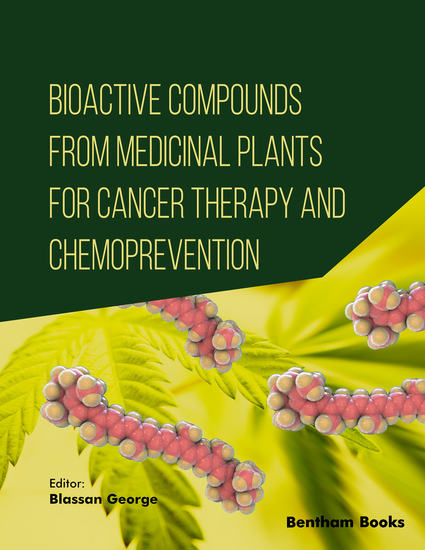
Bioactive Compounds from Medicinal Plants for Cancer Therapy and Chemoprevention - cover

Bioactive Compounds from Medicinal Plants for Cancer Therapy and Chemoprevention

Blassan George

Publisher: Bentham Science Publishers

  • 0
  • 0
  • 0

Summary

This book aims to fill research gaps in the search for chemotherapeutic and chemopreventive natural compounds. It includes a collection of detailed reviews focusing on bioactive compounds from plant sources that can be beneficial for cancer therapy. Topics covered include the role of antioxidants in cancer therapy, medicinal plants for cancer chemotherapeutics, bioactive compounds from marine plants, and a review of inhibiting nitric oxide reactions for preventing cancer. Chapters are contributed by researchers who have provided detailed lists and descriptions of the relevant plant sources, the compounds and the biochemical reactions. The book includes references for advanced reading. This book is intended as a reference for scholars and healthcare professionals studying natural medicines for cancer prevention and treatment.ReadershipScholars in the field of medicinal chemistry, pharmacology and herbal medicine.
Available since: 09/10/2024.
Print length: 185 pages.
Other books that might interest you

  • Entomology - The World of Insects - cover

    Entomology - The World of Insects

    Mike Crawford

    • 0
    • 0
    • 0
    Insects are among the most diverse and ecologically significant organisms on Earth, playing essential roles in maintaining the balance of ecosystems. As the largest group of living creatures, with millions of species identified and many more yet to be discovered, insects contribute to biodiversity, food webs, and ecosystem stability in ways that are often overlooked. Their presence and activities influence plant life, soil health, and the survival of countless other species, making them indispensable to natural processes. 
    One of the most crucial roles insects play is pollination. Many flowering plants, including a significant portion of the world’s crops, depend on insects such as bees, butterflies, and beetles to transfer pollen between flowers, enabling reproduction. Without insect pollinators, ecosystems would struggle to sustain plant diversity, and agricultural yields would decline drastically, threatening food supplies for both humans and wildlife. The economic and ecological value of insect pollination is immeasurable, reinforcing the importance of conserving pollinator populations. 
    In addition to pollination, insects are fundamental to decomposition and nutrient cycling. Species such as dung beetles, termites, and various flies break down organic matter, returning nutrients to the soil and promoting healthy plant growth. This process not only recycles essential elements but also prevents the accumulation of decaying material, contributing to ecosystem cleanliness and balance. By decomposing dead plants and animals, insects help maintain the natural cycle of life, supporting plant regeneration and sustaining the broader environment.
    Show book
  • Colliding Worlds - How Cosmic Encounters Shaped Planets and Life - cover

    Colliding Worlds - How Cosmic...

    Simone Marchi

    • 0
    • 0
    • 0
    Some 4.6 billion years ago, a planetary system was born from a disc of gas and dust surrounding a young star.  
     
    Specks of dust, pushed into dense clumps, collided, stuck together, and grew. While the gas disappeared, the growing bodies clashed in a final violent phase, leaving a series of planets, and much debris. The planets jostled and moved around as they sought a stable  
    arrangement, knocking many small fragments out of the system altogether while others formed a distant icy fringe. The massive violent collisions of this time gouged out vast craters from the newborn planets, and sometimes created moons.  
     
    Such was the birth of our Solar System. Only recently have scientists begun to find subtle clues of these ancient, violent times. Remarkably, they are still there, if we look carefully at the Earth’s oldest rocks, at Mars and the Moon with their ancient surfaces, and at the  
    asteroids, which are themselves startlingly varied small worlds. Clues are also to be found in the meteorites that have landed on Earth. From such splinters, from the precious collection of lunar rocks brought back by the Apollo astronauts, and the information  
    gleaned by spacecraft and the Mars rovers, we are slowly building up a picture of the early days of the planets.  
     
    Simone Marchi, a planetary scientist involved with several space missions including Dawn, captures the excitement of these discoveries. We learn of the evidence for an early dramatic rearrangement of the big planets; for a once warm and wet Mars where life  
    perhaps still lurks today; and for the huge collisions that have shaped our own planet and affected life’s trajectory upon it. For all their destructive power, cosmic collisions have played a critical role in creation.  
     
    Without them, we would not exist.
    Show book
  • Lest We Forget - A Doctor’s Experience with Life and Death During the Ebola Outbreak - cover

    Lest We Forget - A Doctor’s...

    Kwan Kew Lai

    • 0
    • 0
    • 0
    In 2014 after fighting through yards of bureaucratic red tape, leaving her family, and putting her own health at risk in order to help suffering strangers, Kwan Kew Lai finally arrived in Africa to volunteer as an infectious disease specialist in the heart of the largest Ebola outbreak in history. What she found was not only blistering heat, inhospitable working conditions, and deadly, unrelenting illness, but hope, resilience, and incredible courage. 


    Lest We Forget chronicles the harrowing and inspiring time spent serving on the front lines of the ongoing Ebola outbreak—the complicated Personal Protective Equipment, the chlorine-scented air, the tropical heat, and the heartbreaking difficulties of treating patients she could not touch. Dr. Lai interweaves original diary entries to create a gripping narrative about life, death, and human relationships that will leave no listener unmoved. 


    Lest We Forget exposes the raw brutality of Ebola, as well as the chaotic nature of the undersupplied and understaffed health infrastructure in the developing world. At once a memoir of triumphs and failures and a memorial, this book will ensure that the victims of Ebola and the fighters who sought to heal them will not be forgotten.
    Show book
  • The Red Limit - The Search for the Edge of the Universe - cover

    The Red Limit - The Search for...

    Timothy Ferris

    • 0
    • 0
    • 0
    For centuries, it was assumed that our universe was static. Then, in the late 1920s, astronomers made a startling new discovery—from Earth, the light of distant galaxies appeared to be red. This meant those galaxies were receding from us, and a revolutionary realization was born: the universe is expanding. In The Red Limit, Timothy Ferris recounts the fascinating tale of this discovery, its far-reaching ramifications, and the passionately competitive astronomers who charted the past, present, and future of the cosmos.
    Show book
  • Crush the Myths: How Processed Foods Are Sabotaging Your Health - "Transform your wellness journey! Explore our audiobook exposing the hidden dangers of processed foods today!" - cover

    Crush the Myths: How Processed...

    Jareth Larkfield

    • 0
    • 0
    • 0
    Crush the Myths: How Processed Foods Are Sabotaging Your Health 
    ⭐⭐ Simplified Guide & Explanations Included ⭐⭐   
    Are you eager to enhance your health and well-being by overcoming common misconceptions about processed foods? 
    Searching for a comprehensive resource that equips you with the knowledge necessary to transform your dietary habits? 
    Look no further! 
    This guide is your ultimate companion for deepening your understanding, applying practical skills, and engaging in hands-on activities. With this resource, you're on the path to success. 
    Updated for the latest information on health and nutrition. 
    Key features of this enriched guide: 
    - In-depth insights into how processed foods are impacting your health 
    - A thorough explanation of the myths surrounding processed foods 
    - Effective strategies for implementing healthier choices in your diet   
    Our guide stands out through its expansive coverage, which is crucial for your health transformation. Concepts are not just touched upon; they are explored in detail. 
    Crafted with a clear structure and straightforward language, our guide ensures smooth transitions between topics. Say goodbye to complex jargon and embrace clear, precise, and technically accurate content. 
    So, why wait? Click the BUY NOW button, secure your guide, and embark on your journey to unlocking better health by challenging common food misconceptions! 
    Join us in uncovering the truths about food and learn how to improve your health one myth at a time!
    Show book
  • COPOUT - How governments have failed the people on climate - An insider’s view of Climate Change Conferences from Paris to Dubai - cover

    COPOUT - How governments have...

    Nick Breeze

    • 0
    • 0
    • 0
    ‘Wry and passionate first-hand observations from the global climate negotiations – essential for capturing the spirit of this endlessly frustrating struggle’ – Bill McKibben 
    Most people tend to turn away, perhaps understandably, from the key existential issue of the day: climate change or, some would say more accurately, climate collapse. Nick Breeze tells the engaging, very human story of successive COP conferences over the past decade: it is a tale of imperfection, failure even, but not yet defeat. 
    So far, the UN process has achieved almost the exact opposite of what it first set out to achieve at the Rio Earth Summit in 1992. Nick shows clearly that it is not Extinction Rebellion, Just Stop Oil nor any other climate protesters who are the extremists; the true extremists are the policymakers who consistently undermine faltering efforts to reduce emissions. Repeatedly claiming to be saving us whilst allowing carbon emissions to continue rising, governments have failed their people on climate. Nick shows us how, why and what we can do about it. 
    The public remains largely uninformed about climate change and, for the most part, those who seek to draw attention to the issue are seen as ‘crazy’. There remains a terrifying gap between scientific reality and political action. 
    Packed with his own experiences and insights from expert interviewees, Nick’s page-turning account is less about the intricacies of the science and more about the mainstream perception of how we are understanding and responding to the problem.
    Show book