Join us on a literary world trip!
Add this book to bookshelf
Grey
Write a new comment Default profile 50px
Grey
Subscribe to read the full book or read the first pages for free!
All characters reduced
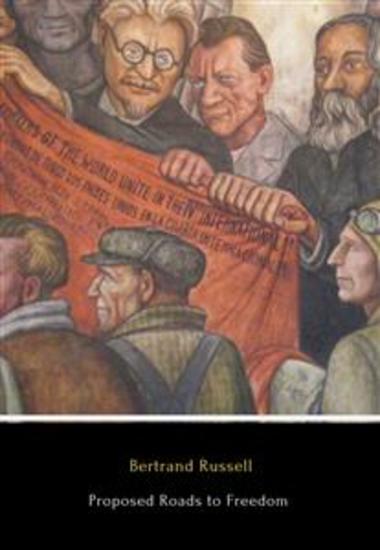
Proposed Roads to Freedom - cover

Proposed Roads to Freedom

Bertrand Russell

Publisher: Logos

  • 0
  • 0
  • 0

Summary

In Proposed Roads to Freedom, Bertrand Russell fearlessly navigates the landscapes of Socialism, Anarchism, and Syndicalism, offering an insightful examination of their principles and potential. Russell's clear and incisive prose sheds light on the fundamental ideas that have shaped societies and revolutions. With intellectual rigor and a commitment to understanding the complexities of these ideologies, Russell's work stands as a timeless guide for those seeking to fathom the intricate paths toward a just and equitable world.
Available since: 01/25/2024.
Print length: 183 pages.

Other books that might interest you

  • Why Governments Get It Wrong - And How They Can Get It Right - cover

    Why Governments Get It Wrong -...

    Dennis C. Grube

    • 0
    • 0
    • 0
    'This humane, accessible and lucid work will enlighten any voter, and remind any would-be – or currently serving – politician of the pitfalls to avoid' - TLSBarely a week goes by without another government U-turn and with the cost of living crisis and rising mortgage rates we really need those in charge to get it right. In this timely book Cambridge Professor Dennis C. Grube explores the pitfalls, failures and successes of those in power around the world.'A must-read' - Sebastian Payne'Convincing' - David Lammy MPWe live in an era when we really need governments to be effective – the economy, our health and the future of the planet are at stake – but so often they can seem clueless, and their decisions leave us confused. With insight and wit, Grube explains how governments can improve their decision-making and by examining fascinating case studies he highlights the key factors that make for effective government. With the stakes higher than ever before, this original and important book is an essential read for any concerned citizen who wants to understand why governments make the wrong decisions and, crucially, what can be done about it.‘Highly original and very entertaining' - Gavin Esler'There is a real gap for this book' - Isabel Hardman
    Show book
  • Silenced Voices: Testimonies of Life in Palestine - cover

    Silenced Voices: Testimonies of...

    Asomoo Asomoo.Net

    • 0
    • 0
    • 0
    Dear readers, 
    We write to you with an urgent call to immerse yourself in the pages of "Silenced Voices: Testimonies of Life in Palestine." This book is much more than a set of stories; It is a bridge connecting distant realities and a window to the profound experiences of life in Palestine, a place where voices have historically been silenced. 
    Each page of this book offers a unique opportunity to understand the complexity of Palestinian history, from roots and identity to resilience, childhood, women, memories of the land, and reflections toward the future. It is an invitation to look beyond conventional narratives, to listen to individual voices that have been eclipsed by the noise of conflict and geopolitical tensions. 
    By reading "Silenced Voices," you will help challenge stigmas and prejudices, humanize the experiences of those who have faced unimaginable challenges, and build bridges of understanding. This book is a call to action, a reminder of the importance of empathy and solidarity in building a more just world. 
    We encourage you to share this call to action with friends, family, and communities. Invite them to join this journey of knowledge and understanding, so that together we can amplify these silenced voices and contribute to a more informed dialogue about the reality in Palestine. 
    Let us not allow these voices to remain silent. Let's make "Silenced Voices" a catalyst for change, a tool for education and an inspiration for action. Reading this book will not only enrich your perspective, but will also be an act of solidarity with those whose stories deserve to be heard.
    Show book
  • Flavian Dynasty - The Era of Roman Construction and Restoration - cover

    Flavian Dynasty - The Era of...

    Kelly Mass

    • 0
    • 0
    • 0
    The Flavian dynasty, which ruled the Roman Empire from AD 69 to 96, is remembered as a period of remarkable transformation, spanning the reigns of Emperor Vespasian and his two sons, Titus and Domitian. This dynasty emerged during a time of political instability, marked by the tumultuous civil war of 69, often referred to as the Year of the Four Emperors. The Roman Empire was in turmoil after the deaths of emperors Galba and Otho, and the brief rule of Vitellius, who assumed the throne in mid-69. However, Vitellius' reign was soon contested by legions in the Eastern provinces, who declared Vespasian their emperor. This marked the beginning of the Flavian rise to power. The Second Battle of Bedriacum was a pivotal moment, securing the Flavian cause and leading to their eventual triumph. On December 20, 69, Vespasian entered Rome and, the following day, was officially declared Emperor by the Senate, establishing the Flavian dynasty. 
    Despite its relatively brief reign, the Flavian dynasty witnessed several notable events that shaped Roman history. One of the most significant challenges of Titus' rule was the eruption of Mount Vesuvius in 79, which buried the cities of Pompeii, Herculaneum, and others under layers of ash and lava. This catastrophic event, along with the subsequent fires and pestilence that ravaged Rome in 80, deeply affected the empire. On the military front, Titus' most enduring legacy was the brutal siege of Jerusalem in 70, following the Jewish revolt that began in 66. The city was destroyed, and its temple, a symbol of Jewish religious and cultural identity, was looted and razed. The military campaigns of the Flavians also extended beyond the Mediterranean; Gnaeus Julius Agricola, during his command in Britain (77–83), achieved remarkable victories that expanded Roman influence in the British Isles.
    Show book
  • My Brother's Keeper - Netanyahu Obama & the Year of Terror & Conflict that Changed the Middle East Forever - cover

    My Brother's Keeper - Netanyahu...

    Ari Harow

    • 0
    • 0
    • 0
    My Brother's Keeper tells the behind-the-scenes story of how the American president and the Israeli prime minister clashed about peace, war, and the future of the region. 


    Barack Obama and Benjamin Netanyahu viewed the world—and especially the Middle East—differently. The US president wanted to end what he saw as America's perpetual war against the Muslim and Arab worlds, use diplomacy to bring about a Palestinian state coexisting peacefully with Israel, and apply his signature foreign policy vision to reward the Islamic Republic of Iran in exchange for the scaling back of their nuclear pursuits. The Israeli premier wanted his country to thrive without the senseless bloodshed of terror and violence, and he was determined to protect the Jewish state from threats of annihilation by a member of the axis of evil that would one day be armed with nuclear weapons. Netanyahu wanted peace for peace, as well as the acceptance of Israel as a full-fledged part of the Middle East. In 2014, during a pivotal summer of terrorist violence, a war in Gaza, and the advancement of a nuclear deal with Iran, the two men clashed, threatening the US-Israeli strategic alliance and the future of the region. The Middle East would never be the same.
    Show book
  • Broken Trust - Greed Mismanagement & Political Manipulation at America's Largest Charitable Trust - cover

    Broken Trust - Greed...

    Samuel P. King, Randall W. Roth

    • 0
    • 0
    • 0
    Princess Bernice Pauahi Bishop was the largest landowner and richest woman in the Hawaiian kingdom. Upon her death in 1884, she entrusted her property--known as Bishop Estate--to five trustees in order to create and maintain an institution that would benefit the children of Hawai‘i: Kamehameha Schools. A century later, Bishop Estate controlled nearly one out of every nine acres in the state, a concentration of private land ownership rarely seen anywhere in the world. Then in August 1997 the unthinkable happened: Four revered kupuna (native Hawaiian elders) and a professor of trust law publicly charged Bishop Estate trustees with gross incompetence and massive trust abuse. Entitled "Broken Trust," the statement provided devastating details of rigged appointments, violated trusts, cynical manipulation of the trust's beneficiaries, and the shameful involvement of many of Hawai‘i's powerful. 
    No one is better qualified to examine the events and personalities surrounding the scandal than two of the original "Broken Trust" authors. Their comprehensive account together with historical background, brings to light information that has never before been made public, including accounts of secret meetings and communications involving Supreme Court justices.
    Show book
  • Whose Language Is English? - cover

    Whose Language Is English?

    Jieun Kiaer

    • 0
    • 0
    • 0
    Whose language is English? Although we often think of it as native to one place, today there are many Englishes. About seventy-five countries are now using English as their official or first language, and the number of people speaking it around the world continues to rise. But the makeup of the English-speaking population is changing. The proportion of speakers for whom English is a first language is decreasing, due to the explosion in popularity of English as a second language. 


    In this ambitious book, Jieun Kiaer explores the lives of English words in the twenty-first century, when the creation and use of language has become an increasingly dynamic, interactive, and diverse process in which ordinary people have taken leading roles—offering such coinages as "flexitarian," "MeToo," "glow up," and "shitizen" to "No sabo kids" and beyond. As English language grows ever more diverse, Kiaer believes, we need a paradigm shift. We must acknowledge that all varieties of English are languages in their own right when they are used by a community of speakers. English is a language that belongs to everyone. 


    Considering the effects of social media, the Covid-19 pandemic, virtual work, globalization, and artificial intelligence, Kiaer paints a compelling portrait of a rapidly evolving language characterized by creativity and democratization.
    Show book