Join us on a literary world trip!
Add this book to bookshelf
Grey
Write a new comment Default profile 50px
Grey
Subscribe to read the full book or read the first pages for free!
All characters reduced
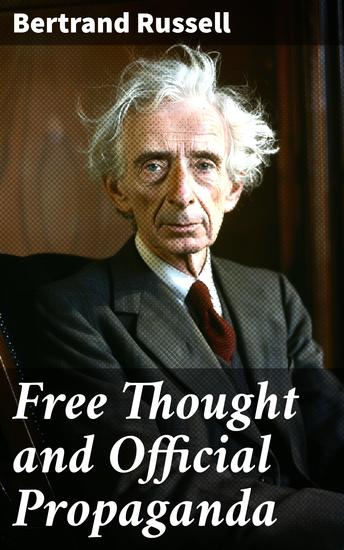
Free Thought and Official Propaganda - Challenging Official Narratives: The Power of Free Thought and Intellectual Freedom - cover

Free Thought and Official Propaganda - Challenging Official Narratives: The Power of Free Thought and Intellectual Freedom

Bertrand Russell

Publisher: Good Press

  • 0
  • 0
  • 0

Summary

In "Free Thought and Official Propaganda," Bertrand Russell deftly critiques the pervasive influence of propaganda in shaping public opinion and constraining independent thought. The book, written in a lucid and engaging prose style, invites readers to scrutinize the manipulation of truth by institutions'Äîfrom government entities to the media. Russell's arguments are steeped in historical context and philosophical inquiry, illuminating the mechanisms that impede rational discourse and the autonomy of beliefs. His exploration of the intersection between knowledge and power serves as both a warning and a call to action for the necessity of free thought in a democratic society. Bertrand Russell, a eminent philosopher, logician, and social critic, was deeply invested in the intersections of knowledge, ethics, and politics, often challenging societal norms through his writings. His experiences during World War I and activism against war propaganda profoundly influenced his worldview. Russell's commitment to pacifism, allied with his skepticism of authority and dogma, informs his relentless pursuit of truth, making this work particularly poignant in his oeuvre. "Free Thought and Official Propaganda" is essential reading for anyone keen on navigating the complexities of modern information environments. Russell's insights urge readers to cultivate their critical faculties and resist the seduction of unquestioned narratives, promoting a society where intellectual freedom thrives.
Available since: 10/12/2023.
Print length: 21 pages.


Other books that might interest you

  • First Inaugural Address - cover

    First Inaugural Address

    Ronald Reagan

    • 0
    • 0
    • 0
    On January 20, 1981, Reagan began his first presidential inauguration address by thanking Carter for his “gracious cooperation in the transition process”. 
    Reagan notes “one of the worst sustained inflations in our national history. It distorts our economic decisions, penalizes thrift, and crushes the struggling young and the fixed-income elderly alike.” “In this present crisis, government is not the solution to our problem; government is the problem.” 
    “For decades we have piled deficit upon deficit, mortgaging our future and our children's future for the temporary convenience of the present.” “It is my intention to curb the size and influence of the Federal establishment and to demand recognition of the distinction between the powers granted to the Federal Government and those reserved to the States or to the people.” 
    “If we look to the answer as to why for so many years we achieved so much, prospered as no other people on Earth, it was because here in this land we unleashed the energy and individual genius of man to a greater extent than has ever been done before.” “It is time to reawaken this industrial giant, to get government back within its means, and to lighten our punitive tax burden.” 
    “As for the enemies of freedom, … [w]e will maintain sufficient strength to prevail if need be, knowing that if we do so we have the best chance of never having to use that strength.” 
    “[T]ogether with God's help we can and will resolve the problems which now confront us. And after all, why shouldn't we believe that? We are Americans. God bless you, and thank you. 
    aspenleafmedia.com
    Show book
  • Bad Hombres - How Hispanics Will Save America - cover

    Bad Hombres - How Hispanics Will...

    Steve Cortes

    • 0
    • 0
    • 0
    As Hispanic citizens rally to the political right, they will provide the economic, cultural, and political renaissance to save the American republic. 


    Hispanics have moved materially to the political right in recent years—but why? What explains this marked and sustained shift? Bad Hombres details the radicalism of the modern Democratic Party, which has turned so many outcasts into political orphans. Steve Cortes provides evidence of the massive benefits of this Hispanic surge to the right. Cortes himself has been a key driver of this mass political movement, first as the lead Hispanic face of the 2016 and 2020 Trump campaigns, and presently as the primary Latino advocate for the New Right—patriotic populism. Given this vantage point, Cortes makes a powerful case that reveals how the teetering American nation will find a national rescue by entrepreneurial, tradition-minded Hispanic citizens.
    Show book
  • Reluctant Conquest - American Wealth Power and Science in the Arctic - cover

    Reluctant Conquest - American...

    Kathryn C. Lavelle

    • 0
    • 0
    • 0
    What drives American foreign relations in the Arctic? It is difficult to give a unified answer to this question because most histories of the region are divided between the Atlantic and Pacific coasts, Asian and European strategic interests, or federal government and Indigenous peoples' concerns, making it difficult to understand the connections among the environmental challenges, scientific understandings, strategic calculations, and governance relationships. Most Americans do not think of their country as an Arctic power, yet it is a region where the United States has had important ties throughout its history.In this sweeping study, from the founding of the country through the acquisition of Alaska to the present, Kathryn C. Lavelle considers American relations across the circumpolar North, incorporating discussions of economics, national security, and science that are conventionally separated. Lavelle argues that it is impossible to understand United States policy without a knowledge of American political development and of how scientific understandings have grown alongside studies of climate and other environmental issues. This history has important implications for future American policy regarding traditional national security and political economy, in addition to climate change and environmental cooperation.
    Show book
  • Balimbing Politician The: No Honesty No Loyalty Only Self‑Interest - cover

    Balimbing Politician The: No...

    A.A. Castor

    • 0
    • 0
    • 0
    In a political arena driven by patronage and pragmatism, The Balimbing Politician: No Honesty, No Loyalty, Only Self‑Interest unveils the unspoken tactics that keep traditional "trapo" figures atop Philippine power structures. Drawing on real‑world case studies and Machiavellian theory, this book guides you through every maneuver—from orchestrating strategic defections to deploying symbolic pageantry—to consolidate influence without ever owning up to principles. 
    Discover how to:Design Patronage Machines that bind constituents with appointments, contracts, and perksMaster Media Narratives through controlled leaks, rapid‑response teams, and social‑media micro‑targetingExploit Crises by turning typhoons, scandals, and economic shocks into political capitalBalance Public Posturing with Private Deals to court foreign investment under a banner of nationalism 
    Each chapter offers step‑by‑step frameworks—mapping factional terrain, negotiating alliance terms, institutionalizing loyalty, and crafting a lasting legacy. You'll learn to wield legal and bureaucratic levers to sideline critics, harness utang na loob for enduring support, and manage succession to protect your reign beyond a single term. 
    Whether you're a grassroots organizer, an aspiring local official, or simply curious about the mechanics of power, The Balimbing Politician equips you with the strategies to navigate—and master—the complex currents of Philippine politics. This is your inside look at how self‑interest shapes leadership, and how you can apply these lessons to secure influence, forge alliances, and leave an indelible mark on the nation's political landscape.
    Show book
  • Political Movements and Revolutions - Examining Populist and Revolutionary Movements (5 in 1) - cover

    Political Movements and...

    Arlo Holders

    • 0
    • 0
    • 0
    This book consists of 5 titles, which are the following: 
      - The Populist Wave  
      - The Rise of Anarchism  
      - The Anarchist Movement  
      - Decolonization Movements  
      - Resistance to Imperialism  
    Take advantage of this discounted bundle!
    Show book
  • Liberal Tradition in America The: Book Summary & Analysis - cover

    Liberal Tradition in America...

    Briefly Summaries

    • 0
    • 0
    • 0
    This is a concise summary and analysis of The Liberal Tradition in America, by Louis Hartz.
     
    It is not the original book and is not affiliated with or endorsed by Louis Hartz.
    Ideal those seeking a quick and insightful overview.
     
    The Liberal Tradition in America is a profound exploration of the unique development of liberal thought in the United States. This seminal work examines the absence of a feudal past and its impact on the country's ideological trajectory, arguing that America's political culture has been defined by an enduring commitment to individualism, property rights, and liberal values. Through incisive historical analysis, the book sheds light on the nation's distinct political identity, its influence on domestic and foreign policy, and the limitations of liberalism in addressing social inequalities. Essential for students of American history and political philosophy, this work offers an enduring framework for understanding the nation's intellectual heritage.
    Show book