¡Acompáñanos a viajar por el mundo de los libros!
Añadir este libro a la estantería
Grey
Escribe un nuevo comentario Default profile 50px
Grey
Suscríbete para leer el libro completo o lee las primeras páginas gratis.
All characters reduced
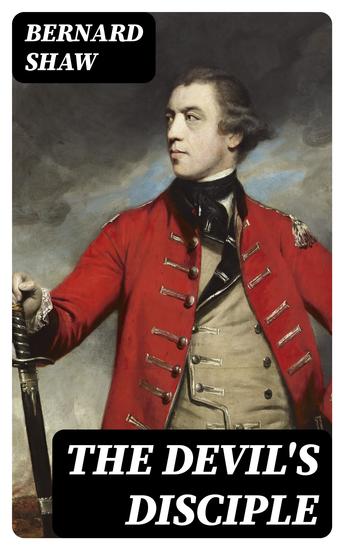
The Devil's Disciple - cover

The Devil's Disciple

Bernard Shaw

Editorial: DigiCat

  • 0
  • 0
  • 0

Sinopsis

In "The Devil's Disciple," Bernard Shaw dynamically explores the interplay of morality, religion, and individualism against the backdrop of the American Revolutionary War. Written in his signature wit and sharp dialogue, the play challenges the societal norms of heroism and virtue, presenting the character of Dick Dudgeon—an anti-hero—to interrogate the nature of good and evil. Shaw's incisive satirical style is embedded within the play's structure, blending comedic elements with profound philosophical discourse, ultimately highlighting the absurdities of dogma and the complexities of human motivations. Bernard Shaw, an influential Irish playwright and critic, was known for his advocacy of social reform and his critical views on religion and authority. His experiences with the theater, combined with his radical political beliefs and exposure to diverse philosophical ideas, shaped his perspective on societal issues. Shaw's disdain for institutional hypocrisy informs the moral dilemmas faced by his characters, allowing him to weave sharp social commentary throughout his works, including in "The Devil's Disciple." This thought-provoking play is highly recommended for readers seeking to engage with Shaw's incisive critique of moral absolutism and the nature of self-sacrifice. With its blend of humor and critical reflection, "The Devil's Disciple" remains a compelling exploration of human conscience and societal expectation, captivating audiences both in its historical context and relevance to contemporary debates.
Disponible desde: 16/09/2022.
Longitud de impresión: 69 páginas.

Otros libros que te pueden interesar

  • Poet in the New World - Poems 1946–1953 - cover

    Poet in the New World - Poems...

    Czeslaw Milosz

    • 0
    • 0
    • 0
    A new collection of work from Nobel laureate Czeslaw Milosz that includes previously untranslated poems written during his time in Washington, D.C., and his years in Europe before and after 
    One of the most revered poets of the twentieth century, Czeslaw Milosz famously bore witness to its violence in his native Poland and in the war’s aftermath from exile in Europe and the United States. Immediately after the war, he lived in Washington, D.C., working as a diplomatic official, having left behind an old world stained by bloodshed and still in the throes of ideological conflict as he sought to find his bearings in a new world. 
    Poet in the New World gathers the poems written during these years—for the first time in English translation—and is contextualized by the poetry that came directly before and after, from poems written in Warsaw in 1945, shortly before he departed for the United States, to others written in Europe from 1951 to 1953, after his significant time away. Capturing Milosz at his existential and stylistic best, Poet in the New World is attuned to the necessity of imagination and the duty of language and is filled with wonder and skepticism. Milosz grapples with the extraordinary violence he had witnessed in Warsaw and the strange postwar United States he has inhabited, all while pondering the enduring fate of his beloved Poland. In the poem “Warsaw,” the poet asks, “How can I live in this country/Where the foot knocks against/the unburied bones of kin?” 
    Equal parts affecting and illuminating, Poet in the New World is an essential addition to the Milosz canon, in a beautifully rendered translation by Robert Hass and David Frick, that reverberates with the questions of histories past, present, and future. 
    Supplemental enhancement PDF accompanies the audiobook. 
     
    Ver libro
  • Lycidas - Much shorter poem from the famed author of Paradise Lost - cover

    Lycidas - Much shorter poem from...

    John Milton

    • 0
    • 0
    • 0
    John Milton was born in Bread Street, London, on December 9th, 1608.  His early years were privately tutored before gaining a place at St Paul’s School and in 1625 he matriculated at Christ's College, Cambridge, earning a BA in 1629 and an MA in 1632. At Cambridge he had developed a reputation for poetic skill but also experienced alienation from his peers and university life as a whole.  
    The next 6 years were spent in private study. He read both ancient and modern works of theology, philosophy, history, politics, literature and science, in preparation for a poetical career.  Milton mastered Latin, Greek, Hebrew, French, Spanish, and Italian. To these he would add Old English (whilst researching his History of Britain) and also acquired more than a passing acquaintance in Dutch.  
    Although he was studying, some of his poetry from this time is remarkable; L’Allegro and Il Penseroso in 1631 and Lycidias in 1638. 
    In May 1638, Milton embarked upon a 15 month tour of France and Italy. These travels added a new and direct experience of artistic and religious traditions, especially Roman Catholicism.  He cut the journey short to return home during the summer of 1639 because of what he claimed were "sad tidings of civil war in England."  
    Once home, Milton wrote prose tracts against episcopacy, in the service of the Puritan and Parliamentary cause.  
    He married 16-year-old Mary Powell in June 1643 but she left him after only a few months during which he wrote and published several writings on divorce. Mary did return after 3 years and their life thereafter seemed harmonious.  Milton received a hostile response to the divorce tracts and drove him to write Areopagitica, his celebrated attack on pre-printing censorship.  
    With the parliamentary victory in the Civil War, Milton wrote The Tenure of Kings and Magistrates (1649) which defended popular government and implicitly sanctioned the regicide which led to his appointment as Secretary for Foreign Tongues by the Council of State.  
    On 24 February 1652 Milton published his Latin defense of the English People, Defensio Pro Populo Anglicano, also known as the First Defense. Milton's Latin prose and intellectual sweep, quickly gained him a European reputation.  
    Tragically his first wife, Mary, died on May 5th, 1652 following the birth of their fourth child.   The following year Milton had become totally blind, probably due to glaucoma.  He then had to dictate his verse and prose to helpers, one of whom was the poet Andrew Marvell.  
    He married again to Katherine Woodcock but she died in February 1658, less than four months after giving birth to a daughter, who also tragically died.  
    Though Cromwell’s death in 1658 caused the English Republic to collapse Milton stubbornly clung to his beliefs and in 1659 he published A Treatise of Civil Power, attacking the concept of a state-dominated church. Upon the Restoration in May 1660, Milton went into hiding for his life. An arrest warrant was issued and his writings burnt. He re-emerged after a general pardon was issued, but was nevertheless arrested and briefly imprisoned before influential friends, such as Marvell, now an MP, intervened 
    His third marriage was to Elizabeth Mynshull. Despite a 31-year age gap, the marriage seemed happy and Milton spent the remaining decade of his life living quietly in London, apart from a short spell in Chalfont St. Giles, during the Great Plague of London.  
    Milton was to now publish his greatest works, which had been gestating for many years.  Paradise Lost, perhaps the classic English Epic poem was originally published in 10 books in 1667.  This was followed by Paradise Regained and Samson Agonistes in 1671.  Because of his anti-monarchy views their reception was muted but over the centuries since Milton has established himself as second only to Shakespeare.  He died of kidney failure on November 8th, 1674 and was buried in the church of St Giles Cripplegate.
    Ver libro
  • The Most Charming Creatures - Poems - cover

    The Most Charming Creatures - Poems

    Gary Barwin

    • 0
    • 0
    • 0
    With uncanny wit, inventive beauty, and numinous surprise, The Most Charming Creatures explores the contemporary and its language, considering our wonder, sorrow, bewilderment, anxiety, and tenderness. While these poems energize and connect and “turn the paren- / theses inside out so that / we mean everything,” they are also alive to the alluring complicity of language and its duplicity and deceptions. “This is the way the world ends / Not with a bang but / while we watch.”
    		 
    A follow-up to the award-winning author’s acclaimed selected poems, this new collection continues Barwin’s examination of the possibilities of the poem: a celebration, a story, an investigation, a riff, a word machine, a parable, a transformation. But what are the “most charming creatures” of the title? In 1862, scientific illustrator Ernst Haeckel termed radiolarians (ancient single-celled organisms with mineral skeletons) “the most charming creatures,” but here Barwin turns the microscope around to consider something just as strange and mysterious: language, our culture, and the self. From microorganisms, onion rings, grief, and Gerard Manley Hopkins to beetles, neoliberalism, sandwiches, Martin Luther, and stand-up comedy, he offers: “it’s a miracle that we’ve survived / it’s a miracle that we’ve survived at all.”
    Ver libro
  • Reflection: Poetry - cover

    Reflection: Poetry

    John Samurai

    • 0
    • 0
    • 0
    John Samurai – Reflection Poetry 
    A book full of inspiring and delightful ruminations. Exquisite poetry that will make you ponder and will get you closer to Satori. Enlightenment. This book was written in order to entertain and leave a gasped by its profundity every reader of any walk of life. You can be a housewife or a professor at MIT and you still will find something in this book that will make you want to read more of it. There are jokes in this book as well as deepest meditations on topics of life and death. The philosophy of the author allows to bring yourself forward and learn from every word written in this book. After all we are all life long learners even if not everyone of us has a degree to show for it. 
    This book is the book to beginner poet and philosopher. The tightly knit words and one-page plots make you wonder how much more of it can you get just between the covers of one hundred pages. 
    Buy, read, enjoy and get closer to your own spiritual enlightenment.   
    Ver libro
  • The Top 10 Poets – The American Women - Five poems each from some of the best American female poets ever - cover

    The Top 10 Poets – The American...

    Alice Dunbar Nelson, Amy Lowell,...

    • 0
    • 0
    • 0
    The language of Poetry is an art that most of us attempt at some point in our lives.  Although its commonplace exposure has been somewhat marginalised in today’s often fast-paced lives we all recognise good verse that can empathise with our thoughts or open us up to experience new things in new ways, to better understand and to enjoy the many strands of our lives. 
     
    But finding a starting point can be overwhelming, even off-putting, so in this series we offer up our Top 10 classic poets, who brim with talent and verse, on a range of subjects and themes that we can all enjoy. 
     
    The American poetess may have lived in the constancy and overbearing shadows of their male colleagues but their verse is the equal of each and every man, whoever they may be.  Their words do not surrender to pity or lack of self-esteem, but are glowing tributes to the talents of humanity despite the shadows that often clouded their lives.
    Ver libro
  • Oi You Lot - cover

    Oi You Lot

    Kareem Parkins-Brown

    • 0
    • 0
    • 0
    'The sky belongs to everybody and everybody belongs to the sky.
    When the genie comes out, wish for late busesand missed trains, and beers on benches,because when someone is gone, they are gone.'
    Kareem Parkins-Brown's highly-anticipated pamphlet is an audacious and richly plural celebration of friends and selves, present and otherwise. In Parkins-Brown's hands, language bends like an illusionist's spoon – a dazzling, fisheye-lens distortion of daily grief, absurdity and communion – while reminding us always that the trick is to carry on living.
    'Kareem Parkins-Brown's excellent pamphlet is like a funeral held in a bouncy castle: the line-breaks slip on their own tears, jumping mourners get bruised by their collisions and the laughing starts to sound a lot like crying.' Caroline Bird
    'I have been waiting for this book for years. There's no voice like Kareem Parkin-Brown's. Sacred and profane, these are critical, kinetic poems for, and of, right now.' Rachel Long
    'Kareem Parkins-Brown is one of the most beloved wordsmiths on the London poetry circuit. 'Oi You Lot' will show its readers why.' Raymond Antrobus
    Ver libro