Join us on a literary world trip!
Add this book to bookshelf
Grey
Write a new comment Default profile 50px
Grey
Subscribe to read the full book or read the first pages for free!
All characters reduced
The Memoirs of the Conquistador Bernal Diaz del Castillo (Vol 1&2) - Complete Edition - cover

The Memoirs of the Conquistador Bernal Diaz del Castillo (Vol 1&2) - Complete Edition

Bernal Díaz del Castillo

Translator John Ingram Lockhart

Publisher: Good Press

  • 0
  • 0
  • 0

Summary

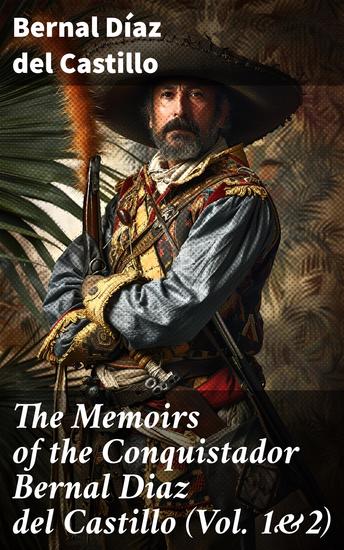
The Memoirs of the Conquistador Bernal D√≠az del Castillo (Vol. 1&2) is an essential historical account that offers an intimate glimpse into the Age of Exploration, specifically the Spanish conquest of Mexico. Written in a candid and unadorned style, D√≠az del Castillo's narrative serves not only as a memoir but also as a crucial primary source for understanding the tumultuous encounters between European colonizers and indigenous civilizations. His vivid descriptions and firsthand experiences detail the treacherous journey of Hern√°n Cort√©s and the complexities of the Aztec Empire, providing a nuanced portrayal that challenges more romanticized historical perspectives. Bernal D√≠az del Castillo was a soldier and witness to the events he chronicled, joining Cort√©s'Äôs expedition in 1519. His background as a common foot soldier, rather than an aristocrat, allows for a remarkable authenticity in his narrative. A contemporary of Cort√©s, D√≠az del Castillo sought to document not only his own experiences but also to give voice to the struggles of fellow adventurers and the indigenous peoples impacted by conquest, thereby contextualizing the historical significance of their interactions. I highly recommend The Memoirs of the Conquistador for anyone interested in colonial history, indigenous studies, or the complex narrative of cultural encounters. D√≠az del Castillo's work is not only engaging and enlightening but also serves as a profound reminder of the consequences of imperial ambitions, making it vital for scholars and general readers alike.
Available since: 12/15/2023.
Print length: 1101 pages.

Other books that might interest you

  • Tairona Civilization - The Goldsmiths and Sacred Cities of Colombia - cover

    Tairona Civilization - The...

    Rolf Hedger

    • 0
    • 0
    • 0
    The Tairona civilization emerged in the Sierra Nevada de Santa Marta, a mountainous region in present-day northern Colombia. This environment, with its dense forests, rivers, and proximity to the Caribbean coast, provided the resources necessary for the development of a complex society. The origins of the Tairona can be traced back to around 200 CE, when early communities began establishing settlements in the highlands and along the coast. These groups developed distinct cultural traditions that set them apart from other indigenous societies in the region. 
    Archaeological evidence suggests that the Tairona were part of the broader Chibchan linguistic and cultural family, which included other groups in Central America and northern South America. Their language and customs connected them to a vast network of indigenous peoples, yet they developed a unique identity characterized by their architectural achievements, goldsmithing skills, and intricate social structures. Unlike nomadic tribes, the Tairona built permanent settlements that evolved into thriving city-states. These cities were connected by a network of stone-paved roads, stairways, and terraces, showcasing an advanced understanding of engineering and urban planning. 
    The natural landscape played a crucial role in shaping the early Tairona civilization. The Sierra Nevada de Santa Marta provided fertile land for agriculture, allowing them to cultivate maize, beans, and cassava. The coastal regions, on the other hand, gave them access to an abundance of marine resources, including fish and shellfish. This diversity of food sources enabled population growth and the expansion of settlements. Over time, the Tairona developed irrigation systems and terraced farming techniques to maximize agricultural production, ensuring food security for their communities.
    Show book
  • Chaldeans The: The History and Legacy of the People Who Ruled Babylon in the Iron Age - cover

    Chaldeans The: The History and...

    Charles River Editors

    • 0
    • 0
    • 0
    Today, Babylon has become a byword for greed, excess, and licentiousness, mostly due to its mention in the Bible, but a closer examination reveals that Babylon was so much more, and even perhaps the most important city in the ancient world. Ancient Babylon was home to great dynasties that produced some of the world’s most influential leaders, most notably Hammurabi and Nebuchadnezzar, and these rulers invoked their wills on the entire ancient Near East and have been remembered as both progressive and cruel all at the same time. Babylon was also the seat of culture in ancient Mesopotamia and the place where scholars made amazing scientific advances that would not be eclipsed for several centuries. Babylon was also instrumental in the development of the region’s religions, and naturally, Westerners have been fascinated by the close connections between some of the Mesopotamian religious texts, which include a flood story, a creation story and a story of the righteous sufferer, and their parallels in the Hebrew Bible.  
    	The Chaldeans were among the last of the native Mesopotamian peoples to rule ancient Babylon. Before them, Akkadians, Kassites, Assyrians, and others ruled the land situated in the middle of Mesopotamia, and before them, the Sumerians ruled southern Mesopotamia and briefly most of the region in the late 3rd millennium BCE. Understanding ancient Mesopotamia requires knowing studying how different city-states and ethnic groups were often vying for power, asserting themselves and their ethnic identities while simultaneously accepting core elements of Mesopotamian culture – notably language, science, religion, and historiography – as they played a role in the region’s development.  
    	What makes the Chaldeans unique, however, is that they can be traced to the Levant. Sometime in the late 2nd millennium BCE, the Chaldeans began a trek across the region, as many people did at that time, and eventually occupied land along the Euphrates River.
    Show book
  • The Jack-Roller - A Delinquent Boy’s Own Story - cover

    The Jack-Roller - A Delinquent...

    Clifford R. Shaw

    • 0
    • 0
    • 0
    The Jack-Roller tells the story of Stanley, a pseudonym Clifford Shaw gave to his informant and co-author, Michael Peter Majer. Stanley was sixteen years old when Shaw met him in 1923 and had recently been released from the Illinois State Reformatory at Pontiac, after serving a one-year sentence for burglary and jack-rolling (mugging),  
     
    Vivid, authentic, this is the autobiography of a delinquent—his experiences, influences, attitudes, and values. The Jack-Roller helped to establish the life-history or “own story” as an important instrument of sociological research. The book remains as relevant today to the study and treatment of juvenile delinquency and maladjustment as it was when originally published in 1930.
    Show book
  • Diary of a Crisis - Israel in Turmoil - cover

    Diary of a Crisis - Israel in...

    Saul Friedländer

    • 0
    • 0
    • 0
    Searching reflections on the crisis in Israel and Gaza by a Pulitzer Prize-winning historian of the Holocaust 


    Diary of a Crisis explores the past tumultuous and traumatic year in Israel-Palestine. The eminent historian Saul Friedländer began a diary of Israeli politics in January 2023 as the country was convulsed by protests against Netanyahu's attempt to overhaul the judiciary. Hundreds of thousands took to the streets to demonstrate against this threat to democracy. But the protests said nothing about the Palestinian question—the "elephant in the room," according to Friedländer, who resumed his diary after Hamas's October 7 assault on southern Israel. Israel was facing one of the worst crises in its history, he observes, under the worst possible internal conditions. 


    Friedländer weaves together profound reflections on a national history in which he has been an active participant. He describes how Prime Minister Golda Meir once flatly declared to him, "There is no Palestinian people." For Friedländer, on the other hand, the fight for democracy is inseparable from equality of treatment for Arab and Jewish citizens and an end to Israeli domination over Palestinians in the Occupied Territories. He argues that despite the continuing bloodshed, a two-state solution remains the only long-term answer to this most intractable of conflicts.
    Show book
  • Obfuscation - Deliberately Making Information Unclear to Mislead - cover

    Obfuscation - Deliberately...

    Cito Harder

    • 0
    • 0
    • 0
    Obfuscation is the deliberate act of making information unclear, ambiguous, or misleading to obscure the truth. It is a technique used in various fields, from politics and business to science and everyday communication. Whether through complex language, excessive detail, or intentional vagueness, obfuscation serves to manipulate perceptions, control narratives, and, in many cases, maintain power. Understanding how and why obfuscation is used is essential to identifying and countering its effects in a world where misinformation and deception are widespread. 
    Throughout history, obfuscation has played a critical role in shaping societies. Governments have used it to control populations, corporations to shield questionable practices, and individuals to navigate social interactions. In politics, leaders often employ ambiguous language in speeches and policies, leaving room for multiple interpretations and avoiding accountability. Businesses use complex legal terms in contracts to obscure hidden fees or unfavorable clauses. Even in science and technology, obfuscation can be found in manipulated research data or complex algorithmic systems that hide biases. 
    One of the most common techniques of obfuscation is the use of technical jargon and complexity. Specialized terminology, while necessary in professional fields, can be used to confuse outsiders and prevent scrutiny. Legal documents, financial statements, and medical reports often contain dense language that makes it difficult for the average person to understand crucial information. This deliberate complexity benefits those in power while keeping the public uninformed.
    Show book
  • The Good Captain - A Personal Memoir of America at War - cover

    The Good Captain - A Personal...

    R.D. Hooker

    • 0
    • 0
    • 0
    The veteran soldier, Pentagon advisor and White House staffer recounts his long and distinguished military career in this acclaimed memoir. 
     
    A combat soldier and leader in five wars, R. D. Hooker also served as a White House staff member in four different administrations. He retired in 2010 as the most decorated colonel in the US Army. Beginning with his enlistment at 18 in 1975, this memoir chronicles his experiences in the post-Vietnam Army as a young paratrooper, West Point cadet, and combatant in the many military conflicts which followed.  
     
    Hooker served in Grenada, Somalia. Rwanda, Bosnia, and Kosovo. He played a key role in the response to 9/11 and returned to combat in Iraq and Afghanistan. He commanded a paratroop company, battalion and brigade and served in the continental US, Latin America, Europe, the Middle East, Africa and Southwest Asia. When not deployed, he taught at West Point and served in several high-level Pentagon assignments and in the White House in the administrations of George H. W. Bush, Bill Clinton, George W. Bush and Donald Trump. 
     
    In The Good Captain, Hooker recounts his storied career with insights and lessons learned through five different conflicts. He also describes each of these campaigns from a strategic and policy perspective informed by his White House and Pentagon experiences as well as years of academic training.
    Show book