Join us on a literary world trip!
Add this book to bookshelf
Grey
Write a new comment Default profile 50px
Grey
Subscribe to read the full book or read the first pages for free!
All characters reduced
Underground Museums - cover

Underground Museums

Benjamin Ramirez

Translator A AI

Publisher: Publifye

  • 0
  • 0
  • 0

Summary

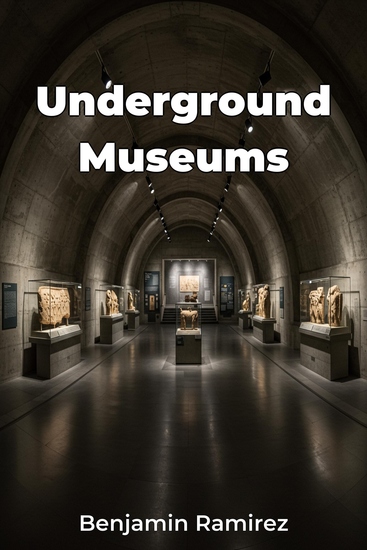
"Underground Museums" explores the captivating world of subterranean cultural institutions, revealing the architectural ingenuity and historical significance of museums built beneath the surface. These hidden spaces serve vital roles, from protecting delicate artifacts from environmental damage to discreetly storing sensitive collections. The book examines how innovative designs, employing unique space utilization and engineering, create environments that enhance both preservation and visitor experience.

 
The book delves into the historical contexts that prompted the creation of these museums. For example, many were constructed in response to wars, natural disasters, or political upheavals, highlighting the critical need to safeguard cultural heritage. It also analyzes how the unique setting of underground museums shapes visitor perception and engagement with exhibits, offering distinct curatorial opportunities.

 
The book progresses by examining architectural challenges, motivations for building underground, and the overall visitor experience. By focusing on the sensory experience and atmosphere of subterranean spaces, this book uniquely considers the impact of lighting, acoustics, and spatial design on visitor perception. This approach enriches our understanding of how these museums function as cultural institutions.

 
Ultimately, the book challenges conventional notions of museums, positioning them as active agents in interpreting and preserving cultural memory.
Available since: 02/24/2025.
Print length: 71 pages.

Other books that might interest you

  • Your Happiness Equation - The Guide To Optimizing Happiness - cover

    Your Happiness Equation - The...

    Leighton Campbell

    • 0
    • 0
    • 0
    Discover the path for lasting happiness with Your Happiness Equation! This insightful guide shows you how to not only find happiness but keep it, and even measure it with your own personal Happiness Score. By answering just seven easy questions, you’ll uncover opportunities to optimize your happiness and transform your life. Whether you’re seeking more fulfillment or looking to improve your well-being, Your Happiness Equation offers practical tools and life-changing insights to help you thrive.
    Show book
  • The Art Of Worldly Wisdom - 300 Maxims on Power Prudence and the Art of Living Well (Oráculo Manual y Arte de Prudencia The Manual Oracle and the Art of Prudence) - cover

    The Art Of Worldly Wisdom - 300...

    Baltasar Gracián y Morales,...

    • 0
    • 0
    • 0
    “Absolutely unique — a book made for constant use and a companion for life" "I have never found a book that contains such a multitude of wise rules for the conduct of life.” - Arthur Schopenhauer  
    “Europe has never produced anything more subtle in matters of moral knowledge" "Such a book should be every thinking person’s constant companion, read slowly, weighed ounce by ounce.” - Friedrich Nietzsche  
    “[Gracian was] the great cartographer of the interior life” - José Ortega y Gasset 
     
    In the courts of seventeenth-century Spain, a Jesuit priest distilled a lifetime of sharp observation into 300 maxims on prudence, strategy, and self‑mastery that became a sensation across Europe, with lasting influence over the centuries. Originally published in 1647 as Oráculo Manual y Arte de Prudencia, this collection of aphorisms and their commentaries was intended to offer guidance on how to live fully, advance socially, and become a better person. Drawing on careful study of statesmen and those in positions of power, Gracián crafted maxims that offer profound insight into the art of living and the practice of achieving. His secular moral reflections on reality and appearances, self-love and friendship, wit and ignorance are pragmatic, spiritual, prudent, and discreet.  
     
     Together the maxims form a durable, tested companion to decision‑making and practical judgment, on how to cultivate inner substance, read others’ intentions without prejudice, and protect one’s energy from futile conflicts. Voltaire praised it for its astute observations on human nature, and Schopenhauer translated it into German, hailing it as his pocket oracle and introducing it to a new audience. It is said to have accompanied Winston Churchill on the voyage that took him to the Boer War, and André Gide was among those who admired the French edition.
    Show book
  • The Book of Memory - How We Become Who We Are - cover

    The Book of Memory - How We...

    Mark Rowlands

    • 0
    • 0
    • 0
    A brilliant journey through the nature of memory, helping us understand how what is lost—and what is remembered—shapes who we are.In this revelatory and intimate exploration of the way memory works, Mark Rowlands, author of The Philosopher and the Wolf, reveals how memories aren’t fixed. They soften and consolidate—and are distorted—each time we revisit them, even those memories most deeply ingrained. The way we call on memory is closer to a "negotiation with the past."From episodic memories like "shining islands in dark waters" and forgotten "Rilkean" memories that underpin our personalities and essential style to the memories we might hold that have been authored by others close to us, The Book of Memory draws on philosophical argument, a range of writers and thinkers, the latest neurological research, and psychology experiments to chart how memories are made, lost and remembered, with important consequences for how we understand ourselves.
    Show book
  • Sapiens Journey The: Exploring the Extraordinary Story of Homo Sapiens - A Deep Exploration of Human Evolution Civilization and the Future of Homo Sapiens - cover

    Sapiens Journey The: Exploring...

    Bryan M. Deleon

    • 0
    • 0
    • 0
    The Sapiens Journey is a deep dive into the story of Homo sapiens, exploring how this species rose from early origins to shaping civilizations. This Homo sapiens audiobook traces the journey through key milestones in human history, from the Cognitive Revolution to the development of society, technology, and culture. 
    For those interested in audiobooks on Homo sapiens, this narration provides a compelling perspective based on anthropology, archaeology, and evolutionary science. Whether searching for sapiens audiobooks, sapiens audiobook, or insights into the human story, this journey offers a broad understanding of our past, present, and future. 
    Covering migration, survival, and the Sapiens Journey, this audiobook is ideal for those fascinated by history, science, and the legacy of humanity. Audiobooks sapiens, sapien audiobook, and sapiends audiobook all explore what makes humans unique—this audiobook provides an accessible and engaging experience. 
    If you’re looking for the definitive exploration of Homo sapiens audiobooks, sapiens history, and the incredible human story, this audiobook offers everything from evolutionary biology to ancient civilizations in one engaging journey.
    Show book
  • Samurai! - cover

    Samurai!

    Saburo Sakai

    • 0
    • 0
    • 0
    Samurai! is the gripping autobiography of Saburō Sakai, one of Japan’s most renowned fighter pilots during World War II. Co-written with Fred Saito and Martin Caidin, the book chronicles Sakai’s rise from a poor rural upbringing to becoming an elite Zero pilot in the Imperial Japanese Navy. With vivid detail and unflinching honesty, he recounts harrowing dogfights, the horrors of war, and his legendary 1,000-mile flight back to base after being grievously wounded. More than just a war memoir, Samurai! offers rare insight into the mindset, discipline, and honor of a warrior shaped by both tradition and global conflict.
    Show book
  • Kaiseki - The Art of Japanese Haute Cuisine - cover

    Kaiseki - The Art of Japanese...

    Malte Härtig

    • 0
    • 0
    • 0
    Simplicity, mindfulness, tranquility, attention to detail — all these elements of Japanese philosophy are nor only reflected in the famous tea ceremony but also in kaiseki cuisine.
    
    Why do the pretty Japanese wagashi sweets taste like dusty sugar, why do the tea bowls have dents, why does the soup taste like nothing? Malte Härtig, chef and philosopher, is puzzled when he tries Japan's famous haute cuisine kaiseki for the first time. Neither his Western philosophical approach nor his European culinary training can help him decipher kaiseki. But then he finds a way in through Zen Buddhism and the famous tea ceremony. And with them, he encounters fundamental wisdom and a refreshing attitude, not only towards food, but also towards life.
    
    Malte Härtig takes us on his journey and guides us through a complete kaiseki menu and the experiences he had with it. It begins with the tea itself, continues with the host's preparations, the guest's knowledge, and the making of the tea bowl, and ends with the various dishes. You learn interesting facts and stories about all the elements that have accumulated over thousands of years of tradition: why a fish called hamo plays such an important role, what is special about growing bamboo shoots, and what rice has to do with Japanese identity. And you understand why Japan, the mentality of its inhabitants, and kaiseki cuisine have become so popular in recent years.
    Show book