Join us on a literary world trip!
Add this book to bookshelf
Grey
Write a new comment Default profile 50px
Grey
Subscribe to read the full book or read the first pages for free!
All characters reduced
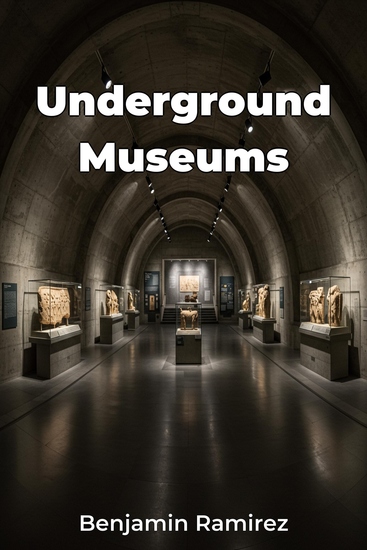
Underground Museums - cover

Underground Museums

Benjamin Ramirez

Translator A AI

Publisher: Publifye

  • 0
  • 0
  • 0

Summary

"Underground Museums" explores the captivating world of subterranean cultural institutions, revealing the architectural ingenuity and historical significance of museums built beneath the surface. These hidden spaces serve vital roles, from protecting delicate artifacts from environmental damage to discreetly storing sensitive collections. The book examines how innovative designs, employing unique space utilization and engineering, create environments that enhance both preservation and visitor experience.

 
The book delves into the historical contexts that prompted the creation of these museums. For example, many were constructed in response to wars, natural disasters, or political upheavals, highlighting the critical need to safeguard cultural heritage. It also analyzes how the unique setting of underground museums shapes visitor perception and engagement with exhibits, offering distinct curatorial opportunities.

 
The book progresses by examining architectural challenges, motivations for building underground, and the overall visitor experience. By focusing on the sensory experience and atmosphere of subterranean spaces, this book uniquely considers the impact of lighting, acoustics, and spatial design on visitor perception. This approach enriches our understanding of how these museums function as cultural institutions.

 
Ultimately, the book challenges conventional notions of museums, positioning them as active agents in interpreting and preserving cultural memory.
Available since: 02/24/2025.
Print length: 71 pages.

Other books that might interest you

  • Chicago - A Biography - cover

    Chicago - A Biography

    Dominic A. Pacyga

    • 0
    • 0
    • 0
    Chicago has been called by many names. Nelson Algren declared it a “City on the Make.” Carl Sandburg dubbed it the “City of Big Shoulders.” Upton Sinclair christened it “The Jungle,” while New Yorkers, naturally, pronounced it “the Second City.” 
    At last there is a book for all of us, whatever we choose to call Chicago. In this magisterial biography, historian Dominic Pacyga traces the storied past of his hometown, from the explorations of Joliet and Marquette in 1673 to the new wave of urban pioneers today. The city’s great industrialists, reformers, and politicians—and, indeed, the many not-so-great and downright notorious—animate this book, from Al Capone and Jane Addams to Mayor Richard J. Daley and President Barack Obama. But what distinguishes this book from the many others on the subject is its author’s uncommon ability to illuminate the lives of Chicago’s ordinary people. Raised on the city’s South Side and employed for a time in the stockyards, Pacyga gives voice to the city’s steelyard workers and kill floor operators, and maps the neighborhoods distinguished not by Louis Sullivan masterworks, but by bungalows and corner taverns. 
    Filled with the city’s one-of-a-kind characters and all of its defining moments, Chicago: A Biography is as big and boisterous as its namesake—and as ambitious as the men and women who built it.
    Show book
  • Vasco da Gama - The First Person to Sail from Europe to India around the African Continent - cover

    Vasco da Gama - The First Person...

    Kelly Mass

    • 0
    • 0
    • 0
    Vasco da Gama, the 1st Count of Vidigueira, is widely celebrated as the first European to reach India by sea. His landmark journey, which took place from 1497 to 1499, was groundbreaking in that it provided the first direct oceanic connection between Europe and Asia. By navigating around the Cape of Good Hope, located at the southern tip of Africa, da Gama linked the Atlantic and Indian Oceans for the first time, thereby bridging the Western world and the Eastern world. This achievement is considered a pivotal moment in history, marking the beginning of an era of global exploration and the rise of maritime multiculturalism. 
    Da Gama’s successful voyage opened up new trade routes, changing the course of history and shaping the future of global commerce and cultural exchange. His discovery of a sea route to India was not just a geographical milestone but a transformative event that spurred the age of global imperialism. By connecting Europe directly to the wealth of the Indian subcontinent, da Gama paved the way for the Portuguese to establish a vast colonial empire that spanned from Africa to Asia. The Portuguese empire, founded on these maritime routes, would become a powerful force in global trade, controlling key trade routes and regions for centuries. 
    However, the Portuguese expansion under Vasco da Gama and his successors was not without controversy. The methods employed by the Portuguese in their expansion were often violent and ruthless. Da Gama and his crew used extreme brutality, including kidnapping and violence against local populations, which created a lasting legacy of fear and animosity between the Portuguese and India’s indigenous rulers. This harsh approach to colonization set a precedent for the broader patterns of Western colonialism that would dominate the Age of Exploration.
    Show book
  • The Age of Elizabeth - cover

    The Age of Elizabeth

    MA Andrew Browning

    • 0
    • 0
    • 0
    From her accession through her impressive reign, this thorough biography of Elizabeth I details the life and rule of one of Britain/s most influential rulers. From diplomatic relations to military choices to the Wars of Religion, this book is extensive, detailed, and fascinating.
    Show book
  • Troy Story - cover

    Troy Story

    Carla Luna

    • 0
    • 0
    • 0
    The friendship that launched a thousand adventures is about to embark on the greatest one of all… 
    Ever since Stuart Carlson and Dusty Danforth met as kids on a dig in Egypt, they've been best friends, supporting each other through heartaches, triumphs, and countless archaeological expeditions. So when Stuart gets hired to help run the American excavations at Troy, he asks Dusty to join him as the site illustrator. 
    For Dusty, the Troy project isn't just another adventure. It’s the chance to tell Stuart how she really feels. After years of pining for him, she’s ready for more than friendship. 
    But soon after they arrive at the site in Turkey, they're caught up in a feud with a group of German archaeologists. While both teams are eager to make a major find, Stuart's boss is so determined to beat his rivals that he's willing to break a few rules. Or laws. 
    As Stuart and Dusty work together to keep the dig on track, they give in to the passion that's been simmering under the surface. But will their romance survive when their boss's scheme puts the entire project in jeopardy?
    Show book
  • Liberal White Supremacy - How Progressives Silence Racial and Class Oppression - cover

    Liberal White Supremacy - How...

    Angie Beeman

    • 0
    • 0
    • 0
    In Liberal White Supremacy, Angie Beeman argues that white supremacy is maintained not only by right-wing conservatives or stereotypically uneducated working-class racial bigots but also by progressives who operate from a liberal ideology of color-blindness, racism-evasiveness, and class elitism. This distinction provides insight on divisions among progressives at the local level, in community organizations, and at the national level, in the Democratic Party. By distinguishing between liberal and radical approaches to racism, class oppression, capitalism, and social movement tactics, Beeman shows how progressives continue to be limited by liberal ideology and perpetuate rather than dismantle white supremacy, all while claiming to be antiracist. 


    She conceptualizes this self-serving process as "liberal white supremacy," the tendency for liberal European Americans to constantly place themselves in the superior moral position in a way that reinforces inequality. Beeman advances what she calls action-oriented and racism-centered intersectional approaches as alternatives to progressive organizational strategies that either downplay racism in favor of a class-centered approach or take a talk-centered approach to racism without developing explicit actions to challenge it.
    Show book
  • Pat in the City - My Life of Fashion Style and Breaking All the Rules - cover

    Pat in the City - My Life of...

    Patricia Field

    • 0
    • 0
    • 0
    From the iconic stylist and fashion provocateur whose designs transformed culture—bringing the glitz of Studio 54 and the sophistication of Sex and the City to the mainstream—comes a playful yet intimate memoir of a life spent challenging conventions. 
     
    Carrie Bradshaw’s pairing of a tutu with a tank top is one of the most iconic outfits ever seen on television—and a look that turned avant-garde New York designer and stylist Patricia Field into a household name. But before she was crowned the fairy godmother of haute couture, Field was the owner of the longtime East Village emporium Pat Field, a haven for drag queens, club kids, starving artists, NYU freshmen, and creative visionaries alike. Presiding over downtown with her distinctive vermillion hair and a constantly lit cigarette, Patricia was a rock ’n’ roll den mother to everyone from Amanda Lepore to Lady Bunny to Patti Smith, with her store providing the city’s eccentrics with a place to discover a sense of family, home, and a rhinestone bedazzled bustier or two. 
    In Pat in the City, Patricia describes her journey from scrappy Queens kid peddling men’s pants to the fashion world’s most notorious renegade. As the daughter of immigrant parents, Field learned the principles of glamour from her entrepreneurial mother, and applied her NYU lessons on democracy to inform a fashion ethos that would reach millions. From her Studio 54 disco-glam styling to her award-winning work in The Devil Wears Prada and Sex and the City to today’s buzzy costuming in Emily in Paris, Field’s inimitable styling has pushed the envelope and created trends that have become the culture standard. Now in her seventies, Patricia Field is ready to tell her story—not to take a final bow, but to spread her credo of challenging convention and filling the world with joy and dancing.  
    Supplemental enhancement PDF accompanies the audiobook.
    Show book