Join us on a literary world trip!
Add this book to bookshelf
Grey
Write a new comment Default profile 50px
Grey
Subscribe to read the full book or read the first pages for free!
All characters reduced
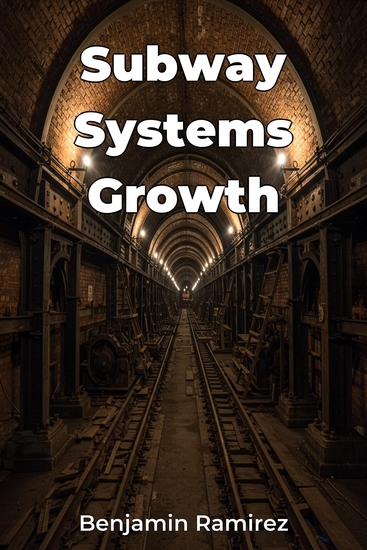
Subway Systems Growth - cover

Subway Systems Growth

Benjamin Ramirez

Translator A AI

Publisher: Publifye

  • 0
  • 0
  • 0

Summary

Subway Systems Growth explores the fascinating architectural and historical evolution of subway systems as vital subterranean arteries shaping urban landscapes. The book reveals how these underground railways, starting in the 1800s, have been instrumental in urban development and have had a profound impact on society and the economy.

 
Delving beyond mere engineering, the book highlights how subway systems reflect a city's response to evolving societal needs. It offers insights into the pioneering spirit of early construction while also emphasizing the technological advancements that fueled expansion. The book examines subway construction through detailed case studies of major cities, showcasing the unique challenges and solutions encountered.

 
Readers will discover how technological advancements, such as tunnel boring machines, revolutionized urban transit. By incorporating archival research, engineering reports, and even oral histories, Subway Systems Growth connects urban planning, civil engineering, and economic history. The book uniquely focuses on the human element, narrating the stories of those who designed, built, and used these systems.

 
The book progresses logically, beginning with foundational concepts and moving through historical case studies and technological impacts. It concludes with an analysis of the future, considering sustainability and accessibility. The approach is designed to be accessible to all, regardless of technical expertise, making it a valuable resource for anyone interested in urban history, architecture, or engineering.
Available since: 02/26/2025.
Print length: 74 pages.

Other books that might interest you

  • Emotional Mastery - Unlock Your Emotional Intelligence for Personal Growth Relationship Success and Professional Achievement (2025 Guide for Beginners) - cover

    Emotional Mastery - Unlock Your...

    Winston Young

    • 0
    • 0
    • 0
    Unlock the full potential of your emotional intelligence with "Emotional Mastery: Unlock Your Emotional Intelligence for Personal Growth, Relationship Success, and Professional Achievement." This transformative self-help guide is designed to empower you with the tools and insights needed to master your emotions, build stronger relationships, and achieve your goals. 
    In "Emotional Mastery," you’ll discover:Self-Awareness Techniques: Uncover strategies to better understand and manage your emotions, leading to improved decision-making and personal growth.Emotional Regulation Strategies: Master the art of controlling and balancing your emotions to respond to challenges with poise and resilience.Empathy Development: Enhance your ability to connect deeply with others, fostering more meaningful and fulfilling relationships.Conflict Resolution Skills: Learn effective techniques for navigating and resolving conflicts constructively, strengthening both personal and professional interactions.Relationship Management: Explore methods to maintain healthy, balanced relationships while avoiding burnout and creating lasting connections. 
    Filled with compelling stories, research-backed insights, and practical exercises, "Emotional Mastery" offers a roadmap to achieving emotional resilience and success in all areas of your life. Whether you’re looking to enhance your personal relationships, advance your career, or simply gain greater self-understanding, this book provides the essential tools for emotional growth and transformation.
    Show book
  • The Ming Dynasty - Maritime Exploration and the Forbidden City - cover

    The Ming Dynasty - Maritime...

    Jun Liu

    • 0
    • 0
    • 0
    The Ming Dynasty, one of China's most influential and enduring dynasties, emerged in the aftermath of the Mongol-led Yuan Dynasty’s decline. It was a period marked by great transformation, political consolidation, and cultural revival. The dynasty's establishment under Zhu Yuanzhang, later known as Emperor Hongwu, signified the restoration of Han Chinese rule and the reinforcement of Confucian governance. Through military conquest, administrative reforms, and strategic centralization of power, the Ming Dynasty laid the foundation for a strong and prosperous China. 
    The fall of the Yuan Dynasty was driven by internal corruption, economic mismanagement, and widespread discontent. Mongol rulers faced difficulties controlling the vast empire, and their reliance on foreign administrators alienated the native Chinese population. Heavy taxation and frequent natural disasters exacerbated social unrest, leading to a series of revolts across the country. Among these rebellions, the Red Turban Rebellion, a movement rooted in peasant uprisings and religious discontent, played a crucial role in undermining Yuan authority. It was within this turbulent period that Zhu Yuanzhang, a former Buddhist monk turned military leader, rose to prominence. His leadership and military strategies enabled him to unify rebel factions and ultimately overthrow the Mongols in 1368, marking the beginning of the Ming Dynasty. 
    Upon ascending the throne, Emperor Hongwu sought to consolidate power and rebuild a nation weakened by war and misrule. His first priority was to eliminate threats to his rule, which led to purges against those he suspected of disloyalty. To prevent a recurrence of Yuan-era administrative failures, he restructured the government, reducing the influence of court eunuchs and emphasizing Confucian ideals in governance. He also reinstated the civil service examination system, ensuring that officials were selected based on merit rather than birthright.
    Show book
  • White Poverty: Book Summary and Analysis - cover

    White Poverty: Book Summary and...

    Briefly Summaries

    • 0
    • 0
    • 0
    This is a concise summary and analysis of White Poverty, by William J. Barber II.
     
    It is not the original book and is not affiliated with or endorsed by 
    William J. Barber II.
     
    Ideal those seeking a quick and insightful overview.
    
    In this eye-opening and transformative audiobook, the author delves deep into the often-overlooked issue of white poverty in America. Through a dynamic and thought-provoking narrative, the author explores the systemic causes, historical roots, and emotional toll of poverty, challenging listeners to rethink their understanding of socioeconomic inequality.
     
    With a tone that is both motivational and compassionate, the audiobook takes you on a journey through the complexities of poverty, from its impact on individuals and families to its long-lasting psychological effects. The author highlights how white communities, often left out of conversations about poverty, face unique challenges that require our attention and collective action.
    Show book
  • Enlightened Conversations Across Ideological Differences - cover

    Enlightened Conversations Across...

    Monica Guzmán

    • 0
    • 0
    • 0
    In this conversation with Justine Willis Toms, Guzmán shares her personal experience of growing up in a politically divided family. She highlights the need for in-person interactions, attention, and containment in dialogues. She also discusses the role of media in perpetuating polarization and the potential for small-scale conversations to impact larger institutions like politics and media. Mónica Guzmán is a journalist and entrepreneur and is the Senior Fellow for Public Practice at Braver Angels, a grassroots, cross partisan, organization working to depolarize America. She is cofounder of the newsletter The Evergrey out of Seattle Washington and is the proud liberal daughter of conservative parents and is a dual US/Mexican citizen. She is the author of I Never Thought of It That Way: How to Have Fearlessly Curious Conversations in Dangerously Divided Times (BenBella Books 2022). Interview Date: 5/15/2025 
    Show book
  • The Race to the Future - 8000 Miles to Paris – The Adventure that Accelerated the Twentieth Century - cover

    The Race to the Future - 8000...

    Kassia St. Clair

    • 0
    • 0
    • 0
    The racers battle over steep inclines, through narrow mountain passages, and across the arid Gobi Desert. Competitors endure torrential rain and choking dust. There are barely any roads, and petrol is almost impossible to find. 


    More than its many adventures, the Peking-to-Paris Motor Challenge took place on the precipice of a new world. As the twentieth century dawned, imperial regimes in China and Russia were crumbling, paving the way for the rise of communist ones. The electric telegraph was rapidly transforming modern communication, and with it, the news media, commerce, and politics. Suspended between the old and the new, the Peking-to-Paris, as bestselling historian Kassia St. Clair writes, became a critical tipping point. 


    A gripping, immersive narrative of the race, The Race to the Future sets the drivers' derring-do (and occasional cheating) against the backdrop of a larger geopolitical and technological race to the future. Interweaving events from the fall of the Qing dynasty to the departure of the horse economy and the rise of gendered marketing, St. Clair shows how the Peking-to-Paris provided an impetus for profound social, cultural, and industrial change, while masterfully capturing the mounting tensions between nations and empires—all building up to the cataclysmic event that changed everything: the First World War.
    Show book
  • Thanks for Your Service - The Causes and Consequences of Public Confidence in the US Military - cover

    Thanks for Your Service - The...

    Peter D. Feaver

    • 0
    • 0
    • 0
    A definitive study on the decades-long run of high public confidence in the military and why it may rest on some shaky foundations. 


    What explains the high levels of public confidence in the US military and does high confidence matter? In Thanks for Your Service, the eminent civil-military relations scholar Peter D. Feaver addresses this question and focuses on what it means for the military. Proprietary survey data show that confidence is partly based on public beliefs about the military's high competence, adherence to high professional ethics, and a determination to stand apart from the bitter divisions of partisan politics. However, as Feaver argues, confidence is also shaped by a partisan gap and by social desirability bias, the idea that some individuals express confidence in the military because they believe that is the socially approved attitude to hold. Not only does Feaver help us understand how and why the public has confidence in the military, but he also exposes problems that policymakers need to be aware of. Specifically, this book traces how confidence in the institution shapes public attitudes on the use of force and may not always reinforce best practices in democratic civil-military relations.
    Show book