Join us on a literary world trip!
Add this book to bookshelf
Grey
Write a new comment Default profile 50px
Grey
Subscribe to read the full book or read the first pages for free!
All characters reduced
Infrastructure Maintenance Models - cover

Infrastructure Maintenance Models

Benjamin Ramirez

Translator A AI

Publisher: Publifye

  • 0
  • 0
  • 0

Summary

Infrastructure Maintenance Models explores innovative approaches to maintaining and enhancing critical urban systems. It emphasizes data-driven decision-making and proactive strategies to combat the risks associated with aging infrastructure, such as water main breaks or bridge collapses. The book highlights the significance of understanding infrastructure lifecycles and adapting maintenance strategies to modern challenges like climate change and technological disruption.

 
One intriguing fact is the emphasis on using machine learning to predict infrastructure deterioration, allowing for optimized maintenance schedules. Another key insight involves balancing preventive and reactive maintenance for cost-effective management.

 
The book presents a comprehensive framework, beginning with fundamental concepts like asset inventory and condition assessment. It then delves into advanced modeling techniques, including statistical analysis and AI applications, for predicting infrastructure performance. The final part focuses on practical implementation strategies, such as risk management and cost-benefit analysis.

 
The book's value lies in its integrated approach, combining advanced modeling with real-world applications, providing a novel perspective on leveraging data and technology for improved infrastructure decision-making in civil engineering and urban planning.
Available since: 02/21/2025.
Print length: 104 pages.


Other books that might interest you

  • The Invisible Bond - Exploring the Therapeutic Power of Emotional Support Animals - cover

    The Invisible Bond - Exploring...

    PhD Dr. Patrick Fisher

    • 0
    • 0
    • 0
    She told me she hadn't left her apartment in eleven days. The grocery delivery sat inside the front door. She had eaten what she could reach from her bed. Her therapist had called twice; she let it go to voicemail. Then her dog pressed its body against her side—and something shifted. 
    The Invisible Bond is the first book in The Invisible Series by Dr. Patrick Fisher—clinician, researcher, and founder of TheraPetic. Built on original doctoral research at Walden University, this book goes beyond clinical data to capture what it actually feels like to manage anxiety with an emotional support animal by your side. 
    Through in-depth qualitative interviews with adults living with clinically significant anxiety, Dr. Fisher documents the themes that emerged: presence, routine, grounding, connection, and the quiet ways an animal can hold space for a person who is struggling. 
    This book is for clinicians seeking to better serve clients who rely on ESAs. For individuals navigating anxiety with an animal companion. For policymakers making decisions about rights they may not fully understand. And for anyone who has ever been told that needing an animal is a weakness rather than a strategy of survival. 
    The science has not changed. Cortisol still drops. Oxytocin still releases. The autonomic nervous system still responds. This book documents why—and what it means for the future of mental health care. 
    The Invisible Series continues with The Invisible Disability, The Invisible Law, The Invisible Prison, The Invisible Identity, and The Invisible Data.
    Show book
  • Alidade Digital Fieldwork - Integration with Modern Digital Workflows for Surveyors and Geomatic Professionals - cover

    Alidade Digital Fieldwork -...

    Julian Vance

    • 0
    • 0
    • 0
    Are you a surveyor or geomatics professional looking to bridge the gap between traditional fieldwork precision and the power of modern digital technologies? "Alidade Digital Fieldwork" is your essential, hands-on guide to integrating classic surveying instruments with contemporary digital workflows, transforming your efficiency and accuracy in the field. 
    Dr. Julian Vance, a distinguished expert with over two decades of experience, demystifies the synergy between the foundational alidade and cutting-edge digital tools. This book is not just theoretical; it's a practical roadmap designed to elevate your skills and future-proof your career. 
    Inside, you will discover:The Alidade Renaissance: Reinvigorate your understanding of this timeless instrument and its enduring relevance.Digital Data Capture in the Field: Master techniques for seamlessly integrating digital measurement and observation.Mapping Terrain Digitally: Learn advanced methods for transforming raw field data into precise digital terrain models and planimetric features.Quality Control & Best Practices: Implement robust strategies to ensure data integrity and project success. 
    From plane table foundations to the intricacies of data integration and processing, each chapter builds your expertise, culminating in a holistic approach to modern surveying. Stop feeling overwhelmed by technological shifts and start harnessing them. Become the future-ready surveyor the industry demands. 
    Elevate your fieldwork. Master digital integration. Secure your professional edge.
    Show book
  • Unraveled - A Climber's Journey Through Darkness and Back - cover

    Unraveled - A Climber's Journey...

    Kate Brown

    • 0
    • 0
    • 0
    As a teenager in the 1990s, Katie Brown was one of climbing's first "comp kids"—a young natural who, along with her peers, redefined the image of a strong and successful climber. After climbing for less than two years, Brown won her first junior national title. The next year she became the Junior World Champion at age fourteen in Laval, France. In 1996 she won both the Rock Master—a prestigious international contest in Arco, Italy—and the esteemed X-Games. From 1996 on, Brown won every US Adult National that she entered, as well as a World Cup Title in France in 1999. 


    Yet even as she reigned on the podium, Brown felt her life begin to unravel. A quiet child, she struggled with a home life that was very different behind closed doors than it seemed on television. A fundamentalist version of Christianity was at the center of the household, and Brown fought to live according to rules that were strict, ever-changing, and irrational. Isolated and feeling hopeless, Brown latched onto food as something she could control. She quit competitive climbing and bounced in and out of the industry, eventually disappearing in her late twenties. 


    Now, more than two decades later, Brown is ready to share her story. Unraveled answers the question thousands of fans worldwide have wondered: "What ever happened to Katie Brown?"
    Show book
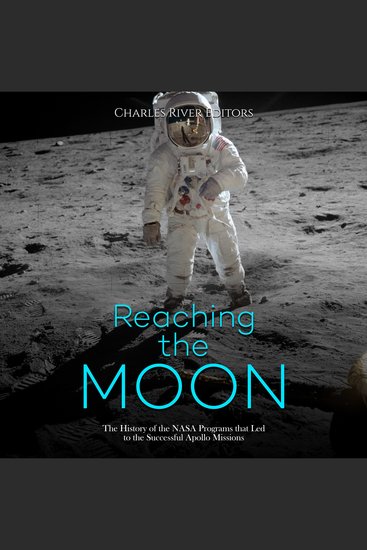
  • Reaching the Moon: The History of the NASA Programs that Led to the Successful Apollo Missions - cover

    Reaching the Moon: The History...

    Editors Charles River

    • 0
    • 0
    • 0
    The Apollo Program is the most famous and celebrated in American history, but the first successful landing of men on the Moon during Apollo 11 had complicated roots dating back over a decade, and it also involved one of NASA’s most infamous tragedies. From 1959-1963, the United States worked toward putting satellites and humans into orbit via the Mercury program, but Eisenhower’s administration was already designing plans for the Apollo program by 1960, a year before the first Russian orbited the Earth and two years before John Glenn became the first American to orbit the Earth. 
    At the same time, America would begin missions to the Moon as early as 1958. On March 27, 1958, Secretary of Defense Neil McElroy announced a lunar project for the International Geophysical Year, consisting of three Air Force launches followed by two Army launches of a JPL-designed lunar probe. ARPA directed the Air Force to launch its probes "as soon as possible consistent with the requirement that a minimal amount of useful data concerning the Moon be obtained." 
    Throughout the 1960s, NASA would spend tens of billions on missions to the Moon, the most expensive peacetime program in American history to that point, and Apollo was only made possible by the tests conducted through earlier missions, including the historic Ranger Program. Conceived as an early part of the attempt to land a man on the Moon, Ranger was designed to photograph the lunar surface in preparation for future landings. Until Ranger, images of the Moon were only available through Earth-based telescopes, which lacked the detail necessary to determine safe sites for landing a spacecraft. Ranger aimed to fill in that gap of knowledge, and like many of NASA’s missions during the 1960s, the program exemplified both the successes and the failures of the agency’s early years.
    Show book
  • Perfect Organism - An Alien: Isolation Companion - cover

    Perfect Organism - An Alien:...

    Andy Kelly

    • 0
    • 0
    • 0
     An unofficial guide to   Alien: Isolation  , the greatest, scariest horror game ever made 
    There aren't many computer games that can justify an entire book, but for superfans,  Alien: Isolation  is truly extraordinary.  Perfect Organism  reveals all there is to know about every aspect of this masterful game.
    
    
    Discover the rationale of the set design and art direction, learn about the alien's unnerving abilities to second-guess players. Find out more about the importance of the dynamic audio, the use of seventies archive soundbites, and the darkly beautiful music. Immerse yourself in the technical brilliance of the level design and user interface, and read about the content that never made the final cut.
    Show book
  • From Terrain to Brain - Forays into the Many Sciences of Wine - cover

    From Terrain to Brain - Forays...

    Erika Szymanski

    • 0
    • 0
    • 0
    In From Terrain to Brain, Professor Erika Szymanski makes wine science accessible to non-experts. Rather than approach wine science as body of facts about wine, Szymanski explores how wine science can open up multiple ways of seeing, understanding, and appreciating wine. 


    Too often, wine science is presented as a comprehensive body of knowledge that enthusiasts aiming to become experts should memorize. This book instead uses scientific research to explore wine as an endlessly rich cultural phenomenon. By foregrounding recent research and developments in wine science, From Terrain to Brain presents wine science as a work-in-progress rather than a codified body of knowledge. 


    Each chapter takes listeners on a journey or "foray" through a topic in wine science, such as minerality, climate, microbiome, and yeast. Chapters are organized from "terrain" (geography, terroir, soil) and cell "membrane" (microbiology) through "brain" (the experience of tasting) and "drain" (sustainability). Throughout, From Terrain to Brain emphasizes that wine science, wine culture, and tradition are interconnected and places scientific research in social and historical context.
    Show book