Join us on a literary world trip!
Add this book to bookshelf
Grey
Write a new comment Default profile 50px
Grey
Subscribe to read the full book or read the first pages for free!
All characters reduced
Compact Living - cover

Compact Living

Benjamin Ramirez

Translator A AI

Publisher: Publifye

  • 0
  • 0
  • 0

Summary

Compact Living examines the rise of micro-apartments, co-living spaces, and other space-efficient housing models as innovative solutions to urbanization and housing affordability challenges. It explores how these developments redefine our understanding of "home" in dense urban environments.

 
For instance, the book highlights the design principles of micro-apartments, revealing how spatial optimization techniques affect residents' quality of life. It also delves into the social dynamics of co-living spaces, investigating their role in fostering community building and addressing social isolation.

 
The book adopts a holistic approach, integrating architectural design, social analysis, and economic considerations. Beginning with an overview of compact living concepts, it progresses through specific housing types like micro-apartments and co-living spaces, using case studies and resident experiences to illustrate key points.

 
Ultimately, Compact Living argues that well-designed compact living solutions can create more affordable, sustainable, and socially connected urban environments, challenging traditional notions of housing size and ownership.
Available since: 02/21/2025.
Print length: 88 pages.
Other books that might interest you

  • Iran's Rise and Rivalry with the US in the Middle East - cover

    Iran's Rise and Rivalry with the...

    Mohsen M. Milani

    • 0
    • 0
    • 0
    The 1979 Islamic Revolution triggered a cold war between Iran and the United States—former fast friends. Despite the US's relentless efforts at containment, Iran has risen as a formidable power in Iraq, Syria, Lebanon, Yemen, and Gaza. Its newfound status not only frustrates the US but has swiftly become a thorn in the side of Israel and Saudi Arabia. How did Iran rise so rapidly? And as it faces ever increasing pressure at home and abroad, can it hold onto its power? Mohsen Milani guides us through the twists and turns of the Iran–US rivalry in the battlefields of the Middle East. Going from the fall of the Shah to revolutionary Iran's alliances with Syria, Hamas, Hezbollah, Iraqi militias, and the Houthis in the Axis of Resistance, Milani lifts the veil on Iran's foreign policy strategy and its implications for the region, the US, and Iran itself.
    Show book
  • Operation Rolling Thunder and Operation Menu: The History of the Vietnam War’s Most Controversial Bombing Campaigns - cover

    Operation Rolling Thunder and...

    Editors Charles River

    • 0
    • 0
    • 0
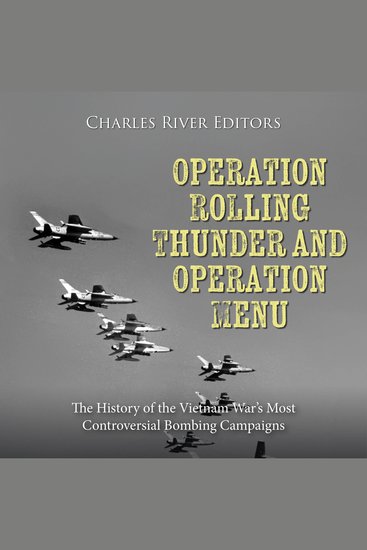
    Before the Vietnam War, most Americans would have been hard pressed to locate Vietnam on a map. South Vietnamese President Diem’s regime was extremely unpopular, and war broke out between Communist North Vietnam and South Vietnam around the end of the 1950s. Kennedy’s administration tried to prop up the South Vietnamese with training and assistance, but the South Vietnamese military was feeble. A month before his death, Kennedy signed a presidential directive withdrawing 1,000 American personnel, and shortly after Kennedy’s assassination, new President Lyndon B. Johnson reversed course, instead opting to expand American assistance to South Vietnam. 
    Over the next few years, the American military commitment to South Vietnam grew dramatically, and the war effort became both deeper and more complex. The strategy included parallel efforts to strengthen the economic and political foundations of the South Vietnamese regime, to root out the Viet Cong guerrilla insurgency in the south, combat the more conventional North Vietnamese Army (NVA) near the Demilitarized Zone between north and south, and bomb military and industrial targets in North Vietnam itself.  
    	The United States, attempting to maintain its status as leader and defender of the non-communist world, gradually offered more and more support to South Vietnam’s leaders in Saigon, and direct military intervention became inevitable after the famous Gulf of Tonkin Incident, which also greatly influenced Operation Rolling Thunder. The actual incident consisted of a skirmish between three North Vietnamese torpedo boats, which managed to put exactly one machine-gun bullet hole in an American vessel, and a follow-up in which spooked American gunners fired at phantasmal radar image on a night of severe storm. These false images, caused by meteorological conditions, later received the sobriquet “Gulf of Tonkin ghosts.” 
    Show book
  • The American Operations in WW2: Normandy - 6 June–24 July 1944 - cover

    The American Operations in WW2:...

    U.S. Army Center of Military...

    • 0
    • 0
    • 0
    World War II was the largest and most violent armed conflict in the history of mankind. Highly relevant today, World War II has much to teach us, not only about the profession of arms, but also about military preparedness, global strategy, and combined operations in the coalition war against fascism. This book follows military operations of the US Army in Normandy from 6 June to 24 July 1944. 
    A great invasion force stood off the Normandy coast of France as dawn broke on 6 June 1944: 9 battleships, 23 cruisers, 104 destroyers, and 71 large landing craft of various descriptions as well as troop transports, minesweepers, and merchantmen—in all, nearly 5,000 ships of every type. The naval bombardment that began at 0550 that morning detonated large minefields along the shoreline and destroyed a number of the enemy's defensive positions. To one correspondent, reporting from the deck of the cruiser HMS Hillary, it sounded like "the rhythmic beating of a gigantic drum" all along the coast. In the hours following the bombardment, more than 100,000 fighting men swept ashore to begin one of the epic assaults of history, a "mighty endeavor," as President Franklin D. Roosevelt described it to the American people, "to preserve . . . our civilization and to set free a suffering humanity."
    The attack had been long in coming. From the moment British forces had been forced to withdraw from France in 1940 in the face of an overwhelming German onslaught, planners had plotted a return to the Continent. Only in that way would the Allies be able to confront the enemy's power on the ground, liberate northwestern Europe, and put an end to the Nazi regime...
    Show book
  • How To Become A Teacher - Your Step By Step Guide To Becoming A Teacher - cover

    How To Become A Teacher - Your...

    HowExpert

    • 0
    • 0
    • 0
    If you want to become a better teacher, then get this step-by-step "How To Become a Teacher" guide. 
    In this step-by-step guide, you will discover how to teach more effectively and become a better teacher. 
    - Stand out as one of the best teachers in your school. 
    - Impact and influence students in a positive and powerful way. 
    - Watch your students grow and become more mature outstanding citizens because of your teaching skills and influence. 
    - How to plans teaching lessons. 
    - Different teaching techniques explained (constructivism, cooperative learning, discovery learning, etc). 
    - How to manage a class the right way. 
    - How to use the art of questioning in conducting discussions. 
    - How to assess and evaluate a student's performance the right way. 
    - How to teach students so that they can listen and want to learn from you. 
    - And much more. 
    HowExpert publishes quick 'how to' guides on all topics from A to Z by everyday experts.
    Show book
  • A Rare Recording of Hindenburg Witness Robert Buchanan - cover

    A Rare Recording of Hindenburg...

    Robert Buchanan

    • 0
    • 0
    • 0
    On May 6, 1937, the LZ 129 Hindenburg, a German commercial passenger-carrying rigid airship and lead ship of the Hindenburg class, the longest class of flying machine and the largest airship by envelope volume, caught fire and was destroyed during its attempt to dock with its mooring mast at Naval Air Station Lakehurst (NJ). The accident caused 35 fatalities (13 passengers and 22 crewmen) from the 97 people on board (36 passengers and 61 crewmen), and an additional fatality on the ground. Hear Robert Buchanan, youngest member of the airfield ground crew, offer his recollection of the disaster as if unfolded around him.
    Show book
  • Pumpkinflowers - A Soldier's Story of a Forgotten War - cover

    Pumpkinflowers - A Soldier's...

    Matti Friedman

    • 0
    • 0
    • 0
    “A book about young men transformed by war, written by a veteran whose dazzling literary gifts gripped my attention from the first page to the last.” —The Wall Street Journal “Friedman’s sober and striking new memoir . . . [is] on a par with Tim O’Brien’s The Things They Carried -- its Israeli analog.” —The New York Times Book Review It was just one small hilltop in a small, unnamed war in the late 1990s, but it would send out ripples that are still felt worldwide today. The hill, in Lebanon, was called the Pumpkin; flowers was the military code word for “casualties.” Award-winning writer Matti Friedman re-creates the harrowing experience of a band of young Israeli soldiers charged with holding this remote outpost, a task that would change them forever, wound the country in ways large and small, and foreshadow the unwinnable conflicts the United States would soon confront in Afghanistan, Iraq, and elsewhere.Pumpkinflowers is a reckoning by one of those young soldiers now grown into a remarkable writer. Part memoir, part reportage, part history, Friedman’s powerful narrative captures the birth of today’s chaotic Middle East and the rise of a twenty-first-century type of war in which there is never a clear victor and media images can be as important as the battle itself. Raw and beautifully rendered, Pumpkinflowers will take its place among classic war narratives by George Orwell, Philip Caputo, and Tim O’Brien. It is an unflinching look at the way we conduct war today.
    Show book