Join us on a literary world trip!
Add this book to bookshelf
Grey
Write a new comment Default profile 50px
Grey
Subscribe to read the full book or read the first pages for free!
All characters reduced
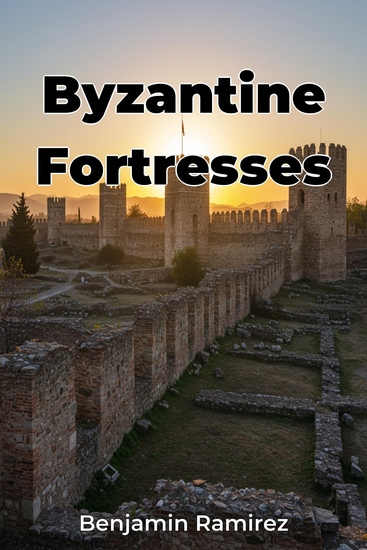
Byzantine Fortresses - cover

Byzantine Fortresses

Benjamin Ramirez

Translator A AI

Publisher: Publifye

  • 0
  • 0
  • 0

Summary

Byzantine Fortresses explores how the Byzantine Empire, enduring for a millennium amidst constant threats, relied on sophisticated military architecture for survival. More than mere barriers, these fortifications were dynamic elements shaping the empire's political, economic, and social fabric.

 
The book reveals that the strategic placement of curtain walls and flanking towers wasn't just about defense; it was integral to the Byzantine military doctrine and their ability to project power. For example, the famed Theodosian Walls of Constantinople stand as a testament to their advanced engineering and strategic thinking.

 
The book examines design and construction, strategic deployment across the empire, and societal impact of these structures. It analyzes the materials and engineering principles used, adapting to evolving siege technologies. 

 
By integrating archaeological surveys, Byzantine military manuals, and historical accounts, the book offers a comprehensive look at how these fortresses influenced urban layouts, trade routes, and imperial authority. This approach highlights the functional, strategic, and socio-economic dimensions of Byzantine fortifications, making it valuable for students, scholars, and anyone interested in military and architectural history.
Available since: 03/29/2025.
Print length: 61 pages.

Other books that might interest you

  • The Cross and the Crucifixion - cover

    The Cross and the Crucifixion

    Manly Palmer Hall

    • 0
    • 0
    • 0
    The prevalent idea that the reverence for the cross is limited to the Christian world is disproved by even the most superficial investigation of its place in religious symbolism. The early Christians used every means possible to conceal the pagan origin of their symbols, doctrines, and rituals. They either destroyed the sacred books of other peoples among whom they settled, or made them inaccessible to students of comparative philosophy, apparently believing that in this way they could stamp out all record of the pre-Christian origin of their doctrines. In some cases the writings of various ancient authors were tampered with, passages of a compromising nature being removed or foreign material interpolated. 
    Show book
  • The Quest - The Historians' Search for Jesus and Muhammad - cover

    The Quest - The Historians'...

    Frank Peters

    • 0
    • 0
    • 0
    Esteemed professor emeritus F.E. Peters compares the similarities and differences in the dual searches for the historical Jesus and the historical Muhammad. These quests have been the focus of considerable effort since the lifetime of each of these venerated figures. Using the primary tools of historical inquiry and the evidence discovered by both believers and unbelievers in the faiths established by Jesus and Muhammad, Professor Peters provides an insightful look into the results thus far found and the surprising truths uncovered.
    Show book
  • Seeing Red - Russian Propaganda and American News - cover

    Seeing Red - Russian Propaganda...

    Gordon Neil Ramsay, Sarah Oates

    • 0
    • 0
    • 0
    The US media has been tainted with Russian disinformation, but the more significant threat is how the Right has embraced the Russian model of the news media as a vehicle for propaganda. This could not have happened without Donald Trump, who has been aided and abetted by politicians and news outlets that favor persuasion over information. From his inauguration onwards, Trump has shown allegiance to the Kremlin propaganda playbook—he consistently denies reality, amplifies lies, vilifies the free media, and broadcasts disinformation. 


    Seeing Red breaks new ground in investigating the scope of Russian disinformation, arguing that key politicians and media outlets in the United States have facilitated the dissemination of Russian propaganda. From the 2020 elections to the Capitol Insurrection to the war in Ukraine, Sarah Oates and Gordon Neil Ramsay examine the penetration of key Kremlin strategic narratives that attempt to project Russian power, blame NATO for Russian aggression, and attack democracy via the US news. Despite knowledge of the risk and resourceful work on tracking down Russian propaganda in the United States, the problem of foreign disinformation continues to this day. As Oates and Ramsay argue, this is in part due to exploitation of the American tradition of free speech and the open nature of the US media system.
    Show book
  • Carnatic Wars - cover

    Carnatic Wars

    Saurabh Kumar

    • 0
    • 0
    • 0
    The books give a brief account of the Carnatic Wars from 1740 to 1765 and the rivalry between the French East India Company and the English East India Company.
    Show book
  • Three Castles Burning - A History of Dublin in Twelve Streets - cover

    Three Castles Burning - A...

    Donal Fallon

    • 0
    • 0
    • 0
    Eason Favourite Book of the Year 2022 
     
    'she is no small town, and this is no small story . . .'
    BASED ON THE POPULAR DUBLIN HISTORY PODCAST
    
    
    A companion to the hugely successful podcast of the same name by Donal Fallon, THREE CASTLES BURNING is an enjoyable wander through some of Dublin's less obvious but more interesting streets and roads such as Henrietta Street, Watling Street, Fownes Street and Kildare Road.
    On the Dublin streets we walk every day, there are hidden reminders of the lesser-known heroes and events that have contributed to the evolving story of our capital. The city's motto, 'the obedience of the citizens produces a happy city', may feel outdated and loaded today but the three burning castles of its ancient coat of arms have come to represent the indomitable spirit, creativity and vision that define this big town. Inspired by the No. 1 podcast, Three Castles Burning: A History of Dublin in Twelve Streets champions the activists, workers, architects, poets, migrants, artists and merchants who have made and remade the city we know and love by going beneath the many layers of twelve key streets where they lived and worked. Because, in the city Joyce called the 'Hibernian Metropolis', the disobedience of its citizens is the cornerstone of its past, present and future.
    This combination of social, cultural, industrial and commercial, and political history, through the prism of the places where revolutions great and small were sparked, offers the reader a fresh and unexpected take on Ireland's capital city.
    Show book
  • The New Freedom - cover

    The New Freedom

    Woodrow Wilson

    • 0
    • 0
    • 0
    We rely on your support to help us keep producing beautiful, free, and unrestricted editions of literature for the digital age. Will you support our efforts with a donation ? Woodrow Wilson was the 28th president of the United States. The New Freedom , a collection of speeches he made during his successful 1912 presidential campaign, takes its name from that campaign platform. In it Wilson describes the conditions necessary for freedom in a rapidly changing society, and highlights the dangers from monopolies and politicians that are either bought, or too cozy with business interests. To combat these regressive influences Wilson stresses the need for open and participatory democracy, as well as positive government intervention to promote individual, rather than business, freedom. Throughout these speeches Wilson shows an unwavering belief in democracy and the wisdom of the people. He admits that he doesn't have all the answers, and begrudges those who make that claim for themselves. According to Wilson, politicians of all parties have been slow to recognize a change in power dynamics. Whereas once workers were familiar with their bosses, now workers toil for faceless corporations that have almost unlimited power over them and bear no practical social responsibilities. Wilson stresses that power over others isn't a sign of wisdom or virtue, and that the government should be emboldened to break up such powers to allow for a fair playing field. He remarks that ignoring these new economic power relations risks disillusioning voters, leaving the door open for unscrupulous politicians to promise easy answers that lead to ruin.
    Show book