Join us on a literary world trip!
Add this book to bookshelf
Grey
Write a new comment Default profile 50px
Grey
Subscribe to read the full book or read the first pages for free!
All characters reduced
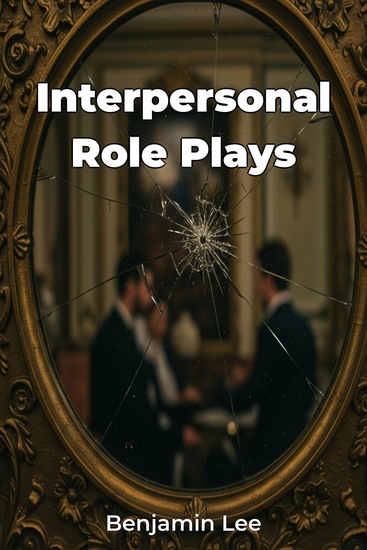
Interpersonal Role Plays - cover

Interpersonal Role Plays

Benjamin Lee

Translator A AI

Publisher: Publifye

  • 0
  • 0
  • 0

Summary

Interpersonal Role Plays explores the hidden rules that govern our social interactions. It examines how we navigate everyday situations by understanding the roles we play, the social scripts we follow, and the face-saving strategies we employ to maintain harmony. Did you know that even seemingly simple acts like apologizing involve complex negotiations of social roles and expectations? The book uses insights from psychology, sociology, and communication studies to dissect these dynamics.

 
The book's core lies in understanding role theory, social scripts, and face-saving. These concepts are explored through real-world case studies, offering readers practical tools for improving their interpersonal skills and conflict resolution abilities. For example, it highlights how deviations from expected social scripts can lead to misunderstandings or even conflict, emphasizing the importance of understanding these unwritten rules.

 
The book progresses systematically, building from foundational concepts to specific scenarios in families, workplaces, and public interactions. This book offers a unique approach by connecting theoretical frameworks with practical applications. It dives into the intricacies of interpersonal communication to improve social competence. By understanding the often subconscious mechanisms at play, the book aims to empower readers to build stronger relationships.
Available since: 02/21/2025.
Print length: 82 pages.

Other books that might interest you

  • Marilyn Monroe: A short biography - 5 Minutes: Short on time - long on info! - cover

    Marilyn Monroe: A short...

    5 Minutes, 5 Minute Biographies,...

    • 0
    • 0
    • 0
    Marilyn Monroe, screen legend: Life and work in a short biography! Everything you need to know, brief and concise. Infotainment, education and entertainment at its best!
    Show book
  • History of England from the Accession of James II - (Volume 2 Chapter 06) - cover

    History of England from the...

    Thomas Babington Macaulay

    • 0
    • 0
    • 0
    This chapter starts from about 1685. James is on the throne and, as ever, there are disputes between crown and Parliament. We see the Habeus Corpus Act introduced, the persecution of the Huguenots and troubles in Ireland.Summary by Jim Mowatt
    Show book
  • The Sign-Language of Astronomical Mythology - Ancient Egypt the Light of the World Books 5 and 6 - cover

    The Sign-Language of...

    Gerald Massey

    • 0
    • 0
    • 0
    The origin of a saviour in the guise of a little child is traceable to Child-Horus, who brought new life to Egypt every year as the Messu of the inundation. This was Horus in his pre-solar and pre-human characters of the fish, the shoot of the papyrus, or the branch of the endless years. In a later stage the image of Horus on his papyrus represented the young god as solar cause in creation. But in the primitive phase it was a soul of life or of food ascending from the water in vegetation, as he who climbs the stalk, ranging from Child-Horus to the Polynesian hero, and to Jack ascending heavenward by means of his bean-stalk. –from “The Sign Language of Astronomical Mythology” It goes unappreciated by modern Egyptologists, but it is embraced by those who savor the concept of a “hidden history” of humanity, and those who approach all human knowledge from the perspective of the esoteric. Gerard Massey’s massive Ancient Egypt: The Light of the World–first published in 1907 and the crowning achievement of the self-taught scholar–redefines the roots of Christianity via Egypt, proposing that Egyptian mythology was the basis for Jewish and Christian beliefs.
    Show book
  • America's Secret Aristocracy - cover

    America's Secret Aristocracy

    Stephen Birmingham

    • 0
    • 0
    • 0
    An "entertaining and perceptive" history of America's most exclusive families, from the Brahmins of New England to the Grandees of California (The Washington Post).
    
    America has always been a constitutionally classless society, yet an American aristocracy emerged anyway—a private club whose members run in the same circles and observe the same unwritten rules. Here, renowned social historian Stephen Birmingham reveals the inner workings of this aristocracy. He identifies which families in which cities have always mattered, and how they've defined America.
    
    America's Secret Aristocracy offers an inside look at the estates, marriages, and financial empires of America's most powerful families—from the Randolphs of Virginia and the Roosevelts of New York to the Carillos and Ortegas of California. With countless anecdotes about our nation's elite, including interviews with their modern-day descendants, Birmingham presents colorful portraits that capture the true definition, essence, and customs of America's aristocracy.
    Show book
  • Femdom Hypnosis - Brainwashing Jacob - cover

    Femdom Hypnosis - Brainwashing...

    Hellen Heels

    • 0
    • 2
    • 0
    18+ 
    Femdom Hypnosis 
    Brainwashing Jacob
    Show book
  • Criminal Fraud and Election Disinformation - Law and Politics - cover

    Criminal Fraud and Election...

    Jeremy Horder

    • 0
    • 0
    • 0
    Deliberate mischaracterization of political opponents and their policies has always been a part of politics; however, lying, dishonesty, and distortion of the facts remain morally wrong and have the potential to obstruct important political interests. For example, a false or misleading claim publicized about an election candidate may lead someone to lose an election that they might otherwise have won. So, does—and should—the law seek to provide protection from the risk of this happening? 


    In attempting to answer this question, Jeremy Horder draws a key distinction between what is called "political viewpoint" fraud and "electoral participation" fraud. In the interests of protecting freedom of speech, false or misleading claims (disinformation) involving political viewpoint content should be tolerated, not only by the criminal law but also by the internet platforms which host political content. By contrast, in the interests of preserving the integrity of democratic electoral processes, disinformation involving electoral participation information should be prohibited by the criminal law and censored by internet platforms. This book explains how the criminal law in various jurisdictions frequently prohibits false or misleading political claims falling into both categories of disinformation, instead of concentrating on electoral participation fraud.
    Show book