Join us on a literary world trip!
Add this book to bookshelf
Grey
Write a new comment Default profile 50px
Grey
Subscribe to read the full book or read the first pages for free!
All characters reduced
Writing API Tests with Karate - Enhance your API testing for improved security and performance - cover

Writing API Tests with Karate - Enhance your API testing for improved security and performance

Benjamin Bischoff

Publisher: Packt Publishing

  • 0
  • 0
  • 0

Summary

Software in recent years is moving away from centralized systems and monoliths to smaller, scalable components that communicate with each other through APIs. Testing these communication interfaces is becoming increasingly important to ensure the security, performance, and extensibility of the software. A powerful tool to achieve safe and robust applications is Karate, an easy-to-use, and powerful software testing framework.
In this book, you’ll work with different modules of karate to get tailored solutions for modern test challenges. You’ll be exploring interface testing, UI testing as well as performance testing.
By the end of this book, you’ll be able to use the Karate framework in your software development lifecycle to make your APIs and applications robust and trustworthy.
Available since: 05/19/2023.
Print length: 326 pages.

Other books that might interest you

  • EXPIRATION DATE 20** - 10 Year´s Later and than? - cover

    EXPIRATION DATE 20** - 10 Year´s...

    Ines Vasku

    • 0
    • 0
    • 0
    Is book feels like a glimpse behind a facade that has long "worked"—and yet has repeatedly developed cracks. At its center is a narrator who, even as a child, learned to read her surroundings like an early warning system: moods, potential dangers, unspoken expectations. Not because she was "too sensitive," but because her inner self understood early on that security is not a given. From this attitude arise patterns that extend to the present day: taking responsibility before anyone demands it; looking for fault within oneself before anyone assigns it; striving to create stability, even when the foundation for it is actually lacking. In parallel, the text opens a second level: life with chronic illness—not as an abstract medical topic, but as a daily reality. Multiple sclerosis appears here as an unpredictable path that drains energy, narrows choices, and divides everyday life into limits of pain and exhaustion. It's a life where "normal" doesn't mean everything is fine, but rather that one has learned to plan, manage, and endure with limitations. And it is precisely through this that the amount of inner work involved in seemingly small things becomes palpable: getting through the night, making it through the next day, not losing oneself. The text's description of relationships is particularly poignant: not as clear categories of "good" or "bad," but as fragile spaces where love, loyalty, grief, and the need for self-protection can coexist. There's, for example, the sibling relationship, which has been difficult since their teenage years. Not loudly dramatic, but worn down by repetition: accusations, misunderstandings, the feeling that one's own pain is not believed or is downplayed ("you're faking it"). At the same time, there remains a willingness to consider the other side: that a sibling might feel overlooked…
    Show book
  • The Sixth History of Man - cover

    The Sixth History of Man

    MD John Bershof

    • 0
    • 0
    • 0
    In the spirit of medieval writer Chaucer, all human activity lies within the artist’s scope, the History of Man Series uses medicine as a jumping off point to explore precisely that, all history, all science, all human activity since the beginning of time. The jumping off style of writing takes the reader, the listener into worlds unknown, always returning to base, only to jump off again. History of Man are stories and tales of nearly everything. 
    The Sixth History of Man is the last narrative in the History of Man Series that uses infection as the underlying foundation. The series will continue but use other disease platforms for jumping off. From a human infection perspective, this sixth book will visit with the King of Pop Michael Jackson, vitiligo and propofol, the famous and infamous sexually transmitted diseases—herpes, gonorrhea, chlamydia, trichomonas, HIV and the granddaddy of colorful stories, syphilis—with their very entertaining tales, a world of romance, suspense, and thrillers. We’ll hop from science to art to music, going back in time to the astronomy of the Persians, Syrians, the Greek Aristotle and on to Ptolemy, Copernicus and Kepler. Our travels will take us to the Renaissance of art and music, stopping along a few stations, such as da Vinci, Michelangelo, Rembrandt, and Monet. A discussion of why and how humans went from spoken language to written language is on our menu. We will pay homage with another visit with the First Viennese School, parse senility, delirium, and dementia and most assuredly discuss the women who helped build Johns Hopkins Hospital. OK Boomers! and the sociology of cohort generations will help complete this narrative.
    Show book
  • Post-Traumatic Stress Disorder: The Self-Help Book – Understand the Causes of PTSD Step by Step and Treat It Successfully – Including a 10-Week Transformation Plan for Trauma Recovery - cover

    Post-Traumatic Stress Disorder:...

    Carolin Rehnberg

    • 0
    • 0
    • 0
    Beyond PTSD – Into a New Life After Trauma
    
    
    Trembling, sweating, panic attacks – a small noise or a faint smell is enough to catapult you into hell. You have experienced this countless times, you know the loss of control, the physical and emotional reactions, and all the limitations that come with it. But alongside the pain, there is something else: your strong, unyielding will to reclaim your life. And here, in all the horror, there is good news: There is life with, and above all, life after PTSD.
    
    Post-traumatic stress disorder, or PTSD for short, turns your entire life upside down. With the experience that triggered this mental disorder, you have gone to the limits of what is bearable and beyond. Whether you are affected yourself or a relative, you know exactly how fundamentally the rest of your life is determined by the consequences of the traumatic event. But you are not powerless against it. Psychology now offers numerous methods to help you reclaim your self-determination, and alongside professional therapy, your own initiative is at least as important. It essentially consists of two building blocks: thought and awareness exercises give you concrete, easy-to-implement tools with which you can directly influence your perception and experience, and in addition, by acquiring comprehensive knowledge, you become an expert on your own illness – a crucial step on the path to self-empowerment.
    
    Observe, understand – and finally move on
    
    This encouraging guide now provides you with all the tools you need. It first presents the current state of science in a clear and precise way and explains why PTSD is neither a verdict nor a destiny. You will learn how the disorder develops, what valuable protective function your brain has taken on for you, and how the illness can finally be overcome constructively and healingly. Simple and immediately applicable exercises offer a strong shield against the attacks of dreaded trigger situations and give you precious moments of calm and relaxation.
    
    Discover in this book …
    ✓ how PTSD develops and what it does to the human psyche ✓ which psychotherapeutic and medicinal measures modern psychology has to counter it ✓ how you can change your perspective on this challenging ordeal for the better ✓ which effective self-help options are available to you ✓ how to regain control over your life in a ten-week transformation plan and set out toward a hopeful, fulfilling future ✓ and much more …
    
    Follow this book as a clear and encouraging guide from the darkness of traumatic experiences to fresh joy, energy, and awareness. Whether you are fighting your way out of PTSD yourself or accompanying a loved one with understanding, this book offers you valuable knowledge and practical suggestions for your challenging journey.
    
    If you finally want to shake off the shackles of the past and open the door to a new, liberated, and mindful life, scroll up now and click the "Buy now with 1-Click" button.
    Show book

  • When the Ice is Gone - What a Greenland Ice Core Reveals About Earth's Tumultuous History and Perilous Future - cover

    When the Ice is Gone - What a...

    Paul Bierman

    • 0
    • 0
    • 0
    In 2018, lumps of frozen soil, collected from the bottom of the world's first deep ice core and lost for decades, reappeared in Denmark. When geologist Paul Bierman and his team first melted a piece of this unique material, they were shocked to find perfectly preserved leaves, twigs, and moss. That observation led them to a startling discovery: Greenland's ice sheet had melted naturally before, about 400,000 years ago. 


    In When the Ice Is Gone, Bierman traces the story of this extraordinary finding, revealing how it radically changes our understanding of the Earth and its climate. A longtime researcher in Greenland, he begins with a brief history of the island, both human and geological. For the origins of ice coring, Bierman brings us to Camp Century, a US military base built inside Greenland's ice sheet, where engineers first drilled through mile-thick ice and into the frozen soil beneath. Decades later, a few feet of that long-frozen earth would reveal its secrets—ancient warmth and melted ice. 


    Changes in Greenland reverberate around the world, with ice melting high in the arctic affecting people everywhere. Bierman explores how losing Greenland's ice will catalyze devastating events if we don't change course and address climate change now.
    Show book
  • Radiolab Greatest Hits Vol 3 - Space - cover

    Radiolab Greatest Hits Vol 3 -...

    Lulu Miller, Latif Nasser

    • 0
    • 0
    • 0
    Radiolab is one of the most popular and longest-running shows produced by WNYC, with over 2 million weekly listeners across public radio and podcasting.  
    Radiolab is on a curiosity bender. We ask deep questions and use investigative journalism to get the answers. A given episode might whirl you through science, legal history, and into the home of someone halfway across the world. The show is known for innovative sound design, smashing information into music. It is hosted by Lulu Miller and Latif Nasser. 
    VOLUME 3: SPACE 
    “Bit Flip” - What do a hacked Belgian election, a falling airplane, and a fleet of runaway cars all have in common? The answer just might lie in the stars. 
    Terrestrials: “The Unimaginable” (Radiolab for Kids) - An invisible entity journeys to Planet Earth and literally rocks our world. 
    “The Middle of Everything Ever” - We all have moments when, facing the future or staring into the vastness of space, we feel small. But are we small? One listener asked us to find out. 
    “Mixtapes to the Moon” - They promised to change you. They ended up changing all of us. On July 20, 1969, humanity watched as Neil Armstrong stepped foot on the moon. 
    “The Moon Itself” - On Monday, April 8, 2024, for a large swath of North America, the sun disappeared, in the middle of the day. In this episode, we stop treating the moon like a bit player in this epic cosmic event and place it center stage. 
    “The Distance of the Moon” - How far is the moon, really? Could you get there with a ladder? A live event reading hosted by Radiolab and Selected Shorts.
    Show book
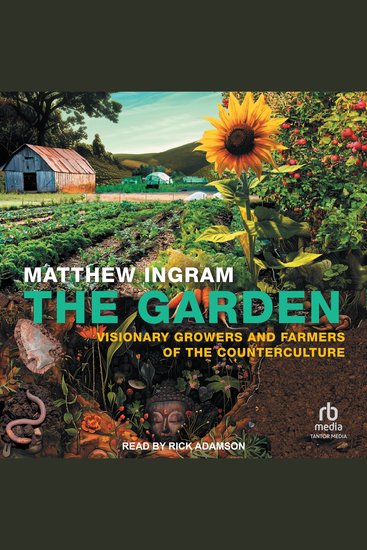
  • The Garden - Visionary Growers and Farmers of the Counterculture - cover

    The Garden - Visionary Growers...

    Matthew Ingram

    • 0
    • 0
    • 0
    The legendary countercultural growers who never stopped changing the world. 


    ● Countercultural Roots: Chronicles how a generation influenced by psychedelics, Eastern philosophy, and reactions to Vietnam, the Oil Shocks, and DDT sparked a deep interest in sustainable farming. 


    ● In-depth Exploration of Influences: Covers movements like the organic food revolution, Permaculture, back-to-the-land initiatives, radical ecology, and the impact of thinkers like Rudolph Steiner on 1970s communities. 


    ● Impact on Today's Agriculture: Through interviews with key figures, The Garden reveals how these visionary growers, often without farming backgrounds, pioneered alternative agriculture and influenced modern sustainable practices. 


    ● A Legacy for the 2020s: Highlights the enduring impact of these farmers, providing inspiration for today's efforts to reconnect with nature and rethink sustainable living. 


    Perfect for listeners interested in organic farming, environmental history, or the cultural legacy of the 1970s, The Garden tells the untold story of how counterculture reimagined food and our relationship to the earth.
    Show book