Join us on a literary world trip!
Add this book to bookshelf
Grey
Write a new comment Default profile 50px
Grey
Subscribe to read the full book or read the first pages for free!
All characters reduced
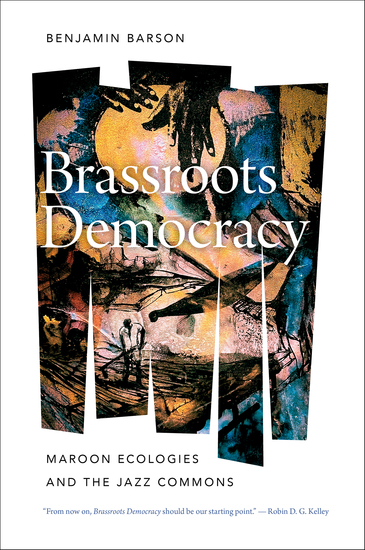
Brassroots Democracy - Maroon Ecologies and the Jazz Commons - cover

Brassroots Democracy - Maroon Ecologies and the Jazz Commons

Benjamin Barson

Publisher: Wesleyan University Press

  • 0
  • 0
  • 0

Summary

Brassroots Democracy recasts the birth of jazz, unearthing vibrant narratives of New Orleans musicians to reveal how early jazz was inextricably tied to the mass mobilization of freedpeople during Reconstruction and the decades that followed. Benjamin Barson presents a "music history from below," following the musicians as they built communes, performed at Civil Rights rallies, and participated in general strikes. Perhaps most importantly, Barson locates the first emancipatory revolution in the Americas—Haiti—as a nexus for cultural and political change in nineteenth-century Louisiana. In dialogue with the work of recent historians who have inverted traditional histories of Latin American and Caribbean independence by centering the influence of Haitian activists abroad, this work traces the impact of Haitian culture in New Orleans and its legacy in movements for liberation.Brassroots Democracy demonstrates how Black musicians infused participatory music practice with innovative forms of grassroots democracy. Late nineteenth-century Black brass bands and activists rehearsed these participatory models through collective performance that embodied the democratic ethos of Black Reconstruction. Termed "Brassroots Democracy," this fusion of political and musical spheres revolutionized both. Brassroots Democracy illuminates the Black Atlantic struggles that informed music-as-world-making from the Haitian Revolution through Reconstruction to the jazz revolution. The work theorizes the roots of the New Orleans brass band tradition in the social relations grown in maroon ecologies across the Americas. Their fruits contributed to the socio-sonic commons of the music we call jazz today.
Available since: 09/24/2024.
Print length: 425 pages.


Other books that might interest you

  • Viral Deception - Unveiling COVIDs Hidden Agenda - cover

    Viral Deception - Unveiling...

    Robert Enochs

    • 0
    • 0
    • 0
    Are you ready to uncover the truth behind the most disturbing global crises of our time? "Viral Deception: Unveiling COVID's Hidden Agenda" takes you on a riveting journey that may forever change your perception of the pandemic and the powers orchestrating it. Witness how a seemingly natural epidemic could be the smoke screen of this century, artfully crafted and strategically unleashed. 
    Explore the historic lineage of biological weaponry and draw chilling connections from the past directly into the chambers of Wuhan's secret laboratory. Navigate through the tangled web of global health governance and the compromised allegiances that may have allowed a synthetic virus to emerge from the shadows. 
    Feel the tension rise as you piece together the political strategy and uncover the alarming blueprint of COVID-19. Learn how suspiciously it mirrors the constructs of other man-made plagues and how bioweapons are not just the relics of the Cold War but active pawns in a game of contemporary Global Domination. As you progress, a harrowing pattern emerges, painting the media, tech giants, and government firewalls as complicit in a cover-up designed to obscure the greatest deception ever waged on humanity. 
    Brace for a critical analysis, drawing correlations between vaccine development and the activation of a tracking framework of bio-surveillance systems that threaten to reshape the very notion of privacy and personal autonomy.  
    "Viral Deception" is not just a book; it's a movement towards unmasking the illusion and empowering readers with the knowledge to discern truth from orchestrated reality. If you dare to confront the narrative that has been fed to the masses, this book promises to lead you towards a path of enlightenment, resilience, and, ultimately, the reclamation of the truth.
    Show book
  • The Meaning of Surah 114 An-Nas The Mankind (La Humanidad) from The Holy Quran Bilingual Edition English Spanish - cover

    The Meaning of Surah 114 An-Nas...

    Jannah Firdaus Mediapro

    • 0
    • 0
    • 0
    Audiobooks The Meaning of Surah 114 An-Nas The Mankind (La Humanidad) from The Holy Quran Bilingual Edition English Spanish 
    Surah An-Nas, the 114th chapter of The Holy Quran, is known as "The Mankind." It is a brief but profound chapter consisting of six verses. The surah emphasizes seeking refuge in Allah SWT from the whispers of Shaytan (Satan) and evil inclinations that may lead one astray. It highlights the universal nature of human vulnerability to such influences and the importance of seeking protection from them. An-Nas is considered a Makki surah, meaning it was revealed in the earlier period of Prophet Muhammad SAW mission, during his time in Makkah. 
    The Surah begins with the invocation "I seek refuge with (Allah SWT), the Lord of mankind." It continues to describe Shaytan as the whisperer who retreats when Allah's name is mentioned, emphasizing the power of divine protection. The Surah concludes with a reminder of Allah's sovereignty and mercy, urging believers to seek refuge in Him alone. An-Nas is often recited for seeking protection from evil, both physical and spiritual, and for seeking guidance in times of distress. Its concise yet profound message makes it a cornerstone of daily prayers and supplications for Muslims worldwide. 
    La sura An-Nas, capítulo 114 del Sagrado Corán, se conoce como «La Humanidad». Es un capítulo breve pero profundo que consta de seis versículos. El surah hace hincapié en buscar refugio en Allah SWT (Dios) de los susurros de Shaytan (Satanás) y las malas inclinaciones que pueden llevarnos por mal camino. 
    Destaca la naturaleza universal de la vulnerabilidad humana ante tales influencias y la importancia de buscar protección contra ellas. An-Nas se considera una sura Makki, es decir, que fue revelada en los primeros tiempos de la misión del Profeta Muhammad SAW, durante su estancia en La Meca.
    Show book
  • Mindfulness for Life - cover

    Mindfulness for Life

    Willem Kuyken

    • 0
    • 0
    • 0
    Mindfulness is exceptionally easy to get started with, and people often experience benefits almost immediately. Why, then, do many initial enthusiasts end up dropping the practice after a short while? 
    According to Oxford professor and leading mindfulness expert Willem Kuyken, it's because traditional mindfulness training is too far removed from how we actually live. This next-generation resource brings mindfulness home by teaching core skills in easy-to-integrate ways that touch directly on life's daily challenges. In his calm, encouraging voice, Dr. Kuyken provides stepping stones to help you build a personal practice that is sustainable, purposeful, and richly rewarding--now and for years to come. Interweaving ancient wisdom and modern scientific psychology, the book includes stories engagingly read by multiple narrators, quotations, reflection questions, tips for overcoming hurdles, and compelling guided practices.
    Show book
  • Surviving Hitler Evading Stalin - cover

    Surviving Hitler Evading Stalin

    Mildred Janzen

    • 0
    • 0
    • 0
    One Woman’s Remarkable Escape from Nazi Germany 
    The peaceful farm life of a teenage girl in Germany is abruptly upended when WWII comes knocking at her family’s door. One month before her sixteenth birthday, Mildred “Mickchen” Schindler and her family are captured by Russian Soldiers. Having already survived life in Hitler’s Nazi Germany, they now face the terror of a new enemy—Stalin’s Red Army. 
    Driven from their home, Mildred and her family become refugees along with a sad, slow-moving caravan of other families who have suffered the same fate. Cleverly disguised by her mother, Mildred avoids being taken to a work camp until one morning when authorities arrive unexpectedly. Her father has already been taken by Russian soldiers, and now she is taken from her mother and brother. 
    Mildred recounts, in meticulous detail, her treacherous journey and the roller coaster of raw emotions she experiences —fear, regret, loneliness, humility, perseverance, and defiance. Mildred’s odyssey of making her way home and finding her family in a war-torn countryside takes many riveting twists and turns. The discovery of a secret, hidden document offers hope for a brighter future. 
    From harrowing to heartwarming, this memoir provides a unique perspective of a Gentile girl’s road to resilience and her fortitude against all odds to forge a life filled with love and laughter. 
    Surviving Hitler, Evading Stalin is a remarkable testimony to the strength of the unconquerable human spirit and an endearing account of God’s faithfulness in the midst of faithless circumstances.
    Show book
  • Mary Wollstonecraft - The British Writer and Female Philosopher - cover

    Mary Wollstonecraft - The...

    Hector Davidson

    • 0
    • 0
    • 0
    Mary Wollstonecraft was a pioneering British writer and philosopher whose ideas on women’s rights and education laid the foundation for modern feminism. Born on April 27, 1759, in Spitalfields, London, she grew up in a time when society severely restricted women's opportunities. Despite these limitations, Wollstonecraft’s determination, intellect, and relentless pursuit of knowledge allowed her to challenge the status quo and advocate for gender equality. Her life was shaped by personal struggles, societal constraints, and an unwavering belief in the power of education. 
    Wollstonecraft’s early years were marked by financial instability and familial hardships. Her father, Edward Wollstonecraft, mismanaged the family’s wealth, frequently moving the household in pursuit of failed business ventures. This instability forced Mary and her siblings into difficult circumstances, with her witnessing firsthand the consequences of economic insecurity. More troubling, her father was reportedly abusive, particularly towards her mother, which deeply affected Mary’s views on marriage and male authority. Unlike many girls of her time, who received little to no formal education, Mary sought knowledge independently. She read extensively, developed a strong moral compass, and displayed an early inclination toward questioning societal norms. 
    One of the most influential figures in her formative years was Fanny Blood, a close friend whose intellect and independence inspired Mary. Their friendship was instrumental in shaping Wollstonecraft’s aspirations and her desire for a life beyond the domestic sphere. In pursuit of financial independence, she worked as a governess and later as a teacher, experiences that would inform her views on education.
    Show book
  • Stalin's Harvest of Despair - 1932-1933 - cover

    Stalin's Harvest of Despair -...

    Sarah Willards

    • 0
    • 0
    • 0
    In the aftermath of the Russian Revolution, the Soviet Union emerged as a bold experiment in socialist governance. The promise of equality, worker empowerment, and rapid industrial advancement stirred hope among the masses, particularly in a country long plagued by aristocratic rule and widespread poverty. Following Vladimir Lenin’s death in 1924, the Soviet Union stood at a crossroads. Competing visions of the nation's future vied for dominance, but it was Joseph Stalin who would seize the reins of power and chart a course that would forever change the fate of the Soviet people. 
    Stalin was not initially seen as Lenin's most likely successor. Quiet and often underestimated, he used his position as General Secretary to quietly build alliances, marginalize rivals, and install loyalists in key positions. Through political maneuvering and calculated ruthlessness, he eliminated opposition, including figures like Leon Trotsky, who posed significant ideological challenges to his authority. By the end of the 1920s, Stalin had effectively become the uncontested leader of the Soviet Union. 
    With Stalin’s rise came a dramatic shift in the nation’s priorities. While Lenin’s New Economic Policy had allowed for a degree of private enterprise and economic flexibility, Stalin viewed such policies as a betrayal of Marxist principles. He replaced them with a command economy, aiming to accelerate industrialization and bring agriculture under state control. This transition was not merely economic—it was deeply ideological. Stalin envisioned a centralized Soviet state capable of projecting power, crushing resistance, and transforming society through sheer force of will.
    Show book