Join us on a literary world trip!
Add this book to bookshelf
Grey
Write a new comment Default profile 50px
Grey
Subscribe to read the full book or read the first pages for free!
All characters reduced
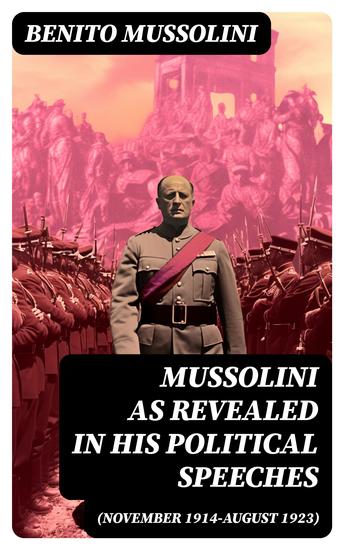
Mussolini as revealed in his political speeches (November 1914-August 1923) - cover

Mussolini as revealed in his political speeches (November 1914-August 1923)

Benito Mussolini

Translator Bernardo Quaranta di San Severino

Publisher: DigiCat

  • 0
  • 0
  • 0

Summary

In "Mussolini as Revealed in His Political Speeches (November 1914-August 1923)," Benito Mussolini chronicles a pivotal phase of his political ascent through carefully curated speeches that reflect the tumultuous socio-political landscape of early 20th-century Italy. The work is marked by Mussolini's characteristic rhetorical flourish, and resonates with his Fascist ideology intertwined with nationalistic fervor, showcasing how he sought to galvanize public sentiment during World War I and the volatile years of the post-war period. Each speech serves as a window into Mussolini's evolving political strategy, revealing his attempts to forge a new national identity amid economic distress and social unrest. Mussolini, who initially emerged as a socialist intellectual, transformed his ideologies to embrace Fascism as he recognized the power of populism in the tumultuous climate of his time. His passion for oratory, combined with his keen political instincts, positioned him as both a leader and a manipulator of public opinion. This collection not only highlights his command of the language but also reflects the intellectual and ideological currents that shaped his worldview. This book is an essential read for scholars of political rhetoric, history, and Fascism. It offers a unique perspective on how revolutionary leaders communicate with their constituencies and manipulate discourse to consolidate power. Readers will gain invaluable insights into the complex dynamics of leadership and the significance of oratory in the context of 20th-century political movements.
Available since: 11/21/2023.
Print length: 281 pages.

Other books that might interest you

  • Ten Things Your Student with Autism Wishes You Knew 2nd Edition - cover

    Ten Things Your Student with...

    Ellen Notbohm

    • 0
    • 0
    • 0
    The essential autism spectrum guidebook for teachers everywhere! 
     
    In this exciting companion to Ellen Notbohm’s beloved classic Ten Things Every Child with Autism Wishes You Knew, the unique perspective of an autistic child’s voice returns to describe for teachers, in the classroom and in the larger  
    community, how to understand thinking and processing patterns common in autism, how to shape an environment conducive to their learning style, and how to communicate with autistic learners of all ages in functional, meaningful ways.  
     
    It’s the guidebook every educator and family member, worldwide, needs to create effective and inclusive settings wherein child and adult are both teachers and learners. 
     
    This vibrantly updated and expanded edition includes an imaginative, all-new guide adaptable for group discussion, self-reflection, or self-expression, added perspective from autistic adults about their experiences in education, and an  
    afterword by Bryce Notbohm. Perennially popular since 2006 and translated into multiple languages, Ten Things Your Student with Autism Wishes You Knew now brings fresh perspective to a new generation of educators and autistic learners.
    Show book
  • Mediterranean Dictators - The Story of Benito Mussolini Torquemada and Francisco Pizarro - cover

    Mediterranean Dictators - The...

    Kelly Mass

    • 0
    • 0
    • 0
    These dictators all lived in Southern European countries. Meet the evil despots called: 
    Benito Mussolini: Ironically, when we think of fascism, we often look at someone as brutal and influential as Adolf Hitler, but the word “fascism” originated from Italian. The ideology that was carried out in the vicious Spanish War right before World War 2, and was embraced by Nazi Germany, was actually pushed and more or less invented by the Italians during a critical time in history when many changes were made, and when fear and uncertainty were all in the air. Mussolini was efficient and influential. He was a fearless leader not to be trifled with. Let’s take a look at what he did and why. 
    Torquemada: The Spanish inquisition was nasty in the 15th century. I am glad we don’t live in those times anymore. We have our own problems to deal with here. But back then, in some countries, primarily the Catholic-dominated ones in Europe, being called a heretic, a witch, or a sinner meant business. It could mean the end of your life. And often, you had nothing to defend yourself with. There weren’t enough fancy lawyers to stand up to the Catholic Church. And so, it is with a tragic view on the past that we see countless innocent victims being accused of something they never did, with no bad intentions or rebellious behavior, and nonetheless being executed in brutal manners. 
    Francisco Pizarro: Conquistadores (or Conquistadors) were the Spanish and Portuguese conquerors who invaded parts of the world that hadn’t been discovered by the Europeans before the 16th century. Some of these conquerors behaved fairly nice and respectful towards the local population in South America, Asia, Africa, and Central America. Others were incentivized by greed, lust, and dominance, which caused them to pillage, steal, and enslave the indigenous people they encountered. Many of their leaders were notorious for their brutality.
    Show book
  • Scientific Method and Critical Thinking - Master the Foundations of Science Through Analytical Reasoning and Evidence-Based Problem Solving - cover

    Scientific Method and Critical...

    Virversity Online Courses

    • 0
    • 0
    • 0
    Explore essential principles of scientific inquiry and develop strong critical thinking skills with this comprehensive course on the Scientific Method and Critical Thinking. Designed to enhance analytical abilities, it equips you to conduct reliable experiments, evaluate evidence effectively, and communicate results clearly.Master Scientific Methods and Enhance Critical Thinking Skills:- Formulate testable hypotheses from observations.- Design experiments controlling variables for accuracy.- Develop data collection and analysis skills for valid conclusions.- Identify logical fallacies and maintain objectivity.- Understand basic statistics, distinguishing correlation from causation.- Learn the importance of peer review and replication.- Improve scientific communication via writing and presentations.- Apply critical thinking in everyday decision-making.Starting with scientific inquiry foundations, you’ll learn how observation leads to reliable hypotheses. The course guides you in designing controlled experiments to minimize errors and ensure trustworthy findings, emphasizing accurate data collection and analysis.It also covers critical thinking essentials like spotting logical fallacies, evaluating evidence quality, and maintaining scientific integrity by recognizing bias. You’ll explore basic statistics and the crucial difference between correlation and causation.Beyond experiments, the course examines the scientific process, including peer review, replication, and clear result communication. Finally, these critical thinking skills extend to everyday situations, helping you reason effectively beyond science.By course completion, you’ll gain a solid grasp of the scientific method and advanced critical thinking, empowering you to solve problems systematically, evaluate information critically, and communicate confidently—enhancing both academic and real-world reasoning.
    Show book
  • We Wanted Workers - Unraveling the Immigration Narrative - cover

    We Wanted Workers - Unraveling...

    George J. Borjas

    • 0
    • 0
    • 0
    We are a nation of immigrants, and we have always been concerned about immigration. As early as 1645, the Massachusetts Bay Colony began to prohibit the entry of "paupers." Today, however, the notion that immigration is universally beneficial has become pervasive. To many modern economists, immigrants are a trove of much-needed workers who can fill predetermined slots along the proverbial assembly line. 


    But this view of immigration's impact is overly simplified, explains George J. Borjas, a Cuban American, Harvard labor economist. Immigrants are more than just workers—they're people who have lives outside of the factory gates and who may or may not fit the ideal of the country to which they've come to live and work. Like the rest of us, they're protected by social insurance programs, and the choices they make are affected by their social environments. 


    In We Wanted Workers, Borjas shows that, in the grand scheme, immigration has not affected the average American all that much. But it has created winners and losers. The losers tend to be nonmigrant workers who compete for the same jobs as immigrants. And somebody's lower wage is somebody else's higher profit, so those who employ immigrants benefit handsomely. In the end, immigration is mainly just another government redistribution program.
    Show book
  • Thoreau's God - cover

    Thoreau's God

    Richard Higgins

    • 0
    • 0
    • 0
    Thoreau? I know him! Well, I know the name. I’m sure I know who he is… don’t I? The nature guy, right? 
    Henry David Thoreau’s spiritual life is a riddle. Thoreau’s passionate critique of formal religion is matched only by his rapturous descriptions of encounters with the divine in nature. He fled the church only to pursue a deeper communion with a presence he felt at the heart of the universe. He called this illimitable presence many names, but he often called it God. 
    In Thoreau’s God, Richard Higgins invites seekers — religious or otherwise — to walk with the great Transcendentalist through a series of meditations on his spiritual life. Thoreau offers us no creed, but his writings encourage reflection on how to live, what to notice, and what to love. Though his quest was deeply personal, Thoreau devoted his life to communicating his experience of an infinite, wild, life-giving God. By recovering this vital thread in Thoreau’s life and work, Thoreau’s God opens the door to a new understanding of an original voice in American religion that speaks to spiritual seekers today.
    Show book
  • Giving Wings to Your Career as a Flight Attendant - Everything You Ever Wanted to Know About Being a Cabin Crew Member - cover

    Giving Wings to Your Career as a...

    Hans-Georg Rabacher

    • 0
    • 0
    • 0
    Living the dream! 
    Flying has fascinated and thrilled people for generations. Maybe you, too, have always dreamt of having a job way up above the clouds, but haven't found the courage to follow this dream? Then this book is for you: 
    Aviation expert and flight instructor Hans-Georg Rabacher gives us some detailed insights into what it is like to work as a flight attendant, sharing insider knowledge with you and revealing all kinds of useful tips and tricks that will be the perfect preparation for your career in the skies. So what are you waiting for? 
    Here are some of the things you will learn from this book: 
    -) What makes this profession so special 
    -) What qualities you should bring to the table 
    -) How to prepare effectively for the interview and the assessment day 
    -) What sort of career ladder you can expect 
    -) What the pros and cons of the job are 
    Active flight attendants working for airlines from all corners of the world share their experiences and give practical tips that will help you launch your career. Inspirational insights and essential background information guaranteed!
    Show book