Join us on a literary world trip!
Add this book to bookshelf
Grey
Write a new comment Default profile 50px
Grey
Subscribe to read the full book or read the first pages for free!
All characters reduced
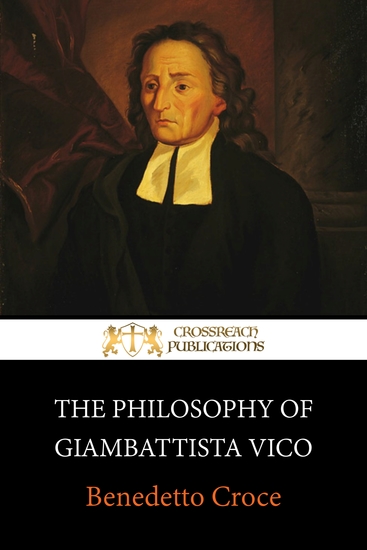
The Philosophy of Giambattista Vico - cover

The Philosophy of Giambattista Vico

Benedetto Croce

Translator R. G. Collingwood

Publisher: CrossReach Publications

  • 0
  • 0
  • 0

Summary

My reasons for believing that a new exposition of Vico's philosophy is required may easily be inferred from the observations on the effects of his work and the biographical notes which form respectively the second and fourth appendices to this volume. Here I merely wish to state that my exposition is not meant for a summary of Vico's writings work by work and part by part. It rather presupposes an acquaintance with these writings, and, where that is lacking, is intended to induce the reader to procure them in order to follow better and to check the interpretation and estimate of them here offered. On this supposition, though I have made free use of my author's actual words, especially in the chapters dealing with history, I have not thought it desirable to mark them as quotations except where it was important to emphasise the precise phrase of the original. I have in general combined such passages from fragments scattered over a wide field, sometimes abbreviating, sometimes amplifying, and always freely adding words and phrases of my own by way of commentary: and the continual use of quotation marks would merely have shown up in a manner more wearisome than valuable the reverse side of my embroidery, which any reader who so desires can study by the help of the references given at the end of the book. In my anxiety to show in every detail of my work, so far as I could, the veneration due to the great name of Vico, I have endeavoured to be brief with the brevity at which he himself aimed as the hall-mark of sterling scientific thought. With this in view I have refrained even from controversy with his various interpreters, and have either contented myself with mere remarks, or more often left my details to be justified by the coherence of my view as a whole. Some of the interpretations supported by me I believe to be the mature fruit of the investigations and controversies which form the greater part of the literature on Vico: all the rest, for which I am personally responsible, and the general idea of my book, I will defend against alternative and contradictory views when occasion arises, should it ever do so, in the detailed and direct manner which I have not thought it necessary to adopt in the course of my exposition. I hope, in fact, that the present work will rekindle rather than quench the discussion of Vico's philosophy: since in him we have, as Goethe calls him, the Altvater whom a nation is happy to possess, and to him we must hark back for a time in order to imbue our modern philosophy with an Italian feeling, however cosmopolitan it may be in thought. The dedication of my book, besides being a token of respect to one of the greatest modern teachers of the history of philosophy, is intended to express the expectation and hope that the gap in this history to which I have called attention more than once, especially on page 277 of the present volume, may soon be filled.
 
B. C.RAIANO (AQUILA),September 1910.​​​​​​​CrossReach Publications
Available since: 12/15/2022.
Print length: 192 pages.
Other books that might interest you

  • Fulcanelli Master Alchemist - The Mystery of the Cathedrals - cover

    Fulcanelli Master Alchemist -...

    Fulcanelli

    • 0
    • 0
    • 0
    Embark on a journey of profound mystery and esoteric knowledge with “The Mystery of the Cathedrals” audiobook, a captivating exploration of alchemy, symbolism, and the hidden secrets encoded within the architecture of Europe’s most enigmatic cathedrals. Authored by the enigmatic figure known as Fulcanelli, this seminal work delves into the profound spiritual and philosophical teachings concealed within the stone walls and intricate carvings of these ancient structures. 
    Narrated with intrigue and depth, this audiobook unravels the cryptic symbolism and allegorical imagery found throughout the cathedrals, revealing a tapestry of hidden meanings that speak to the timeless quest for spiritual enlightenment and transcendence. From the alchemical transformations depicted in stained glass windows to the sacred geometry embedded in the architecture, Fulcanelli guides listeners on a transformative journey of discovery, illuminating the profound connections between art, science, and spirituality. 
    “The Mystery of the Cathedrals” audiobook offers listeners a rare opportunity to delve into the depths of esoteric wisdom, unlocking the secrets of the alchemists and uncovering the hidden truths encoded within these architectural marvels. Whether you’re a seeker of esoteric knowledge, a lover of history and architecture, or simply curious about the mysteries of the past, this audiobook will captivate and inspire, inviting you to explore the hidden dimensions of reality hidden within the heart of the medieval cathedrals.
    Show book
  • What's Right With America - And How We Can Keep It That Way! - cover

    What's Right With America - And...

    Hon. Paul Johnson, Larry Aldrich

    • 0
    • 0
    • 0
    Is America's future as bright as its past? What's Right With America argues that not only is the answer "Yes," but the nation's most incredible days are yet to come. Despite the challenges and divisions we face, America's true strength lies in its core principles and the resilient spirit of its people. 


    From the vision of our Founding Fathers to the resilience and determination that have shaped our history, What's Right With America explores what makes the country uniquely capable of thriving in times of change. With inspiring stories and thought-provoking analysis, authors Paul Johnson and Larry Aldrich reveal how America's prosperity is rooted in more than just economic might—it's grounded in values like freedom, individual empowerment, and deep commitment to justice and liberty. 


    Johnson and Aldrich have identified five defining characteristics that have propelled the United States to greatness, showing how these ideals can guide us through current and future challenges. Whether you're concerned about politics, society, or the economy, What's Right With America offers a powerful reminder that America's strength is more than just its leadership—it's in every citizen who believes in the promise of a better future.
    Show book
  • The Pharaohs of Ancient Egypt - Rulers of the Nile - cover

    The Pharaohs of Ancient Egypt -...

    Omar Khalil

    • 0
    • 0
    • 0
    The emergence of the pharaohs marked the beginning of one of history’s most iconic civilizations. In the early dynastic period around 3100 BCE, Egypt underwent a dramatic transformation as Upper and Lower Egypt were unified under a single ruler, traditionally identified as King Narmer or Menes. This unification not only established centralized rule but also laid the foundations for a dynastic tradition that would endure for millennia. The pharaoh, whose name means “great house,” came to be seen as both a political leader and a divine figure, embodying the will of the gods on earth. 
    As Egypt’s first kings consolidated power, they created administrative systems to manage resources, command armies, and oversee large-scale construction projects. Hierarchical governance emerged, with officials and scribes acting under the pharaoh’s authority to maintain order throughout the land. This new system allowed the pharaohs to centralize authority, control the fertile Nile Valley, and ensure the production and redistribution of grain and other goods, which became critical for sustaining a growing population and for asserting royal dominance. 
    Religious ideology played a key role in solidifying the power of the pharaohs. They were often depicted as the sons of deities, particularly associated with the sun god Ra and the sky god Horus. Temples were erected not just as places of worship, but as instruments of royal propaganda, showcasing the divine legitimacy of the ruler. Rituals, festivals, and monumental inscriptions reinforced the pharaoh’s sacred status and his role in maintaining ma’at, the cosmic order of balance and harmony.
    Show book
  • Portuguese Empire and the Americas The: The History and Legacy of Portugal’s Exploration and Colonization in the New World - cover

    Portuguese Empire and the...

    Editors Charles River

    • 0
    • 0
    • 0
    By the start of the 15th century, ships were now much larger and able to support long distance travel with a minimum number of crew aboard. With that, the Portuguese started exploring the west coast of Africa and the Atlantic under orders from Prince Henry the Navigator. At this point, Europeans had not yet been capable of navigating completely around Africa since the ships being built were not yet fully capable of being able to sail very far from the coast and navigation in open waters was difficult, but the Portuguese continued pushing down the western African coast looking for ways to bypass the Ottomans and Muslims of Africa who had been making overland trade routes difficult. In 1451, Prince Henry the Navigator helped fund and develop a new type of ship, the caravel, that featured triangular lateen sails and would be able to travel in the open ocean and sail against the wind. In 1488, Bartholomew Diaz rounded the southern tip of Africa, named the Cape of Good Hope by King John of Portugal, and entered the Indian Ocean from the Atlantic.  
    	One explorer, Christopher Columbus, sought funding from the Portuguese to search for a passage to Asia by sailing westwards, but he was rejected. At this time in the late 15th century, Portugal’s domination of the western African sea routes prompted the neighboring Crown of Castile and the Catholic monarchs in modern Spain to search for an alternative route to south and east Asia (termed Indies), so they provided Columbus with the funding he required. Ultimately, Columbus discovered the Americas in 1492, and European settlements would soon follow. At the same time, when it became clear Columbus hadn’t landed in Asia, it was understood by everyone that this was not necessarily the route the Europeans were searching for, the Portuguese continued to send explorers around the world in several directions in an attempt to reach the East Indies. 
    Show book
  • Pertinax - The Son of a Slave Who Became Roman Emperor - cover

    Pertinax - The Son of a Slave...

    Simon Elliott

    • 0
    • 0
    • 0
    The son of a former slave, Pertinax was the Roman Emperor who proved that no matter how lowly your birth, you could rise to the very top through hard work, grit and determination. 


    Born in AD 126, Pertinax made a late career change from working as a grammar teacher to a position in the army. As he moved up the ranks and further along the aristocratic cursus honorum, he took on many of the most important postings in the Empire, from senior military roles in fractious Britain, the Marcomannic Wars on the Danube, to the Parthian Wars in the east. He held governorships in key provinces, and later consulships in Rome itself. When Emperor Commodus was assassinated, the Praetorian Guard alighted on Pertinax to become the new Emperor, expecting a pliable puppet. But Pertinax was nothing of the sort and when he then attempted to reform the Guard, he was assassinated. His death triggered the beginning of the "Year of the Five Emperors" from which Septimius Severus, Pertinax's former mentoree, became the ultimate victor. 


    This previously untold story brings a fascinating and important figure out of the shadows. A self-made everyman, a man of principle and ambition, a role model respected by his contemporaries, Pertinax's remarkable story offers a unique and panoramic insight into the late 2nd century AD Principate Empire.
    Show book
  • 10 Things I Think I Know For Sure About Getting Your Writing Published - cover

    10 Things I Think I Know For...

    John Lehman

    • 0
    • 0
    • 0
    "10 Things I Think I Know For Sure About...Getting Your Writing Published" is presented by John Lehman, founder of Rosebud magazine. 
     
    John suggests writers stop thinking in terms of books, articles, poems and stories, and instead start thinking in terms of what benefits readers will receive from reading and buying them. 
    Literary agent Georgia Hughes, formerly an editor from Harper San Francisco, has complemented that this program is, "entertaining, inspiring and extremely helpful for writers of all levels of ability." 
    ©2009 John Lehman; (P)2009 John Lehman
    Show book