Join us on a literary world trip!
Add this book to bookshelf
Grey
Write a new comment Default profile 50px
Grey
Subscribe to read the full book or read the first pages for free!
All characters reduced
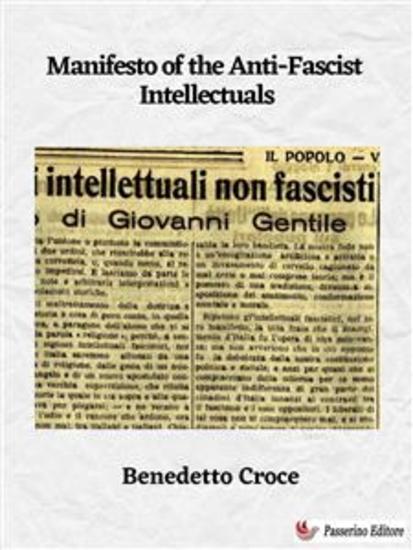
Manifesto of the Anti-Fascist Intellectuals - cover

Manifesto of the Anti-Fascist Intellectuals

Benedetto Croce

Publisher: Passerino

  • 0
  • 0
  • 0

Summary

Benedetto Croce's "Manifesto of the Anti-Fascist Intellectuals" was a document written in 1925 by a group of Italian intellectuals, including Croce, to denounce the rise of fascism in Italy under Benito Mussolini.

The manifesto argued that fascism was a threat to individual liberty, democracy, and intellectual freedom, and called for intellectuals to stand up against the fascist regime. It also stressed the importance of education, culture, and democracy in promoting a free and open society.

Benedetto Croce (1866-1952) was an Italian philosopher, historian, and politician. He is best known for his contributions to aesthetics and philosophy of history.

Croce was born in Pescasseroli, Italy, and studied philosophy and literature at the University of Rome. He later became a professor of philosophy at the University of Naples, where he taught for many years.
Available since: 03/28/2023.

Other books that might interest you

  • The Shocking Truth about International Relations - cover

    The Shocking Truth about...

    Zoey Fraisers

    • 0
    • 0
    • 0
    International relations is a complex and ever-evolving field that shapes the global political landscape. The relationships between countries, organizations, and individuals influence everything from trade and diplomacy to security and human rights. Understanding the history, theories, and modern-day dynamics of international relations is essential for anyone seeking to grasp the intricacies of global affairs. The study of international relations has evolved from a niche academic discipline into a vital framework for analyzing global conflicts, cooperation, and power struggles. 
      
    The modern world has been profoundly shaped by the forces of globalization, which have made international relations more interconnected than ever before. Advances in communication, transportation, and technology have blurred the lines between domestic and international issues. Countries can no longer afford to operate in isolation; they must cooperate on matters of shared concern, such as climate change, terrorism, economic crises, and public health. However, the globalized world also comes with challenges. Increasingly, nations must navigate a complex web of relationships and competing interests, where power dynamics and the quest for dominance can create conflict. 
      
    Globalization has had a profound impact on international relations, but it has also revealed the limits of traditional diplomacy. In the past, diplomacy was primarily conducted between states, often in secret negotiations behind closed doors. Today, international diplomacy involves a wider range of actors, from multinational corporations and non-governmental organizations to grassroots movements and individual leaders. This shift has led to both opportunities and challenges for international cooperation, as diverse interests often clash in the pursuit of a global agenda.
    Show book
  • Brexit: What the Hell Happens Now? - Revised edition - cover

    Brexit: What the Hell Happens...

    Anonymous

    • 0
    • 0
    • 0
    Journalist Ian Dunt reveals how leaving the European Union will damage Britain's politics, courts, businesses and consumers. This fast-paced bestseller strips Britain's biggest issue of the gloss put on it by its cheerleaders and exposes it for what it is: a sham.It is based on extensive research with experts across the law, trade and politics. It maps the trade and legal cliff edge that Britain faces unless it secures a transitional deal with the European Union — and explains why the odds are stacked against the UK government in the negotiations and how the World Trade Organisation is not the solution to leaving the EU.The author (who reads this audiobook) reveals how Brexit will: *make the UK poorer*leave industries like pharmaceuticals and finance struggling to operate*threatens to break up the United KingdomIn brief, it paints the real picture of a country about to undergo a sharp and self-inflicted isolation. In the run up to the EU referendum in 2016, the British cabinet minister Michael Gove said that the British public had had enough of experts. Ian Dunt disagrees. This is a book is for people who believe in evidence and reason.Reviews: 'Magnificent' - Ben Goldacre'Excellent. A must-read. Harass every MP until they read Dunt's book' - AC Grayling'I would strongly recommend this excellent guide. Dunt has taken the extraordinary step of asking a set of experts what they think. I learnt a lot.' - Philip Collins, Prospect'A definitive account of just how much confusion and ignorance has surrounded this entire debate.' - James O'Brien, LBC'I would encourage anyone who is confused, fascinated or frustrated by Brexit to read this book. You will be far wiser by the end of it.'- Caroline Lucas, Co-Leader, Green Party'If you are looking for a good guide to Brexit and what comes next, I can recommend What the Hell Happens Now?' - Tom Watson, Deputy Leader, Labour Party
    Show book
  • Road to Serfdom The: Book Summary & Analysis - cover

    Road to Serfdom The: Book...

    Briefly Summaries

    • 0
    • 0
    • 0
    This is a concise summary and analysis of The Road to Serfdom, by Friedrich A. Hayek.
     
    It is not the original book and is not affiliated with or endorsed by Friedrich A. Hayek.
    Ideal those seeking a quick and insightful overview.
     
    The Road to Serfdom is a powerful critique of centralized economic planning and the dangers it poses to individual liberty and democratic institutions. Drawing from historical analysis and philosophical reasoning, this seminal work explores how the concentration of economic control can lead to the erosion of personal freedoms, the rise of authoritarian governments, and the decline of open societies. A cornerstone of political and economic thought, it remains an essential read for anyone seeking to understand the balance between freedom and government intervention in modern society.
    Show book
  • On Truth in Politics - Why Democracy Demands It - cover

    On Truth in Politics - Why...

    Michael Patrick Lynch

    • 0
    • 0
    • 0
    Do any of us really care about truth when it comes to politics? Should we? In a world of big lies, denialism, and conspiracy theories, democracies are experiencing two interlocked crises: a loss of confidence in democracy itself and the growing sense among many that politics is only about power—not truth. In this book, Michael Patrick Lynch argues that truth not only can—but must—matter in politics. He shows why truth is an essential democratic value—a value we need to sustain our democratic way of life—and how it can be strengthened. 


    Despite evidence that people are rarely motivated by truth when it comes to politics, On Truth in Politics argues that this isn't inevitable. Accessibly written and rigorously argued, it draws on the American pragmatist tradition to develop an original theory of the nature and value of truth in the messy world of politics. Contrary to the belief of many, political beliefs can be true or false. But if democracy is to continue to be a space of reason and not just an arena of power, we must build a better infrastructure of knowledge, including stronger schools and media, and renew our commitment to science and history. 


    A vital and timely book, On Truth in Politics makes an original case for why democracy cannot survive without truth.
    Show book
  • The Politics - cover

    The Politics

    Aristotle

    • 0
    • 0
    • 0
    One of the most influential works in political philosophy, The Politics by Aristotle explores the nature of government, justice, and the ideal state. In this timeless classic, Aristotle examines different political systems, the role of citizenship, and the balance between power and virtue in governance. His insights continue to shape modern political thought, making this an essential listen for anyone interested in philosophy, politics, or history. 
    Presented in a compelling narration by various voices, this audiobook brings Aristotle’s wisdom to life, offering a deep dive into the foundations of democracy, leadership, and societal organization. 
    Perfect for scholars, students, and anyone seeking to understand the principles that govern societies, The Politics remains as relevant today as it was in ancient Greece.
    Show book
  • Episode 7 - Agriculture - cover

    Episode 7 - Agriculture

    Anjum Sharma

    • 0
    • 0
    • 0
    The livelihood of more than half of the people in India is dependent on agriculture. That makes the farmers and agriculture important in this country from a political and an economic point of view. Last year, the opposition to agricultural laws made most of the headlines. In this episode, find out what is the reason behind the farmers' movement. Also find out why the attack of locusts is dangerous for farmers.
    Show book