Join us on a literary world trip!
Add this book to bookshelf
Grey
Write a new comment Default profile 50px
Grey
Subscribe to read the full book or read the first pages for free!
All characters reduced
Breakfast with the Scavengers - cover

Breakfast with the Scavengers

Ben Rhys Palmer

Publisher: Parthian Books

  • 0
  • 0
  • 0

Summary

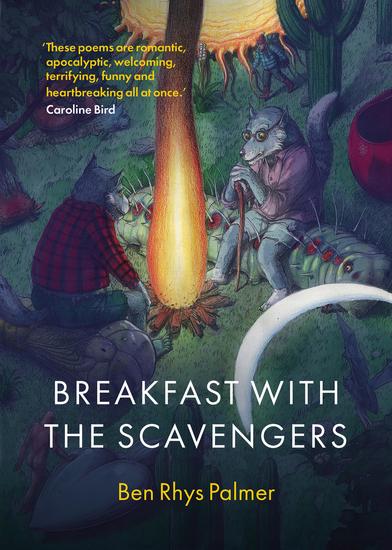
In Ben Rhys Palmer's joyful debut collection, discombobulated robots rub shoulders with philosophising hyenas, orangutan brides, Mesopotamian fish gods, and a psychotherapist from outer space.

A Welsh poet based in Mexico, his poems about Mexico capture the magic and vibrancy of a country André Breton once described as 'the most surrealist in the world.' Other poems pay homage to Welsh cult heroes John Cale and Adrian Street, and Ben's plucky ancestor, Rebecca Howells, who emigrated to Patagonia after her husband was killed in a mining explosion at Blaengwawr Colliery.

At once funny, tender, and beautifully bizarre, Breakfast with the Scavengers explores love, loss, loneliness, our never-ending quest for connection, and those blink-and-you-miss-them moments of transcendence that can light up our lives.
Available since: 02/10/2025.
Print length: 80 pages.

Other books that might interest you

  • Elegies & Laments - Poetic tributes to the dead - cover

    Elegies & Laments - Poetic...

    Percy Bysshe Shelley, Thomas...

    • 0
    • 0
    • 0
    In these more modern time perhaps our first thoughts of an Elegy or a Lament is for someone’s passing.  Wreathed in grief and death we think of a headstone on a silent grave and the memories that shelter within our hearts, slowly receding from one generation to the next, as an often lonely voice extols the virtues and traits of the one who has passed. 
     
    But these two very early forms of poetry, dating back to at least Ovid and probably further, are also surprising in their lyrical touch.  These are not just mournful and sad but also whimsical or rich with celebration and tribute as they journey through joy, laughter, love, tears and comfort. 
     
    Our Classic Poets, who have specifically chosen to include the form in the title of their work, include the likes of Percy Bysshe Shelley, Thomas Chatterton, Aphra Behn, Rainer Maria Rilke, Radclyffe Hall and many others of equal measure are always surprising in their views, their analysis and their sharing of words and thoughts, offering feelings that mirror our own and provide a balm of many hues for our wounded and tender souls. 
     
    1 - Elegies and Laments - An Introduction 
    2 - Elegy Written in a Country Churchyard by Thomas Gray 
    3 - The Lament of Swordy Well by John Clare 
    4 - An Elegy on a Pile of Ruins by John Cunningham 
    5 - Lament by Rainer Maria Rilke 
    6 - Elegy - Supposed to Be Written in Barnet Churchyard by George Townsend 
    7 - Elegy by Thomas Chatterton 
    8 - A Lament by Radclyffe Hall 
    9 - An Elegy by Ben Jonson 
    10 - Laeta - A Lament by HP Lovecraft 
    11 - Angellica's Lament by Aphra Behn 
    12 - Amores - Book I Elegy V - Corinna in an Afternoon by Ovid 
    13 - Morning Lament by Johann Wolfgang von Goethe 
    14 - The Wind's Lament by John Morris-Jones 
    15 - Noon Day Elegiacs by T W Rolleston 
    16 - Midnight Lamentation by Harold Munro 
    17 - February. An Elegy by Thomas Chatterton 
    18 - Elegy in April and September by Wilfred Owen 
    19 - Elegy by Anna Seward 
    20 - Autumn Elegy by Leslie Norris 
    21 - Elegy on the Year 1788 by Robert Burns 
    22 - Elegy for an Enemy by Stephen Vincent Benet 
    23 - An Elegy on the Death of a Mad Dog by Oliver Goldsmith 
    24 - Pointless It Is To Lament by Narsinh Mehta 
    25 - To the Beloved Dead - A Lament by Alice Meynell 
    26 - The Slave's Lament by Benjamin Cutler Clark 
    27 - The Slaves Lament by Robert Burns 
    28 - A Lament by Katharine Tynan 
    29 - The Going of the Battery (Wives Lament November the 2nd 1899) by Thomas Hardy 
    30 - Lament in 1915 by Harold Munro 
    31 - An Elegy on the Death of Llywelyn ab Gruyffyd by Gruffydd ap Yr Ynad Coch 
    32 - Elegy to the Memory of an Unfortunate Lady by Alexander Pope 
    33 - Elegy on a Lady Whom Grief for the Death of Her Bethrothed Killed by Robert Seymour Bridges 
    34 - Lament by Edna St Vincent Millay 
    35 - The Mother's Lament For Her Infant by Lucretia Maria Davidson 
    36 - Elegy on the Death of Mr Phillips by Thomas Chatterton 
    37 - Lament for the Poets, 1916 by Francis Ledwidge 
    38 - Lament for Thomas McDonagh by Francis Ledwidge 
    39 - Elegy on the Earl of Rochester by Anne Wharton 
    40 - Elegy on William Shakespeare by William Basse 
    41 - Adonais - An Elegy on the Death of John Keats by Percy Bysshe Shelley
    Show book
  • Marie Corelli's Collected Poems - cover

    Marie Corelli's Collected Poems

    Marie Corelli

    • 0
    • 0
    • 0
    Marie Corelli is best known as a novelist, but was always a poet at heart, composing on her strongest passions, whether for love, nature, God, or country.This volume collects poems from across her bestselling books and across her career, curated by Brenda Vyver, her her 'companion' of 40 years, who she left everything to when she died, and who is buried alongside her in a twin grave. It is perhaps worth noting that Brenda drove much of Corelli's work, which ran heavy to erotic descriptions of women.Corelli was the Victorian romance author who outsold Arthur Conan Doyle, H. G. Wells, and Rudyard Kipling put together. Despite critics labelling her as "as "the favourite of the common multitude", she was a favourite of Winston Churchill, Queen Victoria and William Gladstone. She was the only author invited to the coronation of Edward VII, and her friends included Mark Twain, Ouida, the Empress Frederick of Germany, and Alfred Tennyson. Her often darkly romantic works tried to reconcile Christianity with mystical ideas such as reincarnation and astral projection.A true character, Corelli claimed that she had warned the finders of the tomb of Tutankhamun about the "dire punishment" likely to occur to those who rifle Egyptian tombs, claiming to cite an ancient book that indicated that poisons had been left after burials. She . She was associated at some point with the Fraternitas Rosae Crucis; a mystical Rosicrucian group, and her books were a part of the foundation of today's corpus of esoteric philosophy."a woman of deplorable talent who imagined that she was a genius, and was accepted as a genius by a public to whose commonplace sentimentalities and prejudices she gave a glamorous setting." - Grant Allen "the imagination of a Poe with the style of an Ouida and the mentality of a nursemaid." -James Agate
    Show book
  • War and Peace - cover

    War and Peace

    Leo Tolstoy

    • 0
    • 0
    • 0
    "A world at war, a nation in flux, and the lives of five families caught in the tide of history."
    
    In War and Peace, Leo Tolstoy intertwines the lives of private individuals with the grand scale of public history. As Napoleon's army marches toward Moscow, the fates of the idealistic Pierre Bezukhov, the spirited Natasha Rostova, and the cynical Prince Andrei Bolkonsky become inextricably linked. This novel is not just a story of military campaigns and ballroom dances; it is a profound search for meaning in a world dominated by chaos. From the bloody fields of Borodino to the intimate drawing rooms of St. Petersburg, Tolstoy explores the forces that drive history and the small, personal moments that define our humanity.
    
    A Masterpiece of Immense Scope: Tolstoy's genius lies in his ability to shift from the minute details of a young girl's first ball to the grand strategies of emperors and generals. With over 500 characters, the novel creates a complete world, capturing the essence of Russian life—its nobility, its peasantry, and its enduring soul.
    
    History and Philosophy: Beyond the narrative, War and Peace serves as a vehicle for Tolstoy's unique philosophy of history. He challenges the "Great Man" theory, suggesting that the course of events is determined not by kings and commanders, but by the collective will of thousands of ordinary individuals.
    
    Why It Is a Must-Read: War and Peace is often called the "Book of Life" because it contains everything: youth and age, peace and war, life and death. It is a transformative reading experience that demands patience and rewards it with a deeper understanding of what it means to be alive.
    
    Embark on the journey of a lifetime. Purchase "War and Peace" today.
    Show book
  • Summer - cover

    Summer

    Edith Wharton

    • 0
    • 0
    • 0
    Rescued from a poverty-stricken mountain life, Charity Royall lives as ward to Lawyer Royall in the New England town of North Dormer. However, Charity is bored by her job at the local library–until a young man Lucius Harney plucks her from the drabness of North Dormer life.  A young architect and sophisticated man about town, Herney’s good looks and refinement awaken Charity’s passionate nature. Meanwhile, Charity contends with unwanted matrimonial advances from Lawyer Royall.   
    Summer is a heart-wrenching coming-of-age story regarded by Wharton as one of her best works.
    Show book
  • The Red Shoes - cover

    The Red Shoes

    Nancy Harris

    • 0
    • 0
    • 0
    'What's wrong with wanting to dance?'
    When an orphaned young woman is taken in by some local do-gooders, she is expected to be seen and not heard.
    Dazzled by a pair of beautiful shoes, she sees in them an opportunity to shine – but soon her feet betray her, taking her to places she does not wish to go.
    Nancy Harris's version of The Red Shoes is a contemporary retelling of Hans Christian Andersen's extraordinary fairytale of dance, desire and destruction. It was first performed at the Gate Theatre, Dublin, in 2017 and revived in the version published here in 2024 at the Swan Theatre, Stratford-upon-Avon, by the Royal Shakespeare Company, directed by Kimberley Rampersad.
    Show book
  • Goodness - cover

    Goodness

    Michael Redhill

    • 0
    • 0
    • 0
    Winner of the Best of the Edinburgh Fringe Prize
       
    Althea: Do you believe in your own death? Every moment you are alive is endless and the present goes on and on with you inside it. Of course the end is truly coming, but it’s so far off, and in the meantime the spring bulbs need bringing out of the dark and the windows must be cleaned. These distant murmurings of unrest are like the way you sometimes hear your name on the wind and you shudder. Because it’s eerie that the wind should know your name.
       
    This remarkable autobiographical play by the award-winning author of Building Jerusalem and Martin Sloane, is a Russian-doll-like play: concentric stories enveloping each other. A writer is told, in confidence, a terrible tale of murder and injustice and he promises never to repeat the story. Goodness is the writer breaking his word.
       
    Recently divorced, Michael Redhill goes to Poland to get away from his life and to do some research on the Holocaust. Thwarted by witnesses unwilling to talk, he returns home via England, but in London is introduced to someone who can tell him a 'real' story of evil. Through this reluctant witness, Redhill learns of a genocide. He encounters, through the memory of the storyteller, an alleged war criminal, about to be put on trial. But this is an old man with Alzheimer's who can no longer remember the time his crimes were allegedly committed. Has his guilt dissolved with his memory? Could he be pretending to be ill in order to escape punishment? The witness conjures for Redhill the war criminal's passionate and beautiful daughter, who will defend her father at all costs. There is also the prosecuting attorney, who has much in common with the old man whose destruction he seeks. As well as an uncomfortable attraction to his daughter. Each is drawn to theother. All is witnessed by a female prison guard - the one who tells the playwright, years later, what really happened in the quest to give a nation some closure. Everyone's story is compelling, and the ending is as unexpected as it is shocking.
       
    Who do we believe? A prison guard still wounded by history? A writer suffering from heartache? A dying war criminal? What is our responsibility? Who does memory serve? Did the past really happen? And if it did, who has a claim on it?
       
    Goodness is a play about what happens in the gaps between experiencing, telling and hearing.
    Show book