Join us on a literary world trip!
Add this book to bookshelf
Grey
Write a new comment Default profile 50px
Grey
Subscribe to read the full book or read the first pages for free!
All characters reduced
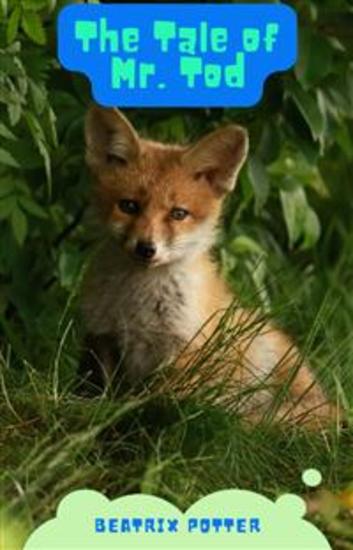
The Tale of Mr Tod - cover

The Tale of Mr Tod

Beatrix Potter

Publisher: Cervantes Digital

  • 0
  • 0
  • 0

Summary

Welcome to the enthralling world of "The Tale of Mr. Tod" by Beatrix Potter, a story that beckons you into the mysterious and adventurous lives of woodland creatures. In this gripping tale, prepare to follow the cunning Mr. Tod, a fox of deceit and craftiness, as he navigates a world where danger and cleverness intertwine.

Meet Mr. Tod, a sly and strategic fox with a penchant for plotting and mischief. He finds himself in a race against time and another formidable foe, Tommy Brock, a badger of brawn and stubbornness. Their clash takes unexpected twists as they both have their eyes set on a young family of rabbits.

Beatrix Potter's storytelling is an engaging blend of suspense, wit, and the spirit of perseverance. The tale unfolds amidst vivid illustrations that beautifully capture the essence of the animal characters and the breathtaking landscapes they inhabit.

The illustrations in this tale are a testament to Beatrix Potter's artistic genius, evoking a sense of wonder and fascination with each turn of the page. The characters come to life with detailed expressions and dynamic scenes that enrich the narrative.

"The Tale of Mr. Tod" is a timeless tale that keeps readers on the edge of their seats, revealing valuable life lessons about wit, survival, and the unpredictable nature of the world. So, step into the world of these cunning creatures, and let their story captivate your imagination and leave you pondering the essence of cleverness and courage.
Available since: 03/26/2023.
Other books that might interest you

  • Dies Irae - From their pens to your ears genius in every story - cover

    Dies Irae - From their pens to...

    Kenneth Grahame

    • 0
    • 0
    • 0
    Kenneth Grahame was born on 8th March 1859 in Edinburgh. 
    At age 5 his mother succumbed to puerperal fever.  His father, who had a drinking problem, now sent his 4 children to live with their grandmother at her large house in Cookham, Berkshire. Here the children lived in large open grounds next to the river.  These early experiences would in later years, be retold in his writing through a myriad of characters. 
    Grahame loved being a pupil at St Edward's School, Oxford and wanted to enroll at the university there but his guardian demurred on account of the cost. 
    Instead, a banking career was chosen for him, starting in 1879 at the Bank of England, where he rose steadily to the rank of its Secretary until retiring, with a pension, in 1908 due to ill health. 
    Alongside his commercial career Grahame had written and published various stories and essays in several periodicals. Some were anthologized as ‘Pagan Papers’ in 1893, and two years later ‘The Golden Age’ and later still ‘Dream Days’ and its masterpiece ‘The Reluctant Dragon’ became part of many home libraries.  His ability to view life through the lens of a young and curious child was superb, enabling the reader to easily identify with the character.   
    Grahame married Elspeth Thomson in 1899 and they had one child; Alastair, born semi-blind and plagued by health problems.  In a heart-rending tragedy he would later take his own life whilst attending Oxford University in 1920.   
    In 1908 Grahame reworked many of the bedtime stories he had fashioned for his son into the enduring favourite; ‘The Wind in the Willows’, describing the heart-warming adventures of Mr Toad and his friends.   
    Kenneth Grahame died in Pangbourne, Berkshire, on 6th July 1932.
    Show book
  • The Adventures of a Lady Pearl Broker Detective - From their pens to your ears genius in every story - cover

    The Adventures of a Lady Pearl...

    Beatrice Heron-Maxwell

    • 0
    • 0
    • 0
    The bookshelves of British literature are incredible collections that have gathered together centuries of very talented authors.  From these Isles their fame spread and whilst among their number many are now forgotten or neglected their talents endure.  Among them is Beatrice Heron-Maxwell.
    Show book
  • Aristocratic Education - From their pens to your ears genius in every story - cover

    Aristocratic Education - From...

    Stephen Leacock

    • 0
    • 0
    • 0
    Stephen P H Butler Leacock FRSC was born on the 30th December 1869 in Swanmore, near Southampton, England, the third of eleven children. 
    The family emigrated to Canada in 1876 to live on a 100-acre farm in Sutton, Ontario.  There Leacock was home-schooled and later enrolled into the elite private school Upper Canada College in Toronto.  Academically he was very strong and enrolled at the University of Toronto to study languages and literature.  He left there after his alcoholic father abandoned the family and finances were too stretched to continue his attendance.  He now enrolled in a three-month course at Strathroy Collegiate Institute to become a qualified high school teacher and with it a regular income. 
    Leacock published humorous articles in many Canadian and US magazines but his real passion was economics and political theory.  In 1899 he enrolled for postgraduate studies at the University of Chicago and earned his PhD in 1903. 
    His marriage to Beatrix Hamilton produced a single child 15 years later.  Over time father and son developed a love-hate relationship, partially caused by his son’s diminutive stature of only four feet.  
    He accepted a post at McGill University and kept it until he retired in 1936.  His work ‘Elements of Political Science’, was adopted as a standard textbook for two decades and was also his most profitable.  He now also began public speaking and lecturing.  
    In 1910, he privately printed some articles as ‘Literary Lapses’.  It was then released by a recognised publisher, and he became a commercially successful writer.  His collections of light-hearted whimsy, parody, nonsense, and satire were now frequently published along with biographies and several award-winning volumes on Canada. 
    Politically Leacock was a difficult creature.  He opposed women’s right to vote, was a champion of Empire but advocated social welfare legislation and wealth redistribution, but he often caused friction with his racist views. 
    Leacock has been forgotten as an economist, but it’s often said that in 1911 more people had heard of him than had heard of Canada.  For the decade after 1915 Leacock was the most popular humorist in the English-speaking world. 
    Stephen Leacock died on 28th March 1944 of throat cancer in Toronto, Canada.  He was 74.
    Show book
  • 3 Christmas Stories - Sad Russian - A trio of Xmas themed stories for the holiday season - cover

    3 Christmas Stories - Sad...

    Anton Chekhov, Fyodor Dostoyevsky

    • 0
    • 0
    • 0
    There is something about the number 3.    
     
    The Ancient Greeks believed 3 was the perfect number, and in China 3 has always been a lucky number, and they know a thing or two.   
     
    Most religions also have 3 this and 3 that and, of course, in these more modern times, three’s a crowd may be too many, except when it’s a ménage à trois.  It seems good things usually come in threes. 
     
    Whatever history and culture says WE think 3, a hat-trick of stories, is a great number to explore themes and literary avenues that classic authors were so adept at creating. 
     
    From their pens to your your ears.
    Show book
  • Alexander Pushkin - A Short Story Collection - Born in Moscow with African roots Pushkin is considered by many to be the founder of modern Russian literature - cover

    Alexander Pushkin - A Short...

    Alexander Pushkin

    • 0
    • 0
    • 0
    Alexander Sergeyevich Pushkin was born on 26th May 1799 in Moscow into a family of Russian nobility. 
     
    Raised by nursemaids and French tutors in French he learnt Russian only via the household staff. 
     
    He graduated from the prestigious Imperial Lyceum, near St Petersburg and plunged into the vibrant and raucous intellectual youth culture of what was then the capital of the Russian Empire.  
     
    In 1820, he published his first long poem, ‘Ruslan and Ludmila’, with much controversy about both subject and style.  Pushkin was heavily influenced by the French Enlightenment and gravitated, with other literary radicals, towards social reform angering the Government. 
     
    His early literary work and reputation was poetic and written as he travelled around the Empire or engaged himself in various rebellions against the Ottoman Empire.  A clash with his own government after his poem, ‘Ode to Liberty’, was found among the belongings of the Decembrist Uprising rebels meant two years of internal exile at his mother's rural estate.  His friends and family continually petitioned for his release, sending letters and meeting with Tsar Alexander I and then Tsar Nicholas I.   
     
    In 1825, whilst at his Mother’s estate, Pushkin wrote his most famous play, the drama ‘Boris Godunov’.  
     
    Upon meeting with Tsar Nicholas I, Pushkin obtained his release and began work as the Tsar's Titular Counsel of the National Archives.  However, because of the earlier problems the tsar retained control of everything Pushkin published, and he was banned from travelling at will. 
     
    Around 1828, Pushkin met the 16-year-old Natalia Goncharova, one of the most talked-about beauties of Moscow.  After much hesitation, Natalia accepted his marriage proposal after she received assurances that the government had no intentions to persecute the libertarian poet.  When the Tsar gave Pushkin the lowest court title, Gentleman of the Chamber, he became enraged, feeling that the Tsar intended to humiliate him. 
     
    In the year 1831, during Pushkin's growing literary influence, he met Nikolai Gogol.  Recognising his gifts Pushkin supported him and published his short stories in his own magazine ‘The Contemporary’. 
     
    By the autumn of 1836, Pushkin was falling into greater and greater debt and facing scandalous rumours that his wife was having an affair.  
     
    In January 1837, Pushkin sent a ‘highly insulting letter’ to his wife’s pursuer, Georges-Charles de Heeckeren d'Anthès.  The only answer could be a challenge to a duel. 
     
    It took place on 27th January.  D'Anthès fired first, critically wounding Pushkin; the bullet entered at his hip and penetrated his abdomen.  Two days later Alexander Pushkin died of peritonitis.  He was 37. 
     
    1 - Alexander Pushkin - A Short Story Collection - An Introduction 
    2 - The Queen of Spades by Alexander Pushkin 
    3 - The Blizzard by Alexander Pushkin 
    4 - The Stationmaster by Alexander Pushkin 
    5 - The Shot by Alexander Pushkin 
    6 - The Coffin Maker by Alexander Pushkin 
     -  
     -  
     -  
    1 - Cornwall - A Short Story Collection - An Introduction 
    2 - Malachi's Cove by Anthony Trollope 
    3 - Ligeia by Edgar Allan Poe 
    4 - The Screaming Skull by F Marion Crawford 
    5 - The Haunted Church by Frederick Cowles 
    6 - The Limping Ghost by Frederick Cowles 
    7 - In the Mist by Mary E Penn 
    8 - The Botathen Ghost from Footprints of Former Men in Far Cornwall by the Reverend R S Hawker 
    9 - Room For One by Frederick Cowles 
    10 - Colonel Benyon's Entanglement by Mary Elizabeth Braddon 
    11 - Christmas Eve at a Cornish Manor House by Clara Venn
    Show book
  • Kess - cover

    Kess

    Tijan

    • 0
    • 0
    • 0
    She's one of two females in Roussou's Crew system. 


    He was sent to protect her. She never knew. 


    Until now . . . 


    A short standalone based in the Crew/Roussou world.
    Show book