Join us on a literary world trip!
Add this book to bookshelf
Grey
Write a new comment Default profile 50px
Grey
Subscribe to read the full book or read the first pages for free!
All characters reduced
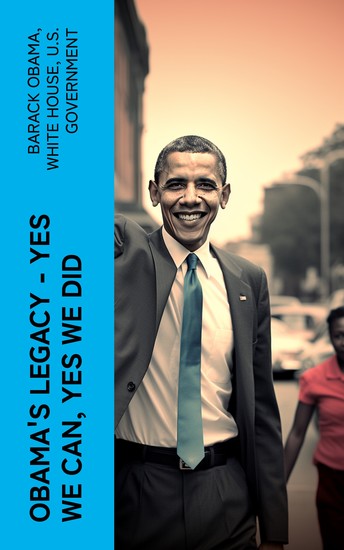
Obama's Legacy - Yes We Can Yes We Did - cover

Obama's Legacy - Yes We Can Yes We Did

Barack Obama, U.S. Government, House White

Publisher: e-artnow

  • 0
  • 0
  • 0

Summary

During his years in office, from 2009 to 2017, Barack Obama signed more landmark legislation than any Democratic president since Lyndon Baines Johnson. This collection presents the legacy of Barack Obama through his presidential work and the legislation of his administration. The edition honors his achievements, the determined efforts despite the resistance and his long lasting influence:  Table of Contents:  Inaugural Speeches First Inaugural Address (2009) Second Inaugural Address (2013) Main Accomplishments Health Care Climate and Energy American Leadership Economic Progress Equality & Social Progress Executive Orders Presidential Records  Review and Disposition of Individuals Detained at the Guantanamo Bay Naval Base and Closure of Detention Facilities  Review of Detention Policy Options  Ensuring Enforcement and Implementation of Abortion Restrictions in the Patient Protection and Affordable Care Act Strengthening Protections Against Trafficking in Persons in Federal Contracts Fair Pay and Safe Workplaces Planning for Federal Sustainability in the Next Decade Implementing the National HIV/AIDS Strategy for the United States for 2015-2020 Delegation of Certain Authorities and Assignment of Certain Functions Under the Trade Preferences Extension Act of 2015 Amendment to Executive Order 13673 Developing an Integrated Global Engagement Center To Support Government-wide Counterterrorism Communications Activities Directed Abroad and Revoking Executive Order 13584 International Agreements & Treaties New START Paris Agreement Farwell Address
Available since: 12/14/2023.
Print length: 153 pages.

Other books that might interest you

  • State of the Union 1988 - cover

    State of the Union 1988

    Ronald Reagan

    • 0
    • 0
    • 0
    The 1988 State of the Union Address delivered January 25, 1988, extols individual rights, the free market, and the value of work, family, and religion, resulting in “the longest peacetime expansion in history”. Reagan stresses unity and common goals, saying there are no Republicans, no Democrats -- just Americans. 
    “We’re for limited government…”, free trade, a balanced budget, and the line-item veto. “[C]ontrol of our schools belongs to the States, local communities and, most of all, to the parents and teachers.” 
     “My friends, some years ago, the Federal Government declared war on poverty, and poverty won.” Our 59 major poverty programs have created a dependency trap that wreaks havoc on the family, the support system most needed to escape poverty. 
    We support a drug-free America, an end to federal funding of abortion, and “believe Congress should pass our school prayer amendment.” 
    “A creative, competitive America is the answer to a changing world, not trade wars that would close doors, create greater barriers, and destroy millions of jobs. … Protectionism is destructionism. America's jobs, America's growth, America's future depend on trade -- trade that is free, open, and fair.” 
    “We must … make adequate, stable defense spending a top goal both this year and in the future.” Our “efforts are to give future generations what we never had -- a future free of nuclear terror. Reduction of strategic offensive arms is one step, SDI another. Our funding request for our Strategic Defense Initiative is less than 2 percent of the total defense budget. SDI funding is money wisely appropriated and money well spent.”  
    We thank God for “this place called America, this shining city on a hill, this government of, by, and for the people. Thank you, and God bless you.” 
    Audio recording courtesy of the Ronald Reagan Presidential Library. 
    AspenLeafMedia.com
    Show book
  • John Rawls - Justice Fairness and the Veil of Ignorance - cover

    John Rawls - Justice Fairness...

    Hector Davidson

    • 0
    • 0
    • 0
    John Rawls, one of the most influential philosophers of the 20th century, fundamentally reshaped the field of political philosophy with his groundbreaking work, A Theory of Justice (1971). His vision of "justice as fairness" offered a robust framework for understanding social cooperation and the principles that should govern a just society. By blending elements of social contract theory with contemporary concerns about inequality and human rights, Rawls addressed timeless questions about the nature of justice and the moral obligations of institutions.  
    Born on February 21, 1921, in Baltimore, Maryland, Rawls’ early life was marked by tragedy and intellectual rigor. He lost two brothers to illness at a young age, experiences that profoundly influenced his outlook on morality and the fragility of human life. Rawls attended Princeton University, where he earned his undergraduate degree in philosophy, and later completed his doctorate at Harvard University after serving in the U.S. Army during World War II. These formative years shaped his commitment to exploring ethical frameworks that could withstand the complexities of a modern, pluralistic world.  
    Rawls’ magnum opus, A Theory of Justice, introduced several key concepts that would come to define his philosophy. Central to his work was the idea of the "original position," a hypothetical scenario in which individuals design the principles of justice behind a "veil of ignorance." This veil prevents individuals from knowing their social status, wealth, abilities, or personal biases, compelling them to choose rules that are fair and impartial. The result is a system that prioritizes equal basic liberties for all, coupled with the difference principle, which allows social and economic inequalities only if they benefit the least advantaged members of society. 
    Show book
  • White Lies Matter - The Gospel of MAWA - cover

    White Lies Matter - The Gospel...

    Rev. Micaiah Wright

    • 0
    • 0
    • 0
    This audiobook is narrated by an AI Voice.   
    White Lies Matter: The Gospel of MAWA isn’t just a book—it’s a sermon, a roast, and a history lesson rolled into one blistering satire of American politics. Beneath the bright red MAGA cap, the author exposes what the slogan really meant: Make America White Again. 
    With wit as sharp as Twain, the bite of Carlin, and the unflinching honesty of Chappelle, this audiobook takes listeners on a journey through America’s not-so-secret gospel of racial nostalgia. From the election of Barack Obama that shook the foundations of white exceptionalism, to Steve Bannon and Donald Trump baptizing a movement in fear, grievance, and privilege, WLM uncovers how the “American Dream” was fenced off and sold as exclusive property. 
    Each chapter functions like a scripture reading from the Church of MAWA, complete with commandments, proverbs, and revelations that peel back patriotic veneers to reveal the machinery of exclusion underneath. It’s biting, it’s funny, and it’s devastatingly honest—because America’s greatest myths are also its greatest lies. 
    This is not a quiet audiobook. It’s meant to provoke laughter, outrage, and reflection in equal measure. Whether you’re a believer in the gospel of MAWA or a skeptic watching from the pews, White Lies Matter insists you confront the uncomfortable truth: racism was never a glitch in the system—it was the system. 
    At once irreverent and illuminating, this is satire that cuts to the bone and asks the question no campaign slogan dares to touch: Whose America are we really trying to make “great” again?
    Show book
  • The Invisible Clash - FBI Shin Bet and the IRA's Struggle against Domestic War on Terror - cover

    The Invisible Clash - FBI Shin...

    Davis Truman

    • 0
    • 0
    • 0
    Dive into the gripping world of intelligence agencies, covert operations, and the relentless fight against domestic terror. "The Invisible Clash" takes you on a heart-pounding journey as the FBI, Shin Bet, and the IRA unite in an extraordinary battle to preserve peace, protect lives, and expose the covert forces threatening our existence. 
    Within the pages of "The Invisible Clash," you'll encounter a cast of unforgettable characters, each propelled by their unshakable belief in the righteousness of their cause. Meet the seasoned FBI agent, hardened by years of service, who embarks on a dangerous undercover mission to infiltrate a web of extremist groups. Witness the relentless pursuit of the Shin Bet agent, whose unwavering dedication to homeland security leads him into the heart of the storm. And discover the untold stories of the IRA operatives, caught between their desire for independence and the pursuit of a more peaceful future. 
    Immerse yourself in a world where alliances are tested, secrets are unveiled, and the battle between good and evil unfolds in the shadows. Don't miss your chance to experience "The Invisible Clash" – a literary tour de force that will keep you on the edge of your seat until the very last page.
    Show book
  • A Modern Utopia - cover

    A Modern Utopia

    H. G. Wells

    • 0
    • 0
    • 0
    "For a Utopia to be credible, it must be kinetic—not a static state, but a hopeful stage in an infinite development."
    
    Unlike the rigid, stagnant utopias of the past, H.G. Wells presents a "Kinetic Utopia"—a living, breathing world located on a planet identical to Earth but light-years ahead in social and technological evolution. Following two travelers who find themselves transported to this parallel world, Wells explores a global civilization governed by a World State, where poverty is abolished, technology serves humanity, and a voluntary nobility known as the "Samurai" maintains the moral fiber of the race. This is a brilliant exploration of how a planet-wide society could balance individual liberty with the common good.
    
    The "Samurai" Class: The most enduring concept of the novel is the Samurai—a voluntary order of men and women who follow a strict Rule of life to qualify for leadership. They are not a hereditary caste but an intellectual and moral meritocracy. Wells uses this concept to solve the age-old problem of governance: how to ensure that those in power are disciplined, selfless, and dedicated to the progress of the species.
    
    A World of Motion: Wells argues that a modern utopia cannot be a walled city; it must encompass the entire globe. In this world, every citizen is tracked by a universal indexing system (a startlingly prophetic vision of modern data), ensuring that while people are free to travel and change professions, the state can provide for their needs and maintain social stability. It is a world where the "Five Freedoms" are guaranteed, and the focus of human life shifts from survival to self-actualization.
    
    Rediscover the dream of a better world. Purchase "A Modern Utopia" today and explore the frontiers of human possibility.
    Show book
  • George Soros - A Life In Full - cover

    George Soros - A Life In Full

    Peter L. W. Osnos

    • 0
    • 0
    • 0
    The name George Soros is recognized around the world. Universally known for his decades of philanthropy, progressive politics, and investment success, he is equally well known as the nemesis of the far right—the target of sustained attacks from nationalists, populists, authoritarian regimes, and anti-Semites—because of his commitment to open society, freedom of the press, and liberal democracy. At age ninety-one, Soros still looms large on the global stage, and yet the man himself is surprisingly little understood. 


    Biographers have attempted to tell the story of George Soros, but no single account of his life can capture his extraordinary, multifaceted character. Now, in this ambitious and revealing new book, Soros's longtime publisher, Peter L. W. Osnos, has assembled an intriguing set of contributors from a variety of different perspectives—public intellectuals (Eva Hoffman, Michael Ignatieff), journalists (Sebastian Mallaby, Orville Schell), scholars (Leon Botstein, Ivan Krastev), and nonprofit leaders (Gara LaMarche, Darren Walker)—to paint a full picture of the man beyond the media portrayals. 


    Through this kaleidoscope of viewpoints emerges a vivid and compelling portrait of this remarkable man's unique and consequential impact. It has truly been a life in full.
    Show book