Join us on a literary world trip!
Add this book to bookshelf
Grey
Write a new comment Default profile 50px
Grey
Subscribe to read the full book or read the first pages for free!
All characters reduced
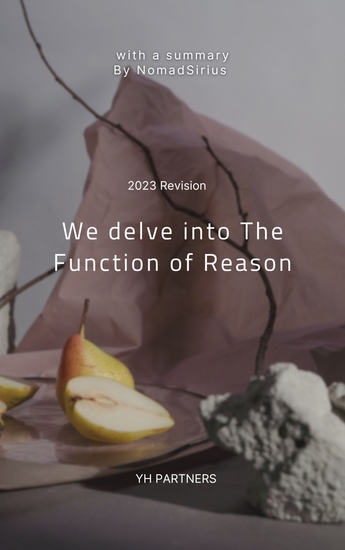
We delve into The Function of Reason - cover

We delve into The Function of Reason

박 Nomadsirius

Publisher: YH Partners

  • 0
  • 0
  • 0

Summary

We delve into The Function of Reason(In English, 2023 Revision).Prologue.Whitehead (1861-1947) is a philosopher from England. He asserts that reason is an impulse toward empty concreteness. That impulse is not empty. It is a fundamental force that can give birth to something. This impulse of mind is appetition, which is an inherent agent of transcendental goals. Therefore, empty concreteness is embodied as material enjoyment. Whitehead\'s reason cannot exist without appetition. Jeong Yi-cheon of the Northern Song Dynasty, who developed Neo-Confucianism, also believed that the main body cannot be separated from the phenomenon. Whitehead advocates Plato, stating that all of Western philosophy is just a footnote to Plato\'s philosophy. However, he overcomes Plato by creating his own organic philosophy. Nietzsche, Marx, and Freud are also critics of the Platonic system. Plato\'s original sin is his ideology that isolates humans from the world and alienates them for 2000 years. Idea corresponds to all phenomena in a monolithic and organic manner. Whitehead can be seen as a Copernican Übermensch. ‘The Function of Reason’ is a lecture given at Princeton University in 1929. This book provides an easy and condensed summary of a long and difficult text.
Available since: 07/21/2023.
Print length: 242 pages.

Other books that might interest you

  • How to Abolish Prisons - Lessons from the Movement against Imprisonment - cover

    How to Abolish Prisons - Lessons...

    Rachel Herzing, Justin Piché,...

    • 0
    • 0
    • 0
    Critics of abolition sometimes castigate the movement for its utopianism, but in How to Abolish Prisons, long-time organizers Rachel Herzing and Justin Piché reveal a movement that has made the struggle for abolition as real as the institutions they are fighting against. 


    Drawing on extensive interviews with abolitionist crews all over North America, Herzing and Piché provide a collective reconstruction of what the grassroots movement to abolish prisons actually is, what initiatives it has launched, how it organizes itself, and how its protagonists build the day-to-day practice of politics. Listeners sit in on the Winnipeg rideshares of Bar None and the meetings of the Chicago Community Bail Fund as they assess the utility of politicized mutual aid. They follow the campaigns and coalitions of Critical Resistance in Oakland and San Francisco and Survived and Punished in New York City, and learn about the prisoner correspondence projects that keep activists behind bars and outside them in constant coordination. 


    Abolitionist campaigns are constructing on-the-ground initiatives across North America to deconstruct carceral society and build resistant communities. Through the words, deeds, and personalities of this beautifully peopled movement, How to Abolish Prisons emerges as a stunning snapshot of a movement's thinking in motion.
    Show book
  • The Dismissive Avoidant Attachment Style & How Childhood Traumas Can Result in Dysfunctional Behaviors in Adult Relationships - Learn Your Triggers & Begin to Heal - cover

    The Dismissive Avoidant...

    Ph.D. Dr. Christine Chin-Sim

    • 0
    • 0
    • 0
    As a relationship and life coach, I’ve seen firsthand how entrenched ways of behaving, as a result of childhood trauma, can result in toxic and unhealthy relationships. These unhealthy relationships can leave one or both partners bruised and battered from chronic emotional abuse. Many become closed-off toward any prospect of having their heart ripped out, from yet another toxic relationship. Others, find themselves having the same types of relationship with different partners and asking the question, “Why do I keep attracting the same man/woman over and over again?” 
    As children, our experiences dictated how we attached to our caregivers. Unfortunately, how we attach to our caregivers, have also proven to be an indicator of how we now experience our close adult relationships; especially romantic ones. 
    In this book, I will be focusing on the Dismissive Avoidant Attachment Style, and how this style of attachment now dictates how this individual interacts with their significant others in romantic relationships. 
    Attachment styles affect every type of relationship, however, the effects are further magnified in romantic relationships, because of the lack of emotional intelligence and depth, this attachment style is challenged with. 
    In this book, you will learn how to identify the dismissive avoidant attachment style individual, some of the challenges they face in their relationships, and finally, given you some tools (exercises) to help move you toward a more secure way of experiencing relationships.
    Show book
  • Predator - A Memoir a Movie an Obsession - cover

    Predator - A Memoir a Movie an...

    Ander Monson

    • 0
    • 0
    • 0
    In his first memoir, Ander Monson guides listeners through a scene-by-scene exploration of the 1987 film Predator, which he has watched 146 times. Some fighters might not have time to bleed, but Monson has the patience to consider their adventure, one frame at a time. He turns his obsession into a lens through which he poignantly examines his own life, formed by mainstream, white, male American culture. Between scenes, Monson delves deeply into his adolescence in Michigan's Upper Peninsula and Riyadh, his role as a father and the loss of his own mother, and his friendships with men bound by the troubled camaraderie depicted in action and sci-fi blockbusters. Along with excursions into the conflicted pleasures of cosplay and first-person shooters, he imagines himself beside the poet and memoirist Paul Monette, who wrote the novelization of the movie while his partner was dying of AIDS. 


    A sincere and playful book that lovingly dissects the film, Predator also offers questions and critiques of masculinity, fandom, and their interrelation with acts of mass violence. In a stirring reversal, one chapter exposes Monson through the Predator's heat-seeking vision, asking him, "What do you know about the workings of the hidden world?" As Monson brings us into the brilliant depths of the film and its universe, the hunt begins.
    Show book
  • Classic Speeches: 1940-1987 - cover

    Classic Speeches: 1940-1987

    Winston Churchill, Martin Luther...

    • 0
    • 0
    • 0
    A collection of the most famous speeches of all time from political figures, such as Winston Churchill, Martin Luther King Jr and John F Kennedy.
    Show book
  • Mastering Human - A manual to understanding the purpose of life on Earth - cover

    Mastering Human - A manual to...

    Conversations with Heaven on Earth

    • 0
    • 0
    • 0
    And so we were wanting to discuss the significance of the new book. We even know you are questioning the title of this, it wasn't about opening up your mindset, it was about understanding the significance of the written text, once again, and how that can be so profound, and absorption of the information is easier to digest. We see that the voice and the words through the videos with the sound can almost put people into a hypnotic state themselves, where they are not even able to consciously absorb and follow the information. They find that they have to keep listening to the sessions many times because they just go into a very relaxed trance state themselves where they're getting their own upgrades and epiphanies and senses of their own higher versions of selves and other multi-dimensional aspects of self. 
    This is going to be a profound book that we view this as, because this is the teachings of Jesus. And while we were giving you strong senses that we did not want you to abuse or label the name of him because of the misperceptions of who he is, and who he stands for; we see many people reluctant to be interested in what that man had to say, because they have still got a firm attachment to him being a part of a religion that may have been part of their inner childhood trauma or work, not just this lifetime. We know many who are still traumatized by being killed for a religion, either because they did not comply or they were trying to share other perspectives of religion. So there is much to be said about what religion has done to humanity. And of course, it's human free-will choices. But the truth has almost been so hidden from humanity that the truth has been so watered down and twisted with opinions. It's been a total manipulation for many. This is Earth's history. We cannot pretend it has not been as such. 
    Show book
  • The Invention of Scarcity - Malthus and the Margins of History - cover

    The Invention of Scarcity -...

    Deborah Valenze

    • 0
    • 0
    • 0
    With the publication of Essay on the Principle of Population and its projection of food shortages in the face of ballooning populations, British theorist Thomas Robert Malthus secured a leading role in modern political and economic thought. In this startling new interpretation, Deborah Valenze reveals how canonical readings of Malthus fail to acknowledge his narrow understanding of what constitutes food production. 


    Valenze returns to the eighteenth-century contexts that generated his arguments, showing how Malthus mobilized a redemptive narrative of British historical development and dismissed the ways that people adapted to the challenges of subsistence needs. She uses history, anthropology, and food studies to redirect our attention to the margins of Malthus's essay, where activities such as hunting and gathering were rendered extraneous. She demonstrates how Malthus's omissions and his subsequent canonization provided a rationale for colonial imposition of British agricultural models, regardless of environmental diversity. 


    By broadening our conception of human livelihoods, Valenze suggests pathways to resistance against the hegemony of Malthusian political economy. She invites us to imagine a world where monoculture is in retreat and the margins are recentered as spaces of experimentation, nimbleness, and human flourishing.
    Show book