Join us on a literary world trip!
Add this book to bookshelf
Grey
Write a new comment Default profile 50px
Grey
Subscribe to read the full book or read the first pages for free!
All characters reduced
The Mormon Battalion Its History and Achievements - A Unique Military Unit: The Brave Journey of Mormon Pioneers in the Mexican-American War - cover

The Mormon Battalion Its History and Achievements - A Unique Military Unit: The Brave Journey of Mormon Pioneers in the Mexican-American War

B. H. Roberts

Publisher: Good Press

  • 0
  • 0
  • 0

Summary

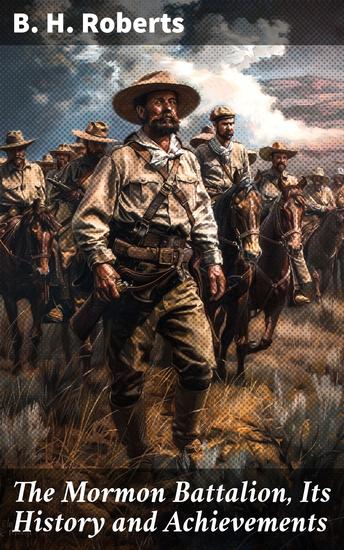
In "The Mormon Battalion, Its History and Achievements," B. H. Roberts constructs a vivid historical narrative that chronicles the remarkable journey of the Mormon Battalion during the Mexican-American War. Through a meticulous blend of archival research and personal accounts, Roberts employs a compelling literary style that is both informative and engaging, weaving together the themes of faith, sacrifice, and perseverance. This work not only documents the battalion's contributions to American history but also contextualizes their experiences within the broader tapestry of 19th-century American society, illuminating the complexities faced by this unique group of pioneers. B. H. Roberts was a noted historian, scholar, and leader in the early 20th-century Mormon community. Raised in a culture steeped in the legacy of the Mormon pioneers, his firsthand knowledge and passion for the history of the Latter-day Saints profoundly influenced his writing. Roberts's extensive involvement in Church history and his role as a member of the Quorum of the Seventy provided him with unique insights into the motivations and experiences of the Mormon Battalion. I recommend this book to readers interested in American history, military studies, or the intricate narratives of faith-based communities. Roberts's work is not only a valuable historical account but also a profound exploration of the human spirit, making it essential reading for anyone seeking to understand the multifaceted nature of pioneer life.
Available since: 09/18/2023.
Print length: 73 pages.
Other books that might interest you

  • Mansa Musa and the Empire of Mali - A True Story of Gold and Greatness from Africa - cover

    Mansa Musa and the Empire of...

    P. James Oliver

    • 0
    • 0
    • 0
    Oliver's well-researched biography of Mansa Musa reads like an exotic tale of gold, glory, and adventure. During his long reign as Mali's emperor, Mansa Musa led his empire into its Golden Age; presided over a spectacular, 60,000 person, 9,000 mile pilgrimage; founded a university in Timbuktu; and helped revolutionize architecture across the Sudan. Oliver does not allow Musa's story to get bogged down in detail by seamlessly weaving a lot of history into his narrative and by supplying curious readers with an extensive description. 
    Many of the African ancestors of today's African-Americans came from West Africa. From 700 -- 1600 A. D., one after the other, three great, black, commercial empires dominated West Africa. They were powerful, prosperous, complex, stable -- and large. At its height, the Empire of Mali was the size of all of Western Europe.
    Show book
  • Indus Valley Civilization and Maurya Empire The: The History and Legacy of Ancient India’s Most Influential Powers - cover

    Indus Valley Civilization and...

    Editors Charles River

    • 0
    • 0
    • 0
    India’s oldest civilization, known as the Indus Valley Civilization or the Harappan Civilization, was contemporary with ancient Mesopotamia and ancient Egypt and had extensive contacts with the former, making it one of the most important early civilizations in the world. Spread out along the rivers of the Indus River Valley, hundreds of settlements began forming around 3300 BCE, eventually coalescing into a society that had all of the hallmarks of a true civilization, including writing, well-developed cities, a complex social structure, and long-distance trade. 
    During the last centuries of the first millennium BCE, most of the Mediterranean basin and the Near East were either directly or indirectly under the influence of Hellenism. The Greeks spread their ideas to Egypt, Mesopotamia, and Persia and attempted to unify all of the peoples of those regions under one government. Although some of the Hellenistic kingdoms proved to be powerful in their own rights – especially Ptolemaic Egypt and the Seleucid Empire, which encompassed all of Mesopotamia, most of the Levant, and much of Persia during its height – no single kingdom ever proved to be dominant. The Hellenic kingdoms battled each other for supremacy and even attempted to claim new lands, especially to the east, past the Indus River in lands that the Greeks referred to generally as India. But as the Hellenistic Greeks turned their eyes to the riches of India, a dynasty came to power that put most of the Indian subcontinent under the rule of one king. The dynasty that came to power in the late 4th century BCE is known today as the Mauryan Dynasty, and although the ruling family was short-lived and their power was ephemeral, its influence resonated for several subsequent centuries and spread as far east as China and into the Hellenistic west.
    Show book
  • North to Boston - Life Histories from the Black Great Migration in New England - cover

    North to Boston - Life Histories...

    Blake Gumprecht

    • 0
    • 0
    • 0
    Between World War II and 1980, tens of thousands of Black people moved to Boston from the South as part of the Great Migration, one of the most consequential mass movements of people in American history. Black migration from the South transformed the city, as it did urban areas across the country. North to Boston is the first book to examine that important subject. 


    Blake Gumprecht traces the history of this migration and explores its impacts in greater depth through the lives of ten individuals, each the subject of one chapter. Those chapters are short biographies based on extensive interviews by the author and are told in an engaging style that reflects the author's background as a journalist. 


    The ten people featured came from six southern states. They fled racism, limited opportunity, and hopelessness, and moved north in pursuit of better jobs, equal treatment, and greater freedom. They settled in neighborhoods such as Roxbury, Dorchester, and Mattapan. They worked as teachers, factory workers, welders, and security guards. Their stories are emblematic of the experiences of Black people everywhere who left the South, and provide a rare glimpse into the lives of ordinary people living in one city's Black community.
    Show book
  • Happy Habits - A Happier Healthier Life One Minute at a Time - cover

    Happy Habits - A Happier...

    Tal Ben-Shahar

    • 0
    • 0
    • 0
    In Happy Habits, happiness expert Tal Ben-Shahar provides accessible and easy-to-implement tools, and an easy-to-follow three step process, that can help you realize your goals, aspirations, and dreams.He starts with simple intervention techniques to reset your mood in as little time as possible—what he calls Happiness Boosters in the form of MVIs—Minimum Viable Interventions, which include taking three deep breaths; writing down five things for which you are grateful; reading a quote slowly and deliberately; and vigorously climbing stairs for forty-five seconds. From there, discover how to improve wellbeing and build a stronger base within yourself for committing to change, increasing your willpower, and finding joy in the journey.The final step in Ben-Shahar's guide will help you learn how to create the daily rituals that will help you turn goals into habits, and intentions into reality, using the 3 Rs of change: Reminders, Repetitions, and Rituals. 
     
    With concrete examples, practical, direct advice, and an easy-to-follow action plan,  Ben-Shahar shows you that while cultivating lasting change takes motivation, it does not have to be a frustrating experience that is doomed to failure.
    Show book
  • End of the Civil War The: The History of the Battles and Events that Destroyed the Confederacy and Finished the War Between the States - cover

    End of the Civil War The: The...

    Editors Charles River

    • 0
    • 0
    • 0
    Americans have long been fascinated by the Civil War, marveling at the size of the battles, the leadership of the generals, and the courage of the soldiers. Since the war's start over 150 years ago, the battles have been subjected to endless debate among historians and the generals themselves. The Civil War was the deadliest conflict in American history, and had the two sides realized it would take 4 years and inflict over a million casualties, it might not have been fought. Since it did, however, historians and history buffs alike have been studying and analyzing the biggest battles ever since. 
    By the close of 1864, Abraham Lincoln had been reelected, the Union army had taken Nashville from General Hood, and Sherman had concluded his total war, “slash-and-burn” march of destruction to Savannah, Georgia, offering it as a Christmas present to Lincoln. Nevertheless, with everything seemingly falling to pieces, the South still held out hope of some sort of miracle, and Davis even attempted to send a peace delegation to meet with Lincoln in the early months of 1865. To most observers, the South was clearly reaching its end, but Davis had no intention of quitting the war. Even while he was fleeing, he attempted to order Confederate generals in the field to keep fighting. On April 9, 1865, Lee formally surrendered his weary army to Grant at Appomattox. Appomattox is frequently cited as the end of the Civil War, but there still remained several Confederate armies across the country, mostly under the command of General Joseph E. Johnston, the same commander who arrived with reinforcements by rail during the First Battle of Bull Run and gave the South hope with victory in the first major battle. 
    On April 26, 1865, Johnston defied Davis’s orders and surrendered all of his forces to General Sherman, and over the next month, the remaining Confederate forces would surrender or quit.
    Show book
  • From 1 CR to 121CR - Theobroma - cover

    From 1 CR to 121CR - Theobroma

    Sindhy Kashyap

    • 0
    • 0
    • 0
    Starting up with Rs 1 Cr from their father, these sisters grew Theobroma into a Rs 121 Cr business
    Show book