Junte-se a nós em uma viagem ao mundo dos livros!
Adicionar este livro à prateleira
Grey
Deixe um novo comentário Default profile 50px
Grey
Assine para ler o livro completo ou leia as primeiras páginas de graça!
All characters reduced
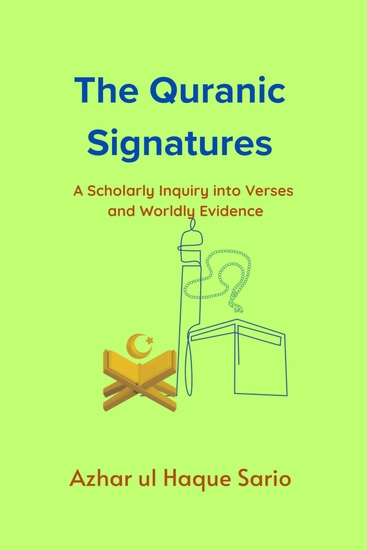
The Quranic Signatures - A Scholarly Inquiry into Verses and Worldly Evidence - cover
LER

The Quranic Signatures - A Scholarly Inquiry into Verses and Worldly Evidence

Azhar ul Haque Sario

Editora: Azhar Sario Hungary

  • 0
  • 0
  • 0

Sinopse

Ever wondered how ancient verses could echo modern science?


This book takes you on a fascinating journey through the Quran and the world around us. It digs into cosmology, like the Big Bang and expanding universe. It explores astronomy, with orbits of the sun and moon. Geology gets a look, with mountains as stabilizers. Oceanography covers seas that don’t mix. Meteorology explains winds and rain. Biology traces life’s watery origins. Embryology unpacks human development stages. Botany reveals plant pairs. Zoology studies animal communities. Human anatomy dives into milk production. History checks Pharaoh and Haman. Psychology probes the human soul. Economics tackles interest bans. Time relativity ties it all together. Each of its 15 chapters stands alone. They analyze specific verses. They blend language, history, and science. It’s a deep dive into whether the Quran foresaw things we only recently figured out.


Now, what makes this book stand out? It’s not just a list of “hey, this matches science!” moments. Other books might stop there, but this one goes further. It digs into the Arabic words and their meanings over time. It compares Quranic ideas with ancient myths and other faiths. It tackles tough questions and criticisms head-on. Think linguistics meets theology meets hard science. It’s built for scholars and curious minds who want more than surface-level answers. You’ll get a balanced view—where the Quran aligns with science and where it might not. It’s a tool to think critically about faith and reason, not just nod along. No fluff, just a solid, thoughtful resource that fills gaps others leave behind.


This author has no affiliation with any board and this work is independently produced under nominative fair use.
Disponível desde: 08/06/2025.
Comprimento de impressão: 178 páginas.

Outros livros que poderiam interessá-lo

  • Summary of Jeffrey D Sachs's The End of Poverty - cover

    Summary of Jeffrey D Sachs's The...

    Falcon Press

    • 0
    • 0
    • 0
    Buy now to get the main key ideas from Jeffrey D. Sachs's The End of Poverty 
      
    Can extreme poverty be eradicated in our lifetime? Jeffrey D. Sachs offers a detailed analysis of poverty in the world and proposes solutions in The End of Poverty (2005). He runs an economic diagnostic of the problem and offers practical solutions, integrating misconceptions and countering them. The End of Poverty is built on Sachs’ rich background in development economics and his professional expertise in the field. Though it is clear that extreme poverty will not be eradicated by 2025, as he once thought possible, The End of Poverty is a valuable read for anyone working in the field of development and sustainability.
    Ver livro
  • Bricks that Build Us Book 1 - Understanding how modern communities develop by looking at its people philosophies and reasoning - cover

    Bricks that Build Us Book 1 -...

    Robin Howat

    • 0
    • 0
    • 0
    We live in a time of increasing conflict due to ignorance, lack of self-discipline and polarization. Just look at what happened in recent events at the White House! Other examples are the Covid Tanker blockade, destructive rioting in cities, hospitals coming under siege, and the Russia-Ukraine conflict.... all were and are avoidable. 
    Staple Society results from succeeding constructive and protective concepts meeting obligations which generally follow traditions aimed at accepted common responsibilities. 
    Rob Howat discusses and explores these social building blocks in these four books with facts and examples. He shows that for society and the law to work responsibilities must be fulfilled before meaningful rights can follow. He suggests the ongoing need for calm discussion, research and reviews, an aim for balance, and well-understood and universally agreed 'ground rules' for educational pursuits. 
    The best time to open calm discussions with a goal to start building change is now, using constructive philosophy, logic, and religious proven wisdom. This set of books will greatly simplify and assist in building that deeper informed debate.
    Ver livro
  • A Beauty That Hurts - Life and Death in Guatemala - cover

    A Beauty That Hurts - Life and...

    W. George Lovell

    • 0
    • 0
    • 0
    When A Beauty That Hurts first appeared in 1995, Guatemala was one of the world’s most flagrant violators of human rights. An accord brokered by the United Nations brought a measure of peace after three decades of civil war, but the country’s troubles are far from over. W. George Lovell revisits Guatemala to grapple once again with the terror inflicted on its Maya peoples by a military-dominated state.
    Ver livro
  • General Douglas MacArthur and Admiral Chester W Nimitz: The Lives and Careers of America’s Commanders-in-Chief in the Pacific Theater during World War II - cover

    General Douglas MacArthur and...

    Editors Charles River

    • 0
    • 0
    • 0
    Despite fighting in North Africa and the Atlantic, the United States still had the resources and manpower to fight the Japanese in the Pacific. Though the Japanese had crippled the American fleet at Pearl Harbor, its distance from Japan made an invasion of Pearl Harbor impossible, and Japan had not severely damaged important infrastructure. Thus, the United States was able to quickly rebuild a fleet, still stationed at Pearl Harbor right in the heart of the Pacific. This forward location allowed the United States to immediately push deeply into the Pacific theater. 
    The Americans would eventually push the Japanese back across the Pacific, and one of the most instrumental leaders in the effort was Admiral Chester W. Nimitz, who commanded the U.S. Pacific Fleet and helped coordinate joint operations with the legendary General Douglas MacArthur, the Supreme Commander, Southwest Pacific Area. 
    Today, Nimitz’s name doesn’t ring as many bells as his counterpart’s, because of all the military men America produced during the 19th and 20th centuries, it’s hard to find one as important, successful, and controversial as General MacArthur. The son of a Civil War veteran, MacArthur rose to become the most instrumental commander in the Pacific Theater during World War II. His legendary return to the Philippines in 1944 made good on one of the war’s most famous vows, and it was MacArthur who fittingly oversaw the occupation and reconstruction of Japan following the war. 
    Given his long and celebrated career, MacArthur was the obvious choice to lead the newly created United Nations’ troops during the Korean War, but his arguments over war strategy and policy eventually led to his controversial firing by President Harry Truman in 1951. After that, in his own words, he “faded away,” living out his remaining days on the top floor of the Waldorf Hotel until his death in 1964. 
    Ver livro
  • Attention Implies the Total Abandonment of the ‘Me' - Santa Monica 1971 - Public Talk 1 - cover

    Attention Implies the Total...

    Jiddu Krishnamurti

    • 0
    • 0
    • 0
    "Attention implies the total abandonment of the ‘me’ " - 6 March 1971Can the mind undergo a radical revolution?How do you observe the world?What solves our human problem is observing the whole process of ourselves without judging, condemning, translating or rejecting – just to observe.Question topics following the talk include: being disturbed in order to know, being confused, transcendental meditation.
    Ver livro
  • Normality - A Critical Genealogy - cover

    Normality - A Critical Genealogy

    Elizabeth Stephens, Peter Cryle

    • 0
    • 0
    • 0
    The concept of normal is so familiar that it can be hard to imagine contemporary life without it. Yet the term entered everyday speech only in the mid-twentieth century. Before that, it was solely a scientific term used primarily in medicine to refer to a general state of health and the orderly function of organs. But beginning in the middle of the twentieth century, normal broke out of scientific usage, becoming less precise and coming to mean a balanced condition to be maintained and an ideal to be achieved.  In Normality, Peter Cryle and Elizabeth Stephens offer an intellectual and cultural history of what it means to be normal. They explore the history of how communities settle on any one definition of the norm, along the way analyzing a fascinating series of case studies in fields as remote as anatomy, statistics, criminal anthropology, sociology, and eugenics. Cryle and Stephens argue that since the idea of normality is so central to contemporary disability, gender, race, and sexuality studies, scholars in these fields must first have a better understanding of the context for normality. This pioneering book moves beyond binaries to explore for the first time what it does—and doesn’t—mean to be normal.
    Ver livro