Join us on a literary world trip!
Add this book to bookshelf
Grey
Write a new comment Default profile 50px
Grey
Subscribe to read the full book or read the first pages for free!
All characters reduced
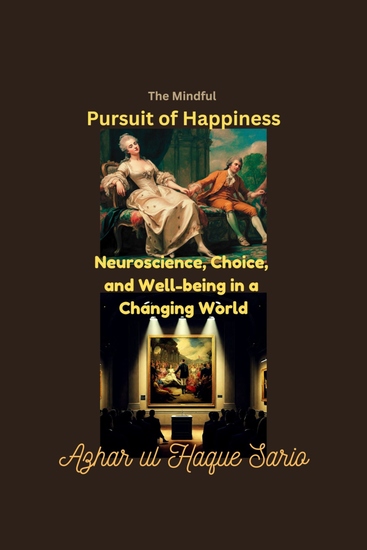
The Mindful Pursuit of Happiness - Neuroscience Choice and Well-being in a Changing World - cover

The Mindful Pursuit of Happiness - Neuroscience Choice and Well-being in a Changing World

Azhar ul Haque Sario

Publisher: Royal Co.

  • 0
  • 0
  • 0

Summary

Ever feel like happiness is just out of reach?  Like you're chasing something that keeps moving further away? This book is your guide to finally catching it. We'll dive deep into the science of happiness, exploring how your brain, your choices, and even the world around you impact your well-being.  It's a journey through neuroscience, psychology, and philosophy, with practical tips you can use every day. We'll uncover the secrets of gratitude, the power of connection, and the importance of mindful living.  Plus, we'll tackle the big stuff: navigating technology, finding purpose in a changing world, and building resilience in the face of challenges.


This isn't just another self-help book.  It's a deep dive into the factors that truly matter for happiness, backed by the latest research.  We go beyond fleeting feel-good advice and give you a real framework for lasting well-being. You'll learn how to break free from the "hedonic treadmill" of chasing fleeting pleasures.  We'll explore how to make choices that truly align with your values. And we'll show you how to cultivate a mindful approach to life that unlocks greater happiness and fulfillment.
Available since: 12/26/2024.
Print length: 236 pages.
Other books that might interest you

  • Land With No Sun - A Year in Vietnam with the 173rd Airborne - cover

    Land With No Sun - A Year in...

    Ted G Arthurs

    • 0
    • 0
    • 0
    A first-person history of the action seen by the United States airborne infantry brigade in Vietnam, from a Silver Star awarded Command Sergeant Major. A no-holds-barred, straight-in-your-face account of combat in Vietnam. You know it's going to be hot when your brigade is referred to as a Fireball unit. From May 1967 through May 1968, Ted Arthurs was in the thick of it, humping an eighty-pound rucksack through triple canopy jungle, chasing down the Viet Cong and North Vietnamese in the Central Highlands of South Vietnam. As sergeant major for a battalion of eight-hundred men, it was his job to see them through this jungle hell and get them back home again.
    Show book
  • Breaking Point - cover

    Breaking Point

    Ph.D. Dorris S. Woods

    • 0
    • 0
    • 0
    Breaking Point captures the essence of teenage suicide and the “trigger” factors that cause it. Compelling new information with vignettes that remind us of each tragic loss.
    Show book
  • Escaping Slavery in America: The History of Slave Uprisings and Escape Routes Before the Civil War - cover

    Escaping Slavery in America: The...

    Charles River Editors

    • 0
    • 0
    • 0
    The Underground Railroad is one of the most taught topics to young schoolchildren, and every American is familiar with the idea of fugitive slaves escaping to Canada and the North with the help of determined abolitionists and even former escaped slaves like Harriet Tubman. The secrecy involved in the Underground Railroad made it one of the most mysterious aspects of the mid-19th century in America, to the extent that claims spread that 100,000 slaves had escaped via the Underground Railroad. Of course, from a practical standpoint, the Underground Railroad had to remain covert not only for the sake of thousands of slaves, but for a small army of men and women of every race, religion and economic class who put themselves in peril on an ongoing basis throughout the first half of the 19th century, and in the years leading up to the war.  
    	Over 150 years later, that same secrecy has helped the Underground Railroad become so romanticized and mythologized that people often visualize it in ways that were far different from reality. Before the American Civil War eliminated slavery, it was a fixture in North America for over 200 years, and by 1850 a trained slave was worth approximately $2,500, around 10 times the sum of a typical annual salary in that day. As a result, the economic dependence on slavery in the South was an extreme one, and in the wake of the Fugitive Slave Act, black people in the North were under constant pressure to defend their “credentials” to bounty hunters and owners. Between the value of slaves in America, rising abolitionist sentiment at home and overseas, and political debates promoting or hindering the movement toward equality, the era in which the Underground Railroad operated cannot be easily fit into a concise body of principles, actions or geography. 
    Show book
  • Phenomenology of Productive Imagination: Embodiment Language Subjectivity - cover

    Phenomenology of Productive...

    Saulius Geniusas

    • 0
    • 0
    • 0
    Although productive imagination has played a highly significant role in (post-) Kantian philosophy, there have been very few book-length studies explicitly dedicated to its analysis. 
    
    In his new book, Saulius Geniusas develops a phenomenology of productive imagination while relying on those resources that we come across in Edmund Husserl’s, Max Scheler’s, Martin Heidegger’s, Ernst Cassirer’s, Miki Kiyoshi’s, Jean-Paul Sartre’s, Maurice Merleau-Ponty’s, and Paul Ricoeur’s writings, while also engaging in present-day philosophical discussions of the imagination. Investigating the relation between imagination and embodiment, affectivity, perception, language, selfhood, and intersubjectivity, the book provides a phenomenological conception of productive imagination, which is committed to basic phenomenological principles and which is sensitive to how productive imagination has been conceptualized in the history of phenomenology. 
    
    Against such a background, Geniusas develops a new conception of productive imagination: It is a basic modality of intentionality that indirectly shapes the human experience of the world by forming the contours of action, intuition, knowledge, and understanding. It is not so much a blind and indispensable function of the soul, but an art concealed in the body, for it springs out of instincts, drives, desires, and needs. 
    
    The author demonstrates unexpected ways in which phenomenology of productive imagination enriches our understanding of embodied subjectivity.
    Show book
  • The Crisis of Psychoanalysis - Essays on Freud Marx and Social Psychology - cover

    The Crisis of Psychoanalysis -...

    Erich Fromm

    • 0
    • 0
    • 0
    "This book is must [listening] . . . although it will at times shock and perhaps even offend the sensibilities of traditional therapists." —American Journal of Psychiatry 


    This book brings together Erich Fromm's basic statements on the application of psychoanalytic theory to social dynamics. At the same time, it offers an image of man consonant with the hopes of radical humanism. 


    The Crisis of Psychoanalysis is a collection of nine brilliant essays. Although his work is deeply rooted in Freudian theory, Fromm further develops Freud's doctrines by including both social and ethical dimensions, and applies his discoveries and insights to address the problems we face in society at large.
    Show book
  • Carthagian Empire - Hannibal Elephants and Rome's Fiercest Rival - cover

    Carthagian Empire - Hannibal...

    Rolf Hedger

    • 0
    • 0
    • 0
    Carthage emerged as one of the most powerful cities of the ancient world, a beacon of wealth, trade, and military strength. Located on the coast of modern-day Tunisia, it was founded by Phoenician settlers from the city of Tyre around the ninth century BCE. These settlers, skilled in navigation and commerce, established Carthage as a strategic hub that would eventually dominate Mediterranean trade. 
    From its earliest days, Carthage thrived on its ability to control maritime routes and forge strong economic connections across North Africa, Iberia, and the islands of the western Mediterranean. Unlike many other ancient powers that relied on agriculture and territorial conquest, Carthage built its strength through commerce. It became the heart of a vast trade network that stretched from the shores of the Middle East to the Atlantic coast of Africa, exchanging goods such as silver, tin, spices, and textiles. 
    The city itself reflected its growing influence. Carthaginian engineers designed an impressive harbor that could shelter hundreds of ships, a crucial asset for a state whose power depended on naval supremacy. This naval dominance allowed Carthage to project its influence far beyond its immediate borders, securing colonies and trading posts in places such as Sicily.
    Show book