Join us on a literary world trip!
Add this book to bookshelf
Grey
Write a new comment Default profile 50px
Grey
Subscribe to read the full book or read the first pages for free!
All characters reduced
Jungle Cities - Animal Societies - cover

We are sorry! The publisher (or author) gave us the instruction to take down this book from our catalog. But please don't worry, you still have more than 500,000 other books you can enjoy!

Jungle Cities - Animal Societies

Azhar ul Haque Sario

Publisher: tredition

  • 0
  • 0
  • 0

Summary

Ever wondered what it's like to live in a bustling jungle city? This book takes you on an exciting journey into the heart of animal societies. We'll explore amazing insect megacities, where ants and termites build incredible nests and work together like a well-oiled machine. It's like a miniature human city, but with way more legs!  We'll also meet chimpanzees, gorillas, and baboons. These primates have families, friends, and even political drama!  Ever seen a herd of zebras or elephants? They stick together for safety and have cool ways of making decisions as a group. But some animals, like leopards, prefer to go solo. We'll learn why animals live in different ways.

This book is special because it connects animal societies to our own. It helps you understand how humans and animals are similar and different when it comes to living together. You'll discover how scientists study these fascinating creatures and learn amazing facts about their behavior. Get ready to see the jungle in a whole new way!
Available since: 12/26/2024.
Print length: 241 pages.
Other books that might interest you

  • The Essential Book of Time - Master the Mysteries of Time in 12 Short Chapters - cover

    The Essential Book of Time -...

    Sten Odenwald

    • 0
    • 0
    • 0
    Time is one of the great mysteries of the universe. In this fascinating volume, NASA astronomer and educator Sten Odenwald brings to life the philosophical and scientific conundrums about time in simple and accessible language. 
     
    Covering subjects such as relativity, the arrow of time, entropy, Einstein's idea of the block universe, and the A and B theories of time, The Essential Book of Time provides the perfect starting point for anyone interested in the subject. 
     
    ABOUT THE SERIES: Arcturus Concepts is a series of titles diving into some of the most compelling subjects in modern science. Written by a variety of experts, these editions provide a perfect starting point to a range of fascinating topics.
    Show book
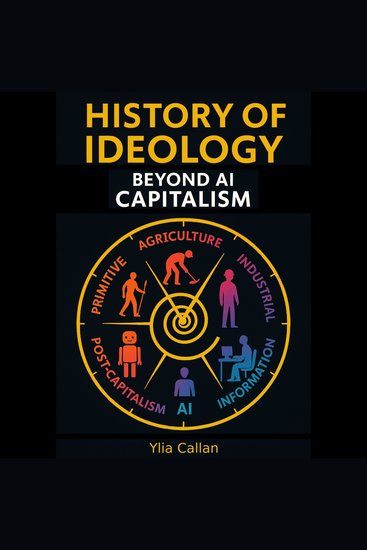
  • History of Ideology - Beyond AI Capitalism - cover

    History of Ideology - Beyond AI...

    Ylia Callan

    • 0
    • 0
    • 0
    This audiobook is narrated by an AI Voice.   
    The History of Ideology: Beyond AI Capitalism, takes listeners on a sweeping journey through humanity’s economic evolution - from primitive tribes and feudal empires to industrial capitalism and the rise of global markets. As AI and automation erase millions of jobs, the foundations of our economic system begin to crumble. 
    But this is not a story of collapse - it is a story of possibility. We explore universal basic income, platform cooperatives, data trusts and regenerative economies as the pillars of a new system designed for human flourishing and planetary health. 
    This audiobook is part history, part manifesto and part roadmap for the future. It will challenge your assumptions, inspire your imagination and help you see why the end of capitalism can be the beginning of something better.
    Show book
  • Peptide Protocols - Volume One - cover

    Peptide Protocols - Volume One

    William A Seeds MD

    • 0
    • 0
    • 0
    This first in a series handbook introduces the cellular biology behind peptides, including how peptides can delay cellular senescence, reduce inflammation throughout the body and the brain, and ultimately prevent disease and the effects of aging. Written by William A. Seeds, MD, the foremost authority on peptides.  
    Show book
  • Luck - cover

    Luck

    David Flusfeder

    • 0
    • 0
    • 0
    ‘A joy’ Philippe Sands‘Glorious’ David Spiegelhalter 
    A fascinating, enchanting and personal look at the meaning of luck, and the way in which it has shaped our shared history and continues to inflect our day to day lives. 
    What does it mean to be lucky? How might we mitigate the effects of bad luck and maximise those of good? Is there actually such a thing as ‘luck’—some force that intervenes between desire and its consummation, that impedes or hastens it? 
    To answer these questions, David Flusfeder sets out on a search for the definition of luck. This quest will take him to Siberia, Versailles, the Old Testament desert; play roulette in Baden-Baden with Dostoevsky; visit a Cambridge fairground with Wittgenstein; meet the sixteenth-century poet Thomas Bastard, who challenged Fortune, and lost; find Nietzsche on the slopes of Vesuvius; learn about the pioneers of probability; the twentieth-century art investigators of chance and possibility; and the intensely personal story of his father’s good fortune in escaping war-time Poland. Starting at the British Library in London, and following the dictates of an online randomiser that decided the chapter order, Flusfeder follows in the footsteps of some victors of luck and those who were defeated by it, from ancient times to the modern day. 
    Luck asks fundamental questions about the world, ourselves, our place in it. In these questions, about our relationships to fortune, to risk, to opportunity, to chance, destiny and fate, we find ourselves deciding who we are and how we might choose to live. 
    ‘Thrilling, intelligent and wilfully unique … I loved it’ James Runcie, author of The Great Passion 
    ‘Ruminative … page-turning’ TLS 
    ‘Fascinating … An eminently enjoyable and engrossing page-turner’ The Jewish Chronicle 
    In LUCK, David Flusfeder delves into the psychology of fortune, intertwining it with elements of mathematics and theory. The book is a top pick for those interested in the social aspects of games, particularly poker, and the communication skills required to navigate them. 
    For fans of Brian Klaas (Fluke), Morgan Housel (Same as Ever), Annie Jacobsen (Surprise, Kill, Vanish), Bill Perkins (Die With Zero), and Cal Newport (Slow Productivity). 
    HarperCollins 2022
    Show book
  • The History of Computing - From the Abacus to Artificial Intelligence - cover

    The History of Computing - From...

    Craig Dames

    • 0
    • 0
    • 0
    The story of computing begins not with electricity or screens, but with simple tools and the human need to solve problems. Long before the modern computer, ancient civilizations were already creating devices to aid in counting, measuring, and performing basic arithmetic. These early innovations laid the groundwork for centuries of progress in computing. 
    One of the most enduring tools from this era is the abacus. Believed to have originated in Mesopotamia over 4,000 years ago, the abacus evolved in various cultures, including Chinese, Roman, and Japanese societies. It was a portable, efficient device that allowed users to perform addition, subtraction, multiplication, and division by sliding beads along rods or grooves. Although simple in design, the abacus was powerful for its time and is still used in some regions for teaching arithmetic and mental calculation skills. 
    In addition to the abacus, ancient number systems were critical to the development of computation. The Babylonians used a base-60 numeral system, which influenced the way we measure time and angles today. The Egyptians employed a system based on units of ten, using hieroglyphs to represent values. Meanwhile, the Romans had a cumbersome numeral system that made complex calculations challenging. It wasn't until the adoption of the Hindu-Arabic numeral system, with its concept of zero and place value, that true advances in mathematical computation became possible.
    Show book
  • The Olive Route - A Personal Journey to the Heart of the Mediterranean - cover

    The Olive Route - A Personal...

    Carol Drinkwater

    • 0
    • 1
    • 0
    The author of acclaimed memoirs about life on a French olive farm explores the larger history and culture of the Mediterranean delicacy. Carol Drinkwater has a passion for olive trees and the fruit they bear—“bitter berries” that are transformed into savory delights and pressed into precious oil. Already intimately familiar with the fruit thanks to her olive farm in the South of France, she decided to travel throughout the Mediterranean basin—from Marseille to Malta, Israel to Tunisia—in a quest to learn about their ancient history, their spread throughout the world, and the tastes and traditions they represent. A culinary travelogue and a celebration of a humble, healthful food that inspires devotion among so many, The Olive Route is filled with unusual characters and fascinating anecdotes from “a storyteller of great economy and deftness” (The Telegraph). “Drinkwater has a sharp eye for character, and the people who populate The Olive Route will not disappoint her fans.” —The Independent
    Show book