Join us on a literary world trip!
Add this book to bookshelf
Grey
Write a new comment Default profile 50px
Grey
Subscribe to read the full book or read the first pages for free!
All characters reduced
Mastering OpenCV with Python - Use NumPy Scikit TensorFlow and Matplotlib to learn Advanced algorithms for Machine Learning through a set of Practical Projects - cover

Mastering OpenCV with Python - Use NumPy Scikit TensorFlow and Matplotlib to learn Advanced algorithms for Machine Learning through a set of Practical Projects

Ayush Vaishya

Publisher: Orange Education Pvt Ltd

  • 0
  • 0
  • 0

Summary

Unlocking Visual Insights: OpenCV Made Simple and Powerful.Book Description"Mastering OpenCV with Python" immerses you in the captivating realm of computer vision, with a structured approach that equips you with the knowledge and skills essential for success in this rapidly evolving field.From grasping the fundamental concepts of image processing and OpenCV to mastering advanced techniques such as neural networks and object detection, you will gain a comprehensive understanding. Each chapter is enriched with hands-on exercises and real-world projects, ensuring the acquisition of practical skills that can be immediately applied in your professional journey.This book not only elevates your technical proficiency but also prepares you for a rewarding career. The technological job landscape is constantly evolving, and professionals who can harness the potential of computer vision are in high demand.By mastering the skills and insights contained within these pages, you will be well-prepared to explore exciting career opportunities, ranging from machine learning engineering to computer vision research. This book is your ticket to a future filled with innovation and professional advancement within the dynamic world of computer vision.Table of Contents1. Introduction to Computer Vision2. Getting Started with Images3. Image Processing Fundamentals4. Image Operations5. Image Histograms6. Image Segmentation7. Edges and Contours8. Machine Learning with Images9. Advanced Computer Vision Algorithms10. Neural Networks11. Object Detection Using OpenCV12. Projects Using OpenCV      Index
Available since: 11/18/2023.
Print length: 424 pages.

Other books that might interest you

  • Cosmos Issue 96 - New Ways of Seeing – Can AI Make Art? - cover

    Cosmos Issue 96 - New Ways of...

    The Royal Institution of Australia

    • 0
    • 0
    • 0
    This is Issue 96 of Cosmos, a quarterly science magazine. Produced by The Royal Institution of Australia, Cosmos aims to inspire curiosity in 'The Science of Everything' and make the world of science accessible to everyone.
    Show book
  • Soft Nomological Physical Science - A Revolution Already Started - cover

    Soft Nomological Physical...

    Philippos Afxentiou

    • 0
    • 0
    • 0
    This book mounts a decisive assault on a "holy element" of physical science: the construct of laws. Yet this is not a purely negative critique; it is driven by a constructive purpose, or telos. The investigation reveals a surprising result: evidence from the last few decades of scientific development shows that "soft-law" science has gained significant ground. This trend validates the author's central hypothesis—that traditional law-based science has inherent limits.
    
    The author begins by outlining a relevant history of physical science before exposing previously untold "dark points" within nomological, or law-based, science. These critiques reveal new openings for discovery.
    
    Finally, the principles of soft-law science are established. The book then explores creative ways to exploit these principles, reinventing known theories of physics within this revitalised paradigm—and does so to a profoundly fruitful extent.
    Show book
  • Multi-Billion-Dollar Pet Food Fraud - cover

    Multi-Billion-Dollar Pet Food Fraud

    Dr. Tom Lonsdale

    • 0
    • 0
    • 0
    Based on keen observation over a lifetime of veterinary practice, Dr Tom Lonsdale gives us the tools to keep our pets healthy. The early chapters reveal essential dietary information—the foundation of good health for all species.Recounting testimonials from grateful pet owners, Tom describes the failings of modern veterinary practice. We learn how veterinary schools brainwash young vets. He helps us identify how most vets selectively disregard scientific facts as they push pet food industry propaganda costing our pets their lives and costing us $billions. Tom’s writings inspire confidence. We learn simple ways to care for our pets leading to huge savings on vet bills.Relying on rock-solid evidence, Tom presents a withering critique of the junk pet food/veterinary alliance. He helps us see through the smokescreens of misinformation and the false and misleading pet food ads. He shows how the media, government regulators and people in high places share responsibility for the multi-billion-dollar pet food fraud.
    Show book
  • Human Genetics - Human Genetics in practice - cover

    Human Genetics - Human Genetics...

    Cybellium

    • 0
    • 0
    • 0
    Understand how biological information is inherited and used
    Human Genetics: Human Genetics in practice brings your study of genetics into focus. This Cybellium study guide connects genes and inheritance, variation and gene expression, helping you see how the ideas fit together.
    Develop a more connected understanding of the subject and the questions it raises. Use it to build a foundation, return to ideas that need another look and connect terminology with the bigger picture.
    Build your understanding
    
    - Understand the role of genes and inheritance.
    - Explore the relationships behind variation.
    - Examine the choices and questions involving gene expression.
    - Bring individual concepts together into a more coherent understanding of the subject.
    Who this guide is for
    For students, professionals and independent learners with an interest in genetics. Use the book for focused study, revision or the next stage of your professional learning, returning to the ideas most relevant to your goals.
    Your included Cybellium learning bonus
    
    - One complimentary month of Cybellium access.
    - One additional Cybellium guide download of your choice.
    - Access to the Cybellium Cybersecurity Knowledge Hub and premium learning resources during the included access period.
    Activate your unique voucher at www.cybellium.com/signup to begin your included month and select your additional guide.
    The included voucher is valid for one-time use only and cannot be combined with another offer.
    Continue your learning with Human Genetics.
    Show book
  • A Brain for Innovation - The Neuroscience of Imagination and Abstract Thinking - cover

    A Brain for Innovation - The...

    Min W. Jung

    • 0
    • 0
    • 0
    What sets humans apart from other animals? The accumulation of discoveries throughout history, big and small, has enabled us to build global civilizations and gain power to shape our environment. But what makes humans as a species so innovative? 


    Min W. Jung offers a new understanding of the neural basis of innovation in terms of humans' exceptional capacity for imagination and high-level abstraction. He provides an engaging account of recent advances in neuroscience that have shed light on the neural underpinnings of these profoundly important abilities. Jung examines key discoveries concerning the hippocampus and neural circuits that have demystified the processes underlying imagination and abstract thinking. He also considers how these capacities might have evolved as well as possible futures for intelligence. 


    Bringing together disparate findings in neuroscience, psychology, anthropology, and artificial intelligence, A Brain for Innovation develops a unified perspective on the mechanisms of imagination, abstract thought, and creativity. Presenting cutting-edge neuroscientific research in a way that is accessible to listeners without a background in the subject, this book is essential for anyone interested in the biological basis of one of the most fundamental aspects of human nature.
    Show book
  • My Life My Science: Pursuing a Cure for Huntington's Disease - cover

    My Life My Science: Pursuing a...

    Nancy Sabin Wexler

    • 0
    • 0
    • 0
    “Nancy Wexler’s story is a lesson in courage, fortitude, heroism, and above all … love. I read it in one gulp. My heart is full.” — Carol Burnett, actor and writer  
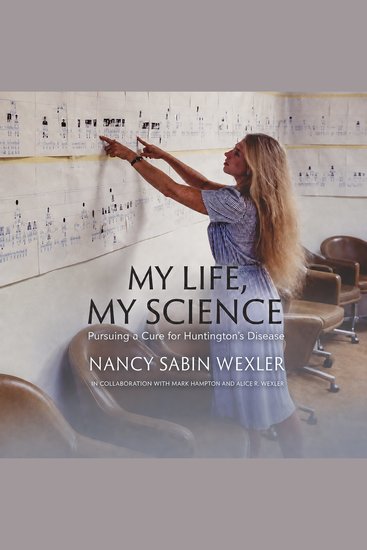
    When Nancy Wexler was 23, her father revealed that the mysterious illness inexorably diminishing her mother had a name. Huntington’s disease, a fatal, hereditary, neurodegenerative disorder. Newly aware she had a fifty-fifty chance of developing the same condition, Wexler could have retreated. Instead, she immersed herself in what has become a lifetime’s pursuit of the causes of the disease and a cure. 
    She pioneered groundbreaking fieldwork that enabled the identification of the responsible gene. She took charge of what is now the Huntington's Disease Foundation and made it a force to be reckoned with. And when the human genome became a focus of scientific study, she was an eloquent voice for patients in disease gene research and insistent advocate for ethical use of genome sequence information. 
    Now living with Huntington’s disease, Nancy Wexler has drawn on decades of letters, research notes, and vivid memories to describe her remarkable life with warmth, wit, and unsparing honesty. 
    She takes us from a privileged but shadowed California childhood to the shores of Venezuela’s Lake Maracaibo, where she and colleagues earned the community trust that enabled them to collect blood samples and construct pedigrees, to the innovative consortium of research laboratories where those samples revealed the malevolent gene, to the halls of Congress where she pressed legislators for resources, and the boardrooms where philanthropists were persuaded into action. 
    In this book, Wexler tells a unique story about the intertwining of personal stakes and professional passions, a testament to her courage, persistence, and belief that science can change destinies—one life, one family, one gene at a time.
    Show book