¡Acompáñanos a viajar por el mundo de los libros!
Añadir este libro a la estantería
Grey
Escribe un nuevo comentario Default profile 50px
Grey
Suscríbete para leer el libro completo o lee las primeras páginas gratis.
All characters reduced
Democracy Mandate Effects - cover

Democracy Mandate Effects

Axel von Neumann

Traductor A AI

Editorial: Publifye

  • 0
  • 0
  • 0

Sinopsis

Democracy Mandate Effects examines how electoral victories translate into effective governance and lasting policy changes in European nations. It highlights that a strong electoral mandate doesn't automatically guarantee effective governance. The book argues that the perception of a mandate's strength, influenced by voter turnout and the political climate, is crucial for navigating political opposition and implementing policies. This is particularly relevant given increasing political fragmentation and volatile voter behavior, which can impact a government's confidence and willingness to enact potentially unpopular policies.

 
The book explores the strength of electoral mandates, the stability of governments formed after elections, and the tangible policy outcomes achieved. Governmental stability is essential for long-term planning and consistent policy implementation, while concrete policy outcomes determine whether campaign promises translate into real-world improvements. Through historical data, government performance metrics, and policy analyses, Democracy Mandate Effects emphasizes that a simple electoral majority might not be enough.

 
The book begins by introducing theoretical frameworks surrounding electoral legitimacy then moves into comparative analyses of European nations. It concludes with a discussion of best practices for fostering effective governance, offering practical recommendations for policymakers and citizens. Ultimately, Democracy Mandate Effects offers valuable insights into strengthening democratic institutions and promoting effective governance, contributing to ongoing conversations about the future of democracy.
Disponible desde: 17/02/2025.
Longitud de impresión: 77 páginas.


Otros libros que te pueden interesar

  • Federalist Papers The (Chartwell Classics) - cover

    Federalist Papers The (Chartwell...

    Alexande Hamilton, John Jay,...

    • 0
    • 0
    • 0
    Immerse yourself in the founding vision of the United States with The Federalist Papers, brilliantly narrated by Joel Schrank. Written by Alexander Hamilton, James Madison, and John Jay to defend and explain the newly proposed Constitution, these 85 essays remain one of the most influential works of political philosophy in American history. Schrank’s clear and authoritative narration brings out the urgency, logic, and passion behind each argument—making this timeless exploration of liberty, union, and governance as engaging and relevant today as it was in the 18th century.
    Ver libro
  • Au Revoir Britannia - cover

    Au Revoir Britannia

    Sylvie Bermann

    • 0
    • 0
    • 0
    From her unique perspective as former French ambassador to the UK, Sylvie Bermann examines the mistruths told by politicians surrounding the fateful 2016 Brexit referendum. Au Revoir Britannia asks the question 'How did this happen?' and exposes what she sees as the 'unrepenting' and 'inveterate' lies of the now pm, Boris Johnson. This first English edition includes a new preface exploring the future of post-Brexit Europe and Britain, and the uncertain implications of the Russian invasion of Ukraine.
    Ver libro
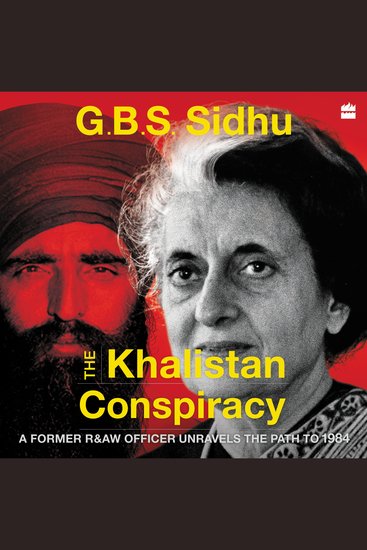
  • The Khalistan Conspiracy - A Former R&AW Officer Unravels the Path to 1984 - cover

    The Khalistan Conspiracy - A...

    G.B.S. Sidhu

    • 0
    • 0
    • 0
    The author, a former Special Secretary of India's external intelligence agency, the Research and Analysis Wing (R&AW) of the Cabinet Secretariat, examines a series of interconnected events that led to the rise of the Khalistan movement, Operation Blue Star, the assassination of Prime Minister Indira Gandhi in 1984 and the anti-Sikh violence unleashed thereafter. With a timeline that moves from seven years before to a decade after 1984, the book strives to answer critical questions that continue to linger till today. 
    The narrative moves from Punjab to Canada, the US, Europe and Delhi, looking to sift the truth from political obfuscation and opportunism, examining the role that the ruling party allegedly played, and the heart-rending violence that devoured thousands of innocent lives in its aftermath.
    Ver libro
  • Phocion - Good Citizen in a Divided Democracy - cover

    Phocion - Good Citizen in a...

    Thomas R. Martin

    • 0
    • 0
    • 0
    "Elegant and enlightening." —Dominic Green, Wall Street Journal 


    Phocion (402–318 BCE) won Athens's highest public office by direct democratic election an unmatched forty-five times and was officially honored as a "Useful Citizen." A student at Plato's Academy, Phocion gained influence and power during a time when Athens faced multiple crises stemming from Macedonia's emergence as an international power under Philip II and his son Alexander the Great. Following Athens's defeat by Macedonia, Phocion unsuccessfully sought mild terms of surrender. Oligarchy was imposed on democratic Athens, and more than twelve thousand "undesirable" Athenians were exiled. When the oligarchic regime was overthrown and the exiles returned, dispossessed Athenians took out their volcanic anger on Phocion, who throughout his career had often been a harsh critic of the citizens' political decisions. His inflammatory rhetoric contributed to the popular conclusion that he lacked a genuine sense of belonging to the community he wished so desperately to preserve. When he was eighty-four, the Athenians convicted him of treason and condemned him to die by hemlock. In this fresh biography, Thomas R. Martin explores how and why Phocion ultimately failed as a citizen and as a leader. His story offers unsettling lessons for citizens in democracies today.
    Ver libro
  • The Great Retreat - How Political Parties Should Behave and Why They Don't - cover

    The Great Retreat - How...

    Didi Kuo

    • 0
    • 0
    • 0
    Once a centralizing force of the democratic process, political parties have eroded over the past fifty years. Parties now rank among the most unpopular institutions in society—less trusted than business, the police, and the media. Identification with parties has plummeted, and even those who are loyal to a party report feeling that parties care more about special interests than about regular citizens. What does a "good" political party look like? Why do we urgently need them? And how do we get them? 


    The Great Retreat explores the development of political parties as democracy expanded across the West in the nineteenth century. It focuses in particular on mass parties, and the ways they served as intermediaries that fostered ties between citizens and governments. 


    For democracy to adapt to a new era of global capitalism, Kuo makes the case that we need strong intermediaries like mass parties—socially embedded institutions with deep connections to communities and citizens. Parties are essential to long-term democratic stability and economic growth, while the breakdown of party systems, on the other hand, has historically led to democratic collapse. As trust in political parties has plummeted, The Great Retreat provides a powerful defense of political parties—for without parties, democratic representation is impossible.
    Ver libro
  • A Relational Agenda - How putting relationships first can reform European society - cover

    A Relational Agenda - How...

    Guy Brandon, Michel Schlüter,...

    • 0
    • 0
    • 0
    What framework can guide Christian engagement with major economic, social and political issues in public life in 21st century Europe?
    What other schools of thought exist apart from Catholic Social Teaching and Christian Democracy?
    
    Sallux has collaborated with the Jubilee Centre in Cambridge over several years to apply a new framework, agenda and strategy for Christian social reform, called Relational Thinking. It starts with the Christian belief that human beings are created by a relational God to form relational societies – the contemporary application of the ancient adage to 'love our neighbour as ourselves'.
    
    This book is a compilation of fi ve reports, two of which discuss the overall concept of Relational Thinking, while the others demonstrate how it can be applied to three contemporary issues: the need for monetary reform, the challenges of artifi cial intelligence and the ethics of remuneration. You can fi nd other examples of issues being analysed from a relational perspective, from business to city transformation.
    
    Deeply biblical, Relational Thinking builds bridges through the language of relationships to connect Christians with people of other faiths or none, and o er a fresh approach to Europe's greatest public policy challenges today.
    Ver libro