

Join us on a literary world trip!
Add this book to bookshelf
Grey
Write a new comment Default profile 50px
Grey
Subscribe to read the full book or read the first pages for free!
All characters reduced
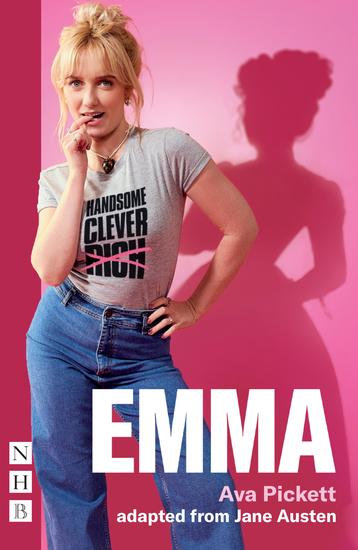
Emma - cover

Emma

Ava Pickett

Publisher: Nick Hern Books

  • 0
  • 0
  • 0

Summary

Emma Woodhouse thinks she has it all figured out. Fresh from Oxford University and back in her hometown for the summer, she's ready to do what she does best: sort out everyone else's lives, whether they like it or not.
Her closest friend Harriet is a total dating disaster, her father keeps disappearing on mysterious errands, and George Knightley refuses to stop pointing out the flaws in her flawless plans. But Emma knows best... right?
Emma is Jane Austen's timeless classic of romance, friendship, and the tricky business of figuring out what truly makes us happy. Ava Pickett's irresistible adaptation joyously pulls the story into the twenty-first century, swapping drawing-room duets for dance-floor fillers. It premiered at Rose Theatre, Kingston upon Thames, in 2025, directed by Christopher Haydon.
Available since: 09/25/2025.
Print length: 128 pages.

Other books that might interest you

  • Memorandum - cover

    Memorandum

    Quah Sy Ren, Hee Wai Siam

    • 0
    • 0
    • 0
    Featuring new translations of previously untranslated Chinese short stories, Memorandum maps out seven decades of Sinophone Singaporean Literature. From bargirls to student activists, from trishaw men to tea merchants, this collection provides a glimpse into a world that has been previously invisible to Anglophone readers. Paired with critical essays, these stories showcase the richness and diversity of Singapore’s Chinese community, but also its inherent interconnectedness with other cultures within Singapore. 
     
    “Memorandum is a pathbreaking anthology that refracts over half a century of Singapore’s history through its lens. The translated stories do much more than simply bridge Sinophone and Anglophone worlds: they actively cross geographical, cultural, linguistic and class boundaries, causing us to think more deeply about the nature of social power, and the transformative interventions literary texts can make.” 
    -Philip Holden, scholar of Singapore &Southeast Asian literatures
    Show book
  • Rhyme A Dozen A - 12 Poets 12 Poems 1 Topic ― Hair - 12 Poets 12 Poems 1 Topic - cover

    Rhyme A Dozen A - 12 Poets 12...

    Katherine Chapman Tillman, Akiko...

    • 0
    • 0
    • 0
    ‘A dime a dozen’ as known in America, is perhaps equal to the English ‘cheap as chips’ but whatever the lingua franca of your choice in this series we hereby submit ‘A Rhyme a Dozen’ as 12 poems on many given subjects that are a well-rounded gathering, maybe even an essential guide, from the knowing pens of classic poets and their beautifully spoken verse to the comfort of your ears. 
     
    1 - A Rhyme A Dozen - 12 Poems, 12 Poets, 1 Topic - Hair - An Introduction 
    2 - When Mandy Combs Her Head by Katherine Chapman Tillman 
    3 - Black Hair by Akiko Yosano 
    4 - Grey Hairs by Marina Ivanova Tsvetaeva 
    5 - A Study In Gray by Ambrose Bierce 
    6 - Ophelia by Elinor Wylie 
    7 - Sonnet 68 - Thus is His Cheek the Map of Days Outworn by William Shakespeare 
    8 - To A Lady Who Presented to the Author....  by Lord Byron 
    9 - Your Strange Hair by Renee Vivien 
    10 - A Visit to the Asylum by Edna St Vincent Millay 
    11 - The Barber by John Gray 
    12 - The Hairy Dog by Herbert Asquith 
    13 - The Highwayman by Alfred Noyes
    Show book
  • The Hurting Kind - cover

    The Hurting Kind

    Ada Limón

    • 0
    • 0
    • 0
    An astonishing collection about interconnectedness—between the human and nonhuman, ancestors and ourselves—from National Book Critics Circle Award winner, National Book Award finalist and U.S. Poet Laureate Ada Limón.“I have always been too sensitive, a weeper / from a long line of weepers,” writes Limón. “I am the hurting kind.” What does it mean to be the hurting kind? To be sensitive not only to the world’s pain and joys, but to the meanings that bend in the scrim between the natural world and the human world? To divine the relationships between us all? To perceive ourselves in other beings—and to know that those beings are resolutely their own, that they “do not / care to be seen as symbols”?With Limón’s remarkable ability to trace thought, The Hurting Kind explores those questions—incorporating others’ stories and ways of knowing, making surprising turns, and always reaching a place of startling insight. These poems slip through the seasons, teeming with horses and kingfishers and the gleaming eyes of fish. And they honor parents, stepparents, and grandparents: the sacrifices made, the separate lives lived, the tendernesses extended to a hurting child; the abundance, in retrospect, of having two families.Along the way, we glimpse loss. There are flashes of the pandemic, ghosts whose presence manifests in unexpected memories and the mysterious behavior of pets left behind. But The Hurting Kind is filled, above all, with connection and the delight of being in the world. “Slippery and waddle thieving my tomatoes still / green in the morning’s shade,” writes Limón of a groundhog in her garden, “she is doing what she can to survive.”
    Show book
  • The Rupture Tense - Poems - cover

    The Rupture Tense - Poems

    Jenny Xie

    • 0
    • 0
    • 0
    Shaped around moments of puncture and release, The Rupture Tense registers what leaks across the breached borders between past and future, background and foreground, silence and utterance. In polyphonic and formally restless sequences, Jenny Xie cracks open reverberant, vexed experiences of diasporic homecoming, intergenerational memory  
    transfer, state-enforced amnesia, public secrecies, and the psychic fallout of the Chinese Cultural Revolution. Across these poems, memory—historical, collective, personal—stains and erodes. Xie voices what remains irreducible in our complex entanglements with familial ties, language, capitalism, and the histories in which we find ourselves lodged. 
     
    The Rupture Tense begins with poems provoked by the photography of Li Zhensheng, whose negatives, hidden under his floorboards to avoid government seizure, provide one of the few surviving visual archives of the Chinese Cultural Revolution, and concludes with an aching elegy for the poet’s grandmother, who took her own life shortly after the end  
    of the Revolution. This extraordinary collection records the aftershocks and long distances between those years and the present, echoing out toward the ongoing past and a trembling future.
    Show book
  • Poems From The Chinese - A Selection of Waley's Best Translations - cover

    Poems From The Chinese - A...

    Arthur Waley

    • 0
    • 0
    • 0
    These are called ''' Poems from the Chinese"" and we have Mr. Waley's assurance that there are in existence Oriental originals. But if it be so (and, of course it is) then we have here a literary miracle. It is a platitude that translation of poetry is either bad verse or bad translation. But Mr. Waley, translating not merely from one language into another, but almost from one planet into another, has produced a body of living poetry, in which there is every reason to believe he re-creates, without distorting, the Chinese poets. This is an unparalleled feat. But as we are, with about six exceptions in the whole of Great Britain, incapable of comparing the English and the Chinese, we must address ourselves to these poems as though they had been written by an Englishman of the twentieth century, and judge them on that basis. It is a severe test to apply to translations, but Mr. Waley emerges from it serenely victorious. Indeed, serenity is the keynote of all this work—the serenity of assured mastery in a difficult medium but still more of outlook. The beauty with which these poems are. inlaid is fundamentally a wise beauty and the wisdom is as much in the shape of Mr. Waley's mind as in that of China. There is no need to hurry here. Wisdom goes at an even pace, and has time between her penetrations of the stars to observe the smallest things of life. Her leisurely glance sweeps over them with patient gold, and they settle, almost without a sigh, into decoration and into pattern. We have lost {and the Chinese have lost) the secret of their enamels of the great periods. But Mr. Waley has private access to them, and his poems, varnished with just that cool and even certainty of paint and texture, achieve one filial translation— the translation of colour into speech. -- Humbert Wolfe.
    Show book
  • The Hindu Bard - The Poetry of Dorothy Bonarjee - cover

    The Hindu Bard - The Poetry of...

    Andrew Whitehead, Mohini Gupta

    • 0
    • 0
    • 0
    The first print collection of Dorothy Bonarjee's verse
    
    In February 1914, Dorothy 'Dorf' Bonarjee was awarded the Bardic chair at the UCW Eisteddfod for verse. She was the first woman and first non-European to win Wales' most prestigious literary prize.
    
    In their 34th Welsh Women's Classic, Honno Welsh Women's Press presents the first publication of Dorothy Bonarjee's verse alongside a vivid account of the poet's extraordinary life in India, London, Wales and France.
    
    Poet Dorothy 'Dorf' Bonarjee was born in India in 1894 into an elite Bengali family. As a child, she moved to London and in 1912 she enrolled at the University College of Wales at Aberystwyth. Two years later, she was awarded the Bardic chair at the Eisteddfod, and went on to publish poems in Welsh journals. Bonarjee later took a law degree at the University of London and eloped with a French artist. France remained her home for the rest of her life.
    Show book
