Join us on a literary world trip!
Add this book to bookshelf
Grey
Write a new comment Default profile 50px
Grey
Subscribe to read the full book or read the first pages for free!
All characters reduced
The History of Abortion Legislation in the USA - Enriched edition Judicial History and Legislative Response - cover

The History of Abortion Legislation in the USA - Enriched edition Judicial History and Legislative Response

Authors Various

Publisher: DigiCat

  • 0
  • 0
  • 0

Summary

The History of Abortion Legislation in the USA is a comprehensive exploration of the complex legal landscape surrounding abortion in the United States, charting its evolution from colonial times to the present day. This anthology assembles contributions from various scholars, employing a multidisciplinary approach that encompasses legal analysis, historical context, and sociopolitical commentary. The work is structured chronologically, highlighting pivotal cases, legislative shifts, and societal impacts such as the women's rights movement, ultimately illustrating how shifting moral values and political ideologies have influenced the ongoing debate over reproductive rights. The authors contributing to this volume are distinguished experts in law, history, and gender studies, each bringing a wealth of knowledge and a unique perspective shaped by their academic pursuits and personal commitments to social justice. Their collective experiences underscore the urgency of understanding abortion as not merely a personal issue but a critical public concern, shaped by historical context and entrenched legal precedents. This collaboration reveals the multifaceted dimensions of abortion legislation and its implications for individual rights and freedoms. For students, lawmakers, and activists alike, The History of Abortion Legislation in the USA serves as an essential resource that illuminates the intricacies of a contentious subject that remains relevant today. By providing depth and insight into the historical trajectory of abortion laws, this volume invites readers to engage with the ongoing challenges and debates surrounding reproductive rights, fostering informed discussions that are vital in navigating this critical issue.

In this enriched edition, we have carefully created added value for your reading experience:
- An Introduction draws the threads together, discussing why these diverse authors and texts belong in one collection.
- Historical Context explores the cultural and intellectual currents that shaped these works, offering insight into the shared (or contrasting) eras that influenced each writer.
- A combined Synopsis (Selection) briefly outlines the key plots or arguments of the included pieces, helping readers grasp the anthology's overall scope without giving away essential twists.
- A collective Analysis highlights common themes, stylistic variations, and significant crossovers in tone and technique, tying together writers from different backgrounds.
- Reflection questions encourage readers to compare the different voices and perspectives within the collection, fostering a richer understanding of the overarching conversation.
Available since: 11/26/2023.
Print length: 410 pages.

Other books that might interest you

  • The World War II History Journals:1945 - cover

    The World War II History...

    Liam Dale

    • 0
    • 0
    • 0
    Do you want to learn more about World War II, but don’t have time to read/listen to huge, long books? Then let The History Journals take you on an hourly history tour of each year of the war with The World War II History Journals series which includes one book per year from 1939 to 1945. 
     
    Throughout this series of journals released to acknowledge 80 years since the beginning of WW2, we will be looking at the seven years of that conflict on an annual basis. The conflict, the buildup to war, the major battles, the strategies and technological developments, the effect on civilians, and most importantly of all we’ll consider the role of the soldiers, sailors, and airmen who gave their lives fighting for the freedom of others. 
     
    Although the Allied nations faced the New Year of 1945 with a huge sense of hope, there was still a great deal of work to be done if world peace was to become a reality. Adolf Hitler and his Axis powers were finally facing defeat after seven years at war, but just like any wounded animal in the wild, they continued to pose a very real and dangerous threat. Follow us onward into the history of WW2 in 1945 – and the end of the war. 
     
    You will learn about: 
     
    A retreating Japan responds with Kamikaze pilots, Russian push to Warsaw 
    Hitler’s suicide 
    German army withdraws after Battle of the Bulge, American forces target Iwo Jima 
    The last rush for Berlin, VE Day, Truman authorizes nuclear bomb testing 
    Hiroshima, Nagasaki, America drops the atomic bomb, Japan surrenders, VJ Day 
     
    Be sure to read/listen to all the books in the series - one for each year through the end of the war in 1945!
    Show book
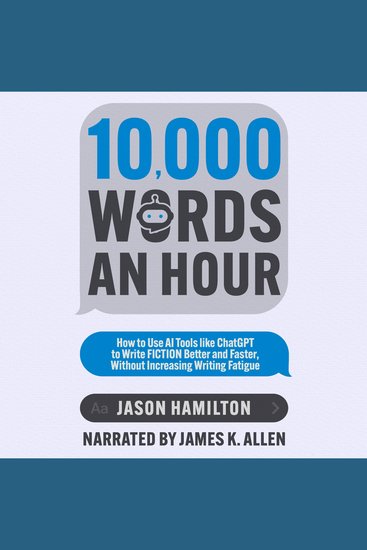
  • 10000 Words an Hour - How to Use AI Tools like ChatGPT to Write Fiction Better and Faster Without Increasing Writing Fatigue - cover

    10000 Words an Hour - How to Use...

    Jason Hamilton

    • 0
    • 0
    • 0
    The Revolutionary Guide to Supercharging Your Fiction Writing with AI (Not Just ChatGPT) 
    Unlock the secrets to writing captivating fiction at lightning speed - without burning out. 
    In this groundbreaking step-by-step guide, I'll reveal how to: 
    ✔ Craft the perfect AI prompt to unleash your creativity - in seconds. 
    ✔ Transform a tiny spark of an idea into a fully-fleshed novel using the "Fractal Technique." 
    ✔ Create deeply complex characters and immersive worlds faster than ever before. 
    ✔ Overcome writer's block and skyrocket your daily word count - while reducing mental fatigue. 
    ✔ Discover the truth about the limiting beliefs that authors have about AI 
    We're living in a new era of storytelling, where AI tools like ChatGPT are revolutionizing the writing process. Now, any writer - including YOU - can harness this technology to produce high-quality fiction without the same creative drain. Most authors haven't yet tapped into this potential - which is where you can gain a massive advantage in today's competitive market. 
    This book is packed with practical examples, prompts, and techniques you can implement immediately to transform your writing process! 
    Don't let outdated writing methods hold you back. Embrace the future of fiction writing today!
    Show book
  • BRAINSPOTTING - Adventures in Neurology - cover

    BRAINSPOTTING - Adventures in...

    A. J. Lees

    • 0
    • 0
    • 0
    As a trainee doctor, Andrew Lees was enthralled by his mentors: esteemed neurologists who combined the precision of mathematicians, the scrupulosity of entomologists and the solemnity of undertakers in their diagnoses and treatments. For them, there was no such thing as an unexplained symptom or psychosomatic problem – no difficult cases, only interesting ones – and it was only a matter of time before all disorders of the brain would be understood in terms of anatomical electrical and chemical connections.
    Today, this kind of 'holistic neurology' is on the brink of extinction as a slavish adherence to protocols and algorithms – plus a worship of machines – runs the risk of destroying the key foundational clinical skills of listening, observation and imagination that have been at the heart of the discipline for over 150 years. In this series of brilliant, insightful and autobiographical essays, Andrew Lees takes us on a kind of Sherlock Holmes tour of neurology, giving the reader insight into – and defending – the deep analytical tools that the best neurologists still rely on to diagnose patients: to heal minds and to fix brains.
    Show book
  • Don't Trust Your Gut - Using Data to Get What You Really Want in Life - cover

    Don't Trust Your Gut - Using...

    Seth Stephens-Davidowitz

    • 0
    • 0
    • 0
    Seth Stephens-Davidowitz is as good a data storyteller as I have ever met.” — Steven Levitt, co-author, Freakonomics 
    Big decisions are hard. We consult friends and family, make sense of confusing “expert” advice online, maybe we read a self-help book to guide us. In the end, we usually just do what feels right, pursuing high stakes self-improvement—such as who we marry, how to date, where to live, what makes us happy—based solely on what our gut instinct tells us. But what if our gut is wrong? Biased, unpredictable, and misinformed, our gut, it turns out, is not all that reliable. And data can prove this. 
    In Don’t Trust Your Gut, economist, former Google data scientist, and New York Times bestselling author Seth Stephens-Davidowitz reveals just how wrong we really are when it comes to improving our own lives. In the past decade, scholars have mined enormous datasets to find remarkable new approaches to life’s biggest self-help puzzles. Data from hundreds of thousands of dating profiles have revealed surprising successful strategies to get a date; data from hundreds of millions of tax records have uncovered the best places to raise children; data from millions of career trajectories have found previously unknown reasons why some rise to the top. 
    Telling fascinating, unexpected stories with these numbers and the latest big data research, Stephens-Davidowitz exposes that, while we often think we know how to better ourselves, the numbers disagree. Hard facts and figures consistently contradict our instincts and demonstrate self-help that actually works—whether it involves the best time in life to start a business or how happy it actually makes us to skip a friend’s birthday party for a night of Netflix on the couch. From the boring careers that produce the most wealth, to the old-school, data-backed relationship advice so well-worn it’s become a literal joke, he unearths the startling conclusions that the right data can teach us about who we are and what will make our lives better. 
    Lively, engrossing, and provocative, the end result opens up a new world of self-improvement made possible with massive troves of data. Packed with fresh, entertaining insights, Don’t Trust Your Gut redefines how to tackle our most consequential choices, one that hacks the market inefficiencies of life and leads us to make smarter decisions about how to improve our lives. Because in the end, the numbers don’t lie. 
    Supplemental enhancement PDF accompanies the audiobook.
    Show book
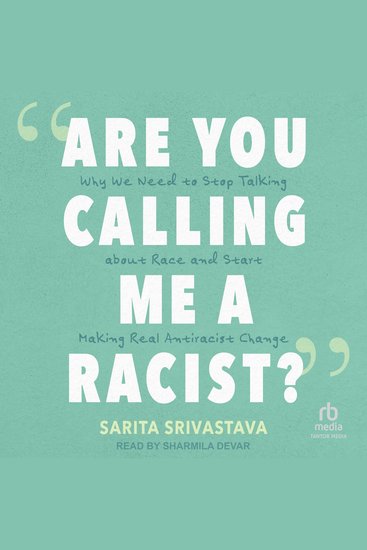
  • "Are You Calling Me a Racist?" - Why We Need to Stop Talking about Race and Start Making Real Antiracist Change - cover

    "Are You Calling Me a Racist?" -...

    Sarita Srivastava

    • 0
    • 0
    • 0
    Despite decades of anti-racism workshops and diversity policies in corporations, schools, and nonprofit organizations, racial conflict has only increased in recent years. "Are You Calling Me a Racist?" reveals why these efforts have failed to effectively challenge racism and offers a new way forward. 


    Drawing from her own experience, as well as extensive interviews and analyses of contemporary events, Sarita Srivastava shows that racial encounters among well-meaning people are ironically hindered by the emotional investment they have in being seen as good people. Diversity workshops devote energy to defending, recuperating, educating, and inwardly reflecting, with limited results, and often make things worse. These "Feel-Good politics of race," Srivastava explains, train our focus on the therapeutic and educational, rather than on concrete practices that could move us towards true racial equity. In this type of approach to diversity training, people are more concerned about being called a racist than they are about changing racist behavior. 


    "Are You Calling Me a Racist?" is a much-needed challenge to the status quo of diversity training, and will serve as a valuable resource for anyone dedicated to dismantling racism in their communities, educational institutions, public or private organizations, and social movements.
    Show book
  • Unjust Debts - How Our Bankruptcy System Makes America More Unequal - cover

    Unjust Debts - How Our...

    Melissa B. Jacoby

    • 0
    • 0
    • 0
    Named one of the Best Summer Books in Economics by the Financial Times 


    A groundbreaking look at the hidden role of bankruptcy in perpetuating inequality in America 


    Bankruptcy is the busiest federal court in America. In theory, bankruptcy in America exists to cancel or restructure debts for people and companies that have way too many—a safety valve designed to provide a mechanism for restarting lives and businesses when things go wrong financially. 


    Legal scholar Melissa B. Jacoby shows how bankruptcy has also become an escape hatch for powerful individuals, corporations, and governments, contributing in unseen and poorly understood ways to race, gender, and class inequality in America. When cities go bankrupt, police unions enjoy added leverage while police brutality victims are denied a seat at the negotiating table; the system is more forgiving of civil rights abuses than of the parking tickets disproportionately distributed in African American neighborhoods. Unjust Debts reveals the hidden mechanisms by which bankruptcy impacts everything from sexual harassment to health care, police violence to employment discrimination, and the opioid crisis to gun violence.
    Show book